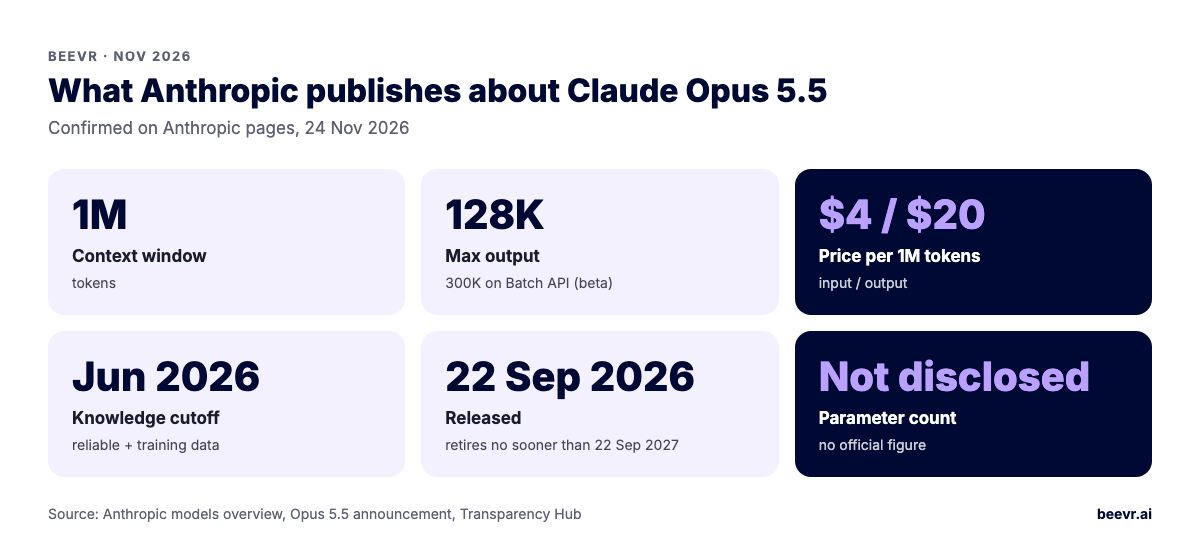
Anthropic has not published a parameter count for Claude Opus 5.5, and neither its model page, system card nor Transparency Hub entry gives one. What is published: a 1M-token context window, 128K max output, $4/$20 per million tokens and a June 2026 knowledge cutoff. Any exact number you see online is a guess. Choose by evals, not size.
Updated 24 November 2026. "How many parameters is Opus 5.5?" is one of the most common questions about Anthropic's flagship model since it launched on 22 September 2026. The short answer is that nobody outside Anthropic knows. The longer answer is more useful: parameter counts stopped predicting quality a while ago, and the numbers that do matter for your product are public. This guide lists what Anthropic has disclosed, explains why size no longer tells you much, shows the counts that open-weight labs do publish, and gives a practical way to pick a model without knowing its size.
How many parameters does Claude Opus 5.5 have?
The number is not public. Anthropic's Opus 5.5 announcement, the models overview and the Transparency Hub (all read on 24 November 2026) describe pricing, limits, safety testing and benchmarks, but give no parameter count, layer count or architecture details.
The Transparency Hub says only that the model was pretrained on large, diverse datasets and then post-trained. It does not say whether Opus 5.5 is a dense model or a mixture-of-experts (MoE) model. That is normal for closed frontier models in 2026: OpenAI's GPT-6 Sol and Google's Gemini 4 models also ship without a published parameter count.
So when a blog post, a Reddit thread or an AI answer says "Opus 5.5 has X trillion parameters", treat it as an estimate. Some are based on inference speed, pricing or hardware maths. None are confirmed, and we do not repeat them here.
What has Anthropic actually published about Claude Opus 5.5?
Quite a lot, and almost all of it is more useful for engineering decisions than a parameter count. The table below lists every hard fact we could confirm on Anthropic's own pages.
| Spec | Claude Opus 5.5 | Source |
|---|---|---|
| API ID | claude-opus-5-5 | Models overview |
| Released | 22 September 2026 | Anthropic announcement |
| Context window | 1M tokens | Models overview |
| Max output | 128K tokens (up to 300K on the Batch API with a beta header) | Models overview |
| Price per 1M tokens | $4 input / $20 output | Models overview |
| Cache reads | $0.20 per 1M (5% of input price) | Announcement, overview |
| Batch API | 50% off | Models overview |
| Knowledge cutoff | June 2026 (reliable and training data) | Models overview |
| Thinking | Adaptive, always on; default effort medium | Models overview |
| Inputs / outputs | Text and images in, text out | Transparency Hub |
| Retirement | Not sooner than 22 September 2027 | Models overview |
| Safety level | Deployed with ASL-3 protections | Transparency Hub |
| Parameters / architecture | Not disclosed | None of the above |
Anthropic also states that Opus 5.5 costs about 40% less to run than Opus 5 on typical workloads and produces output more than 30% faster. Per-token prices are 20% lower than Opus 5 ($5/$25), and cache reads are 60% lower. One more useful number from the overview: on the current tokenizer, 1M tokens is roughly 555,000 English words.
Why don't AI labs publish parameter counts anymore?
Closed labs treat model size as a competitive secret, and the number has become a poor guide to what a model can do. Publishing it would give competitors a hint about training cost and serving hardware while telling customers very little.
There are three practical reasons the number misleads:
- Mixture-of-experts: most frontier models now route each token through a small subset of "expert" layers. Total parameters describe what you store; active parameters describe what you compute per token. The two can differ by 20x or more.
- Inference-time compute: reasoning models spend extra compute while answering. Opus 5.5 has five effort levels, and the same weights at
maxeffort behave very differently fromlow. - Training data and post-training: two models of the same size can score far apart because of data quality, reinforcement learning and tool-use training.
What is the difference between total and active parameters?
Total parameters are every weight in the model. Active parameters are the weights actually used to process one token. In an MoE model, a router picks a few experts per token, so active parameters are a small fraction of the total.
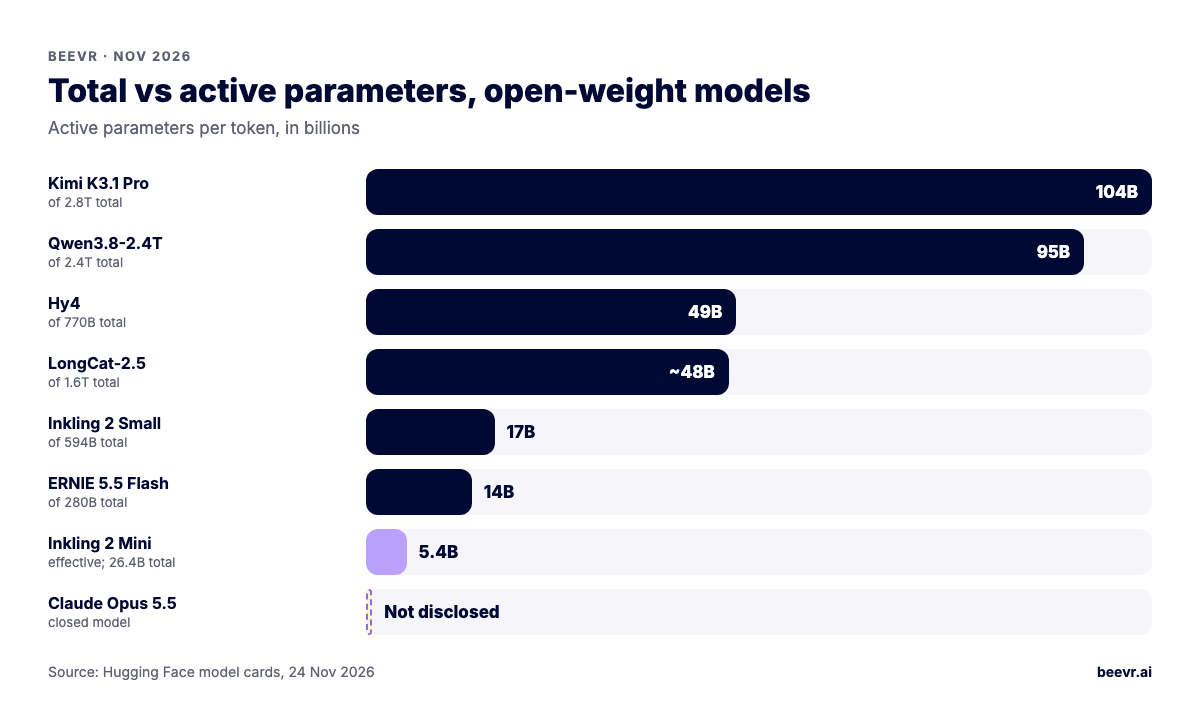
Open-weight model cards make this concrete. Moonshot's Kimi K3.1 Pro card lists 2.8T total and 104B activated parameters. Thinking Machines' Inkling 2 Small lists 594B total and 17B active, routing each token to 8 of 384 experts.
It gets stranger. Inkling 2 Mini is a "looped" transformer: 26.4B parameters, 3.4B active, but its middle layers run three times per token, giving about 5.4B effective active parameters. The card itself warns that compute per token is higher than the active-parameter count suggests. A single number cannot describe that design.
What this means for cost and hardware
Total parameters drive memory: you must hold all the weights in GPU memory to serve the model. Active parameters drive compute per token, and so speed and cost. For a closed API model like Opus 5.5, neither matters to you directly. You pay per token, and Anthropic handles the hardware.
Do more parameters mean a better model?
No, not reliably. Inside one model family trained the same way, bigger usually helps. Across labs and architectures, the correlation is weak, and benchmark tables from the labs themselves show it.
Moonshot's own Kimi K3.1 Pro card compares five models on DeepSWE v1.1, a software engineering benchmark. DeepSeek-V4.1-Flash-1017, a model with about 8B to 16B active parameters, scores 77.0. Kimi K3.1 Pro, with 104B active and 2.8T total, scores 75.5. Claude Opus 5.5, size undisclosed, scores 74.2. On Terminal-Bench 4.0 in the same table, the order flips: Opus 5.5 scores 66.4, Kimi K3.1 Pro 65.7 and DeepSeek 42.3.
The lesson: the "small" model wins one coding benchmark and loses another by 24 points. Size did not predict either result. Your own task is a third data point that no public table covers.
Which frontier AI models do publish their parameter counts?
Open-weight labs do, because you need the size to plan hardware. The table lists disclosed counts from official Hugging Face model cards, read on 24 November 2026. Several of these models were released this month; see our November 2026 open-source model roundup for licenses and links.
| Model (lab) | Total params | Active per token | Context | License |
|---|---|---|---|---|
| Kimi K3.1 Pro (Moonshot) | 2.8T | 104B | 1,048,576 | Custom (extra terms above $20M MaaS revenue) |
| Qwen3.8-2.4T-A95B (Alibaba) | 2.4T | 95B | 262K, extendable to ~1M | Qwen3.8-Max License |
| LongCat-2.5 (Meituan) | 1.6T | ~48B | Not stated on card | MIT |
| Hy4 (Tencent) | 770B | 49B (+1.23B vision) | 1,048,576 | Tencent Hy License |
| Inkling 2 Small (Thinking Machines) | 594B | 17B | 1M | Apache 2.0 |
| ERNIE 5.5 Flash Preview (Baidu) | 280B | 14B | 1,048,576 | Apache 2.0 |
| Inkling 2 Mini (Thinking Machines) | 26.4B | 3.4B (5.4B effective) | 1M | Apache 2.0 |
| Claude Opus 5.5 (Anthropic) | Not disclosed | Not disclosed | 1M | Closed, API only |
Sources: each lab's Hugging Face model card (Qwen3.8, LongCat-2.5, Hy4, ERNIE 5.5 Flash Preview), read 24 November 2026. For how these models do on coding work, see our open-weight coding models comparison.
Can you estimate Opus 5.5's size from its price or speed?
You can try, but the error bars are too wide to be useful. Price reflects Anthropic's margins, hardware, batching and caching strategy as much as model size. Opus 5.5 is 20% cheaper per token than Opus 5 and over 30% faster, which could come from a smaller model, better serving or a different architecture. The public data cannot separate those causes.
Speed has the same problem. Output speed depends on effort level, server load, speculative decoding and region. Anthropic sells a fast mode for Opus 5.5 at $8/$40 that is up to 2.5x faster on the same model, which shows how much speed is a serving choice rather than a size property.
How should you choose between Claude Opus 5.5 and other models without knowing their size?
Build a small eval set from your own tasks and compare cost per successful task. That single number captures quality, token usage and price, and it is the one that shows up on your invoice.
A five-step process we use
- Collect 50 to 200 real cases from your product: inputs, expected outputs and what "correct" means. Include the edge cases that cause support tickets.
- Write graders: exact-match or schema checks where you can, an LLM judge with a rubric where you cannot, and human review for a sample.
- Run each candidate at two or three effort levels. Opus 5.5 at
mediummay beat a bigger model atlow, and cost less. - Record tokens, latency and pass rate per case, then compute cost per passed task.
- Re-run on every model release. In 2026 the frontier moves every few weeks.
Anthropic's own model selection guide recommends the same approach: start with Opus 5.5, lower effort or move to Sonnet 5.5 or Haiku 5.5 where evals allow, and move up to Fable 5.2 only when Opus 5.5 at high effort still falls short. Our guide to testing LLMs and AI agents covers graders and regression suites in more depth.
Is Claude Opus 5.5 the biggest Claude model?
We do not know its size relative to other Claude models, because Anthropic discloses none of them. By price and positioning, Claude Fable 5.2 ($8/$40) sits above Opus 5.5 as the model for "demanding reasoning and long-horizon agentic work". Anthropic does not say whether that comes from a larger model, more compute per answer, or both.
What Anthropic does publish is a benchmark gap. On FrontierSWE v2, Fable 5.2 scores 69.9% against 62.3% for Opus 5.5. On AA-Briefcase Elo, Opus 5.5 leads, 1800 to 1785. Our Claude Fable 5.2 explainer covers when the extra cost is worth it, and our Claude model lineup guide maps all four current models.
Where can you find reliable numbers about Claude models?
Use Anthropic's own pages: the models overview for limits and IDs, the pricing page for costs, each model's announcement for benchmarks, and the system card and Transparency Hub for safety and training details. For side-by-side pricing across vendors, see our LLM API pricing comparison for November 2026, and for a head-to-head with OpenAI's flagship, our Claude Opus 5.5 vs GPT-6 Sol comparison.
Be careful with AI-generated answers on this topic. Model-size questions attract confident guesses, and those guesses get repeated until they look like facts. If a source cannot point to an Anthropic page, assume the number is invented.
How BeevR builds this
We do not pick models by size. For each AI feature we build, we keep an eval set drawn from the client's real cases, run every candidate model and effort level against it, and choose on cost per passed task and latency. The model name is configuration, so when Anthropic, OpenAI or an open-weight lab ships something new, switching is a test run rather than a rewrite. Where a client needs to keep data in their own cloud, we can run open-weight models or Claude inside the client's own AWS account.
BeevR is a senior, founder-led team in Hanoi, rated 5.0 on Clutch. We work on fixed scope and fixed price, from $10K per phase, show a working demo every Friday, and the client owns the source code and IP from day one. See our AI development services.
Not sure which model your product should run on? Book a 30-minute call and we will help you set up the eval.