At least 15 notable open-weight AI models shipped on Hugging Face between 1 and 24 November 2026. The biggest LLMs are Kimi K3.1 Pro (2.8T parameters), LongCat-2.5 (1.6T, MIT) and Tencent Hy4 (770B). For a permissive license, look at Inkling 2 Small and Mini (Apache 2.0), ERNIE 5.5 Flash Preview (Apache 2.0) and Ling-3.2-air (MIT).
Updated 24 November 2026. November was busy for open models: new frontier-scale MoE models from Moonshot, Meituan and Tencent, Thinking Machines' first looped transformer, a 2.3B on-device model from Microsoft, plus new vision, video and speech releases. This roundup lists every release we could confirm on the lab's own Hugging Face model card, with parameters, context length and license. Dates are the date the model repository or weights appeared on Hugging Face, from the Hugging Face API, unless the card states a release date. We left out anything we could not confirm.
Which open-source AI models were released in November 2026?
The main open-weight releases from 1 to 24 November 2026 are listed below. Eight are general-purpose LLMs, one is an on-device small model, and six cover vision, video, image generation and speech.
| Date (2026) | Model | Lab | Type | Params (total / active) | Context | License |
|---|---|---|---|---|---|---|
| 2 Nov | Kimi K3.1 Pro | Moonshot AI | Multimodal LLM | 2.8T / 104B | 1,048,576 | Kimi K3.1 Pro License (custom) |
| 3 Nov | MiniMax-H3-Image | MiniMax | Text-to-image, editing | 33.1B DiT | n/a | MiniMax H3 Image Community License |
| 3 Nov | Depth Pro 2 | Apple | Metric depth (image, video) | Not on card | n/a | Apple AMLR |
| 4 Nov | LongCat-2.5 | Meituan | Multimodal LLM, agentic coding | 1.6T / ~48B | 524,288 (config) | MIT |
| 9 Nov | ZONOS3-Mini | Zyphra | Text-to-speech, voice cloning | 100M active | n/a | Apache 2.0 |
| 12 Nov | Inkling 2 Small | Thinking Machines | Multimodal LLM | 594B / 17B | 1M | Apache 2.0 |
| 15 Nov | Sarvam-105B-1711 | Sarvam AI | LLM, Indian languages | 105B / 10.3B | 131,072 (as evaluated) | Apache 2.0 |
| 16 Nov | FastFrames S / L | Apple | Text-to-video, 480p | 1.3B / 14B | n/a | Apple AMLR |
| 17 Nov | WeMM-Video | Tencent | Audio-visual understanding | 2B, 4B, 9B, 35B-A3B | Not on card | Apache 2.0 |
| 18 Nov | Aion 1.0 Instruct 2.3B | Microsoft | On-device small LLM | 2.29B dense | 32,768 | MIT |
| 18 Nov | AURA | Kyutai | Real-time talking-head video | 5.7B DiT | n/a | Snap Inc. non-commercial |
| 18–20 Nov | Hy4 / Hy4 base | Tencent | Multimodal LLM | 770B / 49B | 1,048,576 | Tencent Hy License |
| 20 Nov | Inkling 2 Mini | Thinking Machines | Looped multimodal LLM | 26.4B / 3.4B | 1M | Apache 2.0 |
| 23 Nov | ERNIE 5.5 Flash Preview | Baidu | LLM (intermediate checkpoint) | 280B / 14B | 1,048,576 | Apache 2.0 |
| 23 Nov | Ling-3.2-air | inclusionAI (Ant Group) | Hybrid-linear MoE LLM | 124B / 5.5B | 262,144 (recommended) | MIT |
All figures from each model's Hugging Face card or LICENSE file, read 24 November 2026. "n/a" means a context window does not apply to that model type. For older open-weight coding models such as GLM-5.3, DeepSeek V4.1 Flash and Qwen3.8, see our open-weight coding models comparison.
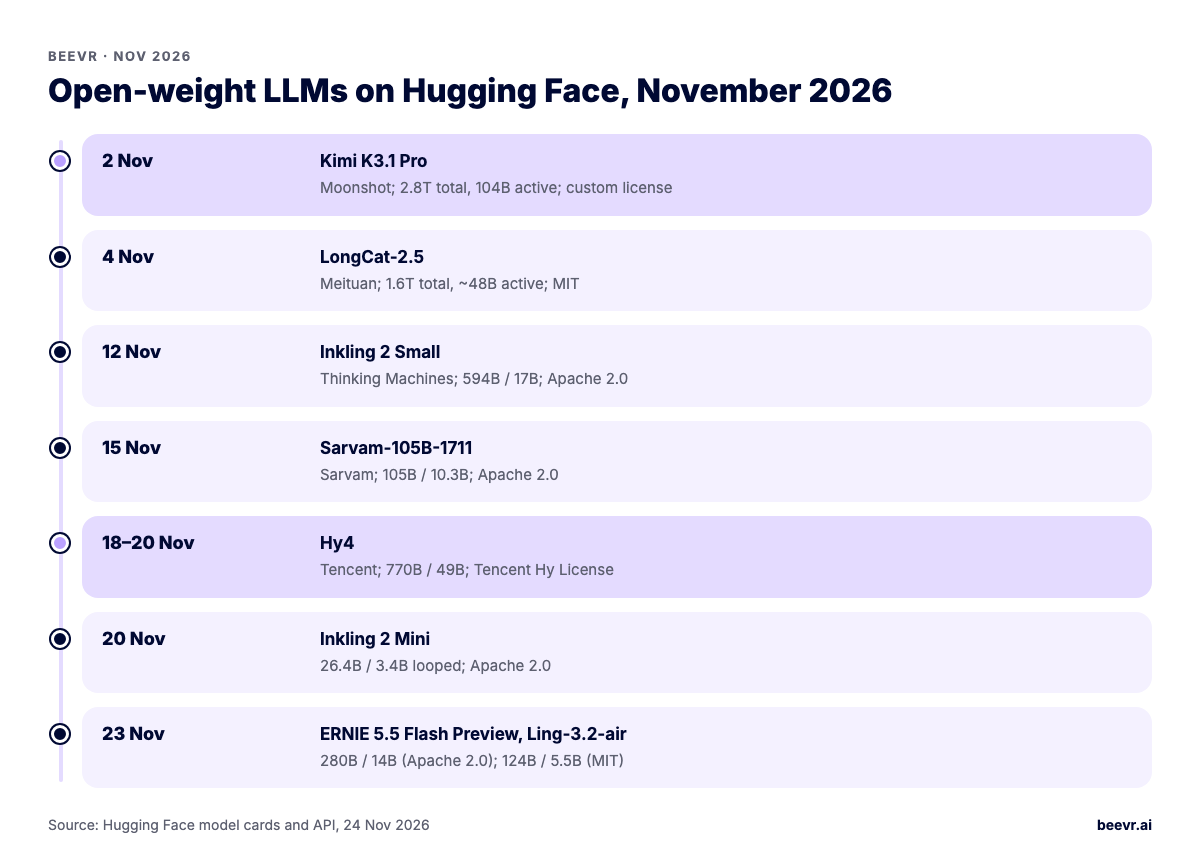
What are the biggest open-weight LLMs released this month?
Kimi K3.1 Pro is the largest at 2.8T total parameters and 104B active, followed by Meituan's LongCat-2.5 (1.6T, ~48B active) and Tencent's Hy4 (770B, 49B active). All three are multimodal MoE models aimed at long-horizon agent work.
Kimi K3.1 Pro (Moonshot AI, 2 November)
Moonshot calls it its "most capable 3T-class model to date", post-trained from Kimi K3. It takes text and images, has a 1,048,576-token context and ships with MXFP4 weights from quantisation-aware training. In Moonshot's own table it scores 65.7 on Terminal-Bench 4.0 against 66.4 for Claude Opus 5.5. The license is permissive with one big condition: a Model-as-a-Service business with over $20 million in revenue over 12 months must sign a separate agreement before commercial use.
LongCat-2.5 (Meituan, 4 November)
A native multimodal MoE model built for long-horizon agentic tasks and agentic coding, released under plain MIT. The card reports W4A4 quantisation of expert weights for native INT4 compute, with 42.77% higher decode throughput than a W8A8 baseline in Meituan's stress tests.
Hy4 (Tencent, weights posted 18 to 20 November)
Tencent open-sourced the instruct model, an FP8 version and the pre-trained base. The language backbone has 770B total and 49B active parameters, plus a 1.23B vision encoder, a 1M context and text, image and video understanding. The card is candid that "a notable gap remains" against top proprietary models. The Tencent Hy License is Apache-derived but adds terms for services above 100 million monthly active users.
Mid-size releases
Thinking Machines' Inkling 2 Small (594B, 17B active, 1M context, Apache 2.0) had its weights uploaded on 12 November. Baidu's ERNIE 5.5 Flash Preview (280B, 14B active, 1M context, Apache 2.0) is explicitly an intermediate post-training checkpoint, so expect a final version. Sarvam-105B-1711 is a post-trained update of Sarvam-105B (10.3B active) focused on Indian languages. Ling-3.2-air from inclusionAI is a 124B hybrid-linear MoE with only 5.5B active.
Which small open models can run on a laptop or phone?
Two November releases target local hardware: Thinking Machines' Inkling 2 Mini (26.4B total, 3.4B active, Apache 2.0), whose card lists Apple silicon Macs with 32GB or more memory among supported hardware, and Microsoft's Aion 1.0 Instruct (2.29B, MIT), built for on-device use in Windows.
Inkling 2 Mini is the first looped transformer Thinking Machines has released: the middle 12 of its 24 layers run three times per token, for about 5.4B effective active parameters. It supports a 1M context and image input. The card is unusually frank about limits: reasoning loops when debugging, destructive file actions without confirmation in agent mode, and weaker output outside English. Set output and turn limits if you use it in an agent.
Aion 1.0 Instruct has a 32,768-token context and covers eight languages. Microsoft says a further optimised version, paired with its content moderation model, will become the Windows OS small language model by the end of January 2027; quantised versions are to follow the unquantised release.
Which new open models handle vision, video and images?
Tencent's WeMM-Video family (Apache 2.0) understands video together with its soundtrack. Apple released Depth Pro 2 for metric depth and FastFrames for low-latency text-to-video. MiniMax released a 33.1B text-to-image and editing model. Kyutai released AURA for real-time talking-head video.
- WeMM-Video (Tencent, 17 November): Chinese-English models in 2B, 4B, 9B and 35B-A3B sizes that take text, images, audio and video, and can transcribe and reason about what is seen and heard. Pretrained on about 1.2 trillion multimodal tokens.
- Depth Pro 2 (Apple, 3 November): per-pixel metric depth from a single photo, a video or a live feed, at full input resolution. Apple's AMLR license is a research license; read it before any commercial use.
- FastFrames (Apple, 16 November): autoregressive, two-step video diffusion models, 1.3B and 14B, generating 480p video at interactive latency. The 14B model builds on Wan2.1-T2V-14B.
- MiniMax-H3-Image (MiniMax, 3 November): a 33.1B dense diffusion transformer for text-to-image and editing, with an optional prompt expander, under MiniMax's own community license.
- AURA (Kyutai, 18 November): turns a portrait and a live speech stream into talking-head video chunk by chunk. It derives from Snap's TalkVerse model, so it inherits a non-commercial license.
Were any open-source speech or voice models released in November 2026?
Yes. Zyphra released ZONOS3-Mini on 9 November, an Apache 2.0 text-to-speech model with voice cloning, about 100 million active parameters and support for 43 languages. It runs in real time on phones, laptops and in the browser.
The ZONOS3-Mini card describes cloning from an audio sample and control of emotion, pace and delivery down to single words. It can be served through an OpenAI-style /v1/audio/speech endpoint. On the speech-recognition side, Tencent's WeMM-Video models can transcribe speech inside audio and video, but we found no new dedicated open ASR model from a major lab this month. Voice cloning raises consent and fraud risks: if you ship it, record consent and watermark output.
Which November 2026 open models have a truly open license?
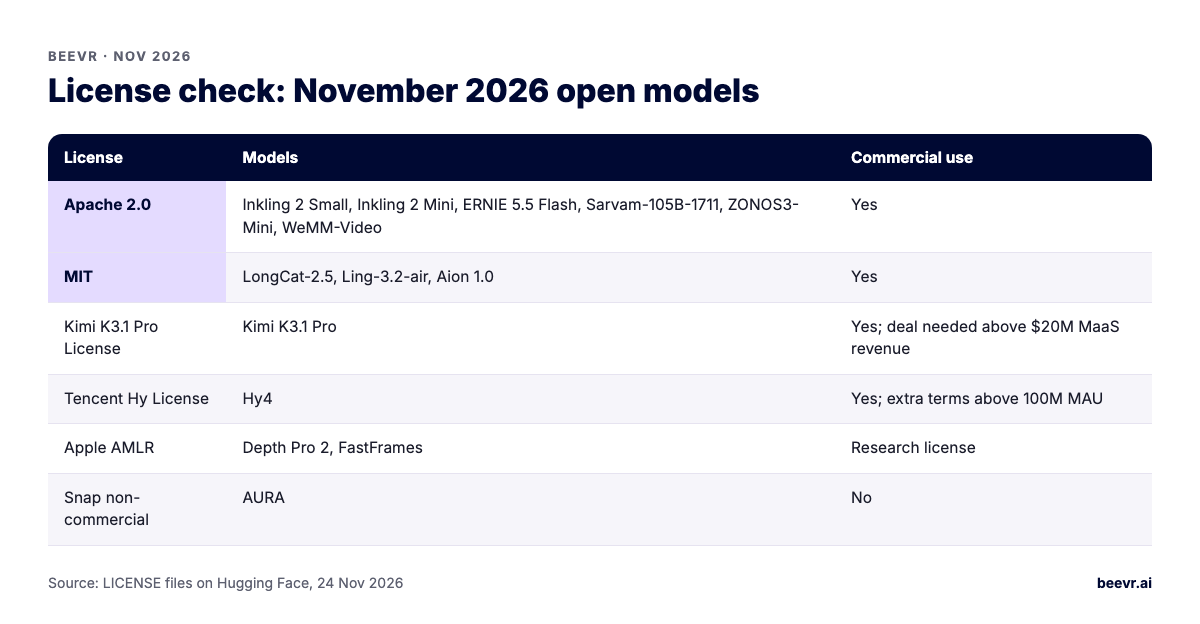
Nine of the releases use standard permissive licenses: Inkling 2 Small and Mini, ERNIE 5.5 Flash Preview, Sarvam-105B-1711, ZONOS3-Mini and WeMM-Video under Apache 2.0, and LongCat-2.5, Ling-3.2-air and Aion 1.0 under MIT. The rest use custom or non-commercial licenses.
"Open-weight" and "open-source" are not the same. A custom license can still be generous, but it adds conditions you must track:
- Kimi K3.1 Pro: separate agreement needed for Model-as-a-Service businesses above $20M revenue over 12 months.
- Tencent Hy4: Apache-derived, with extra terms for services above 100 million monthly active users.
- MiniMax-H3-Image: MiniMax's own community license.
- Apple Depth Pro 2 and FastFrames: Apple's AMLR research license.
- Kyutai AURA: Snap Inc. non-commercial license, inherited from its base model.
For a commercial product, have someone read the actual LICENSE file, not the badge on the model card. Ownership of what you build on top matters too; our article on who owns the code covers the contract side.
Is there a new open-weight coding model this month?
No dedicated coding-only model from a major lab appeared in November in our checks. The coding gains came inside general models: LongCat-2.5 and Kimi K3.1 Pro both target agentic coding and report strong results on agent benchmarks.
For self-hosted coding agents, compare these against October's releases such as GLM-5.3 and DeepSeek V4.1 Flash, which we cover in our open-weight coding models guide. If you are choosing an agent tool rather than a model, see our AI coding agents update for November 2026.
Which notable models are not on this list, and why?
We only included models whose weights appeared on Hugging Face in November 2026 and whose card we could read. Several models often mentioned as "November releases" did not pass that check.
- Mistral Medium 3.5: its Hugging Face repository dates from March 2026.
- H Company Holo4 and Xiaomi MiMo-V2.6: published in September 2026.
- GLM-5.3, DeepSeek V4.1 Flash and MiniMax-M3.1-Flash: October 2026 releases.
- Closed models released this month, such as Claude Fable 5.2 and the Gemini 4 family, are not open-weight. See our November 2026 model releases roundup and Claude Fable 5.2 explainer.
Quantised copies, GGUF conversions and community fine-tunes are also left out. One fine-tune worth a mention: Nous Research's Arete-27B (6 November, Apache 2.0) is a supervised fine-tune of Qwen3.8-27B.
How should a team pick an open-weight model from this month's releases?
Start from your constraints, not the leaderboard: license terms, the GPU memory you can afford, the context you need and the languages you serve. Then test two or three candidates on your own tasks against a closed-model baseline.
- License first. If you sell a hosted AI service, rule out licenses with revenue or user thresholds you might cross.
- Size to hardware. Total parameters set the memory you need; a 1.6T or 2.8T model means a multi-GPU, often multi-node, deployment. Active parameters set speed.
- Check the card's limitations section. Inkling 2 Mini and Hy4 both document known weaknesses; believe them.
- Compare with a closed baseline. Run the same eval on a hosted model such as Claude Opus 5.5, priced in our LLM API pricing comparison. Self-hosting pays off only at volume or when data must stay in your cloud.
Parameter counts are useful for planning hardware but poor at predicting quality; we explain why in what we know about Claude Opus 5.5's parameters.
How BeevR builds this
When a client needs data to stay inside their own cloud, we deploy open-weight models in the client's AWS account and wire them into the same eval harness we use for hosted models. We pick the model by license, hardware cost and cost per passed task on the client's real cases, and keep the model behind a configuration switch so the next release is a test run, not a rebuild. Most teams end up with a mix: a hosted frontier model for the hardest steps and a smaller open model for high-volume ones.
BeevR is a senior, founder-led team in Hanoi, rated 5.0 on Clutch. We work on fixed scope and fixed price, from $10K per phase, show a working demo every Friday, and the client owns the source code and IP from day one. See our AI development services.
Weighing an open-weight model against an API for your product? Book a 30-minute call.