Claude Fable 5.2 is Anthropic's top model for hard reasoning and long-running agent work, released 9 November 2026 at $8/$40 per million tokens, twice the price of Opus 5.5. It leads Opus 5.5 on most of Anthropic's benchmarks (FrontierSWE v2: 69.9% vs 62.3%). Use it only where your evals show Opus 5.5 at high effort falls short.
Updated 24 November 2026. Anthropic's lineup now has four general models, and Fable sits at the top. It is also the least understood: it has a twin called Claude Mythos 5.2, different safeguards, stricter data retention and a few API rules that break older code. This guide explains what Fable 5.2 is, what it costs, how it compares with Claude Opus 5.5 and when the extra spend pays off. Every fact comes from Anthropic's own pages, read on 24 November 2026.
What is Claude Fable 5.2?
Claude Fable 5.2 is the Claude model Anthropic positions "for demanding reasoning and long-horizon agentic work". It has a 1M-token context window, 128K max output, always-on adaptive thinking, and the API ID claude-fable-5-2. It replaced Fable 5.1, which cost $10/$50.
Anthropic's models overview lists four current models: Fable 5.2, Opus 5.5, Sonnet 5.5 and Haiku 5.5. The same page tells most users to start with Opus 5.5 and move to Fable 5.2 "when your evals on Claude Opus 5.5 at higher effort still fall short". In other words, Fable is the escalation tier, not the default. For where it sits among all four, see our Claude model lineup guide.
How much does Claude Fable 5.2 cost?
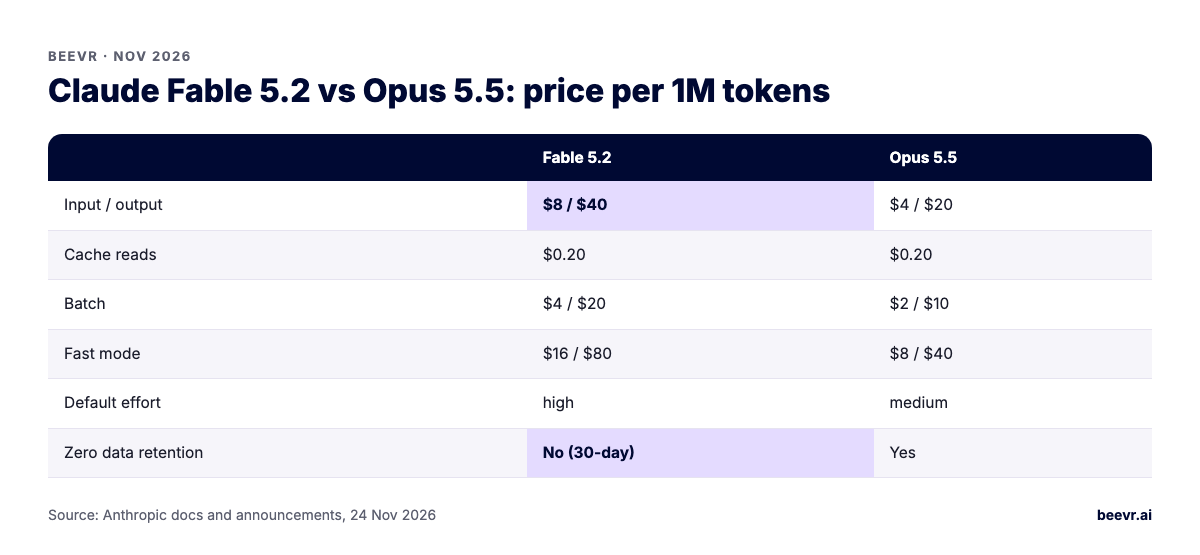
Fable 5.2 costs $8 per million input tokens and $40 per million output tokens. Cache reads are $0.20, Batch is $4/$20, and fast mode is $16/$80. That is exactly twice Opus 5.5 on input and output, and 20% cheaper than Fable 5.1.
| Per 1M tokens | Claude Fable 5.2 | Claude Opus 5.5 |
|---|---|---|
| Input / output | $8 / $40 | $4 / $20 |
| Cache reads | $0.20 (0.025x input) | $0.20 (0.05x input) |
| 5-minute cache writes | $10 | $5 |
| Batch input / output | $4 / $20 | $2 / $10 |
| Fast mode input / output | $16 / $80 | $8 / $40 |
| Default effort | high | medium |
| Zero data retention | No, 30-day retention required unless Anthropic authorises | Available |
| Context / max output | 1M / 128K | 1M / 128K |
| Released | 9 Nov 2026 | 22 Sep 2026 |
Sources: What's new in Claude Fable 5.2, Opus 5.5 announcement and models overview. Note that cache reads cost the same $0.20 on both models, so workloads dominated by cached context (long system prompts, big codebases re-read each turn) narrow the price gap. Output is where Fable costs twice as much. For cross-vendor prices, see our LLM API pricing comparison.
The default effort is a hidden cost
Fable 5.2 defaults to high effort; Opus 5.5 defaults to medium. Anthropic notes that at high and above, Fable thinks before almost every reply, and that prompt lines asking for less thinking do not stop it at medium and above. If you switch models without setting effort, you pay double the rate and likely more thinking tokens per answer.
Is Claude Fable 5.2 better than Claude Opus 5.5?
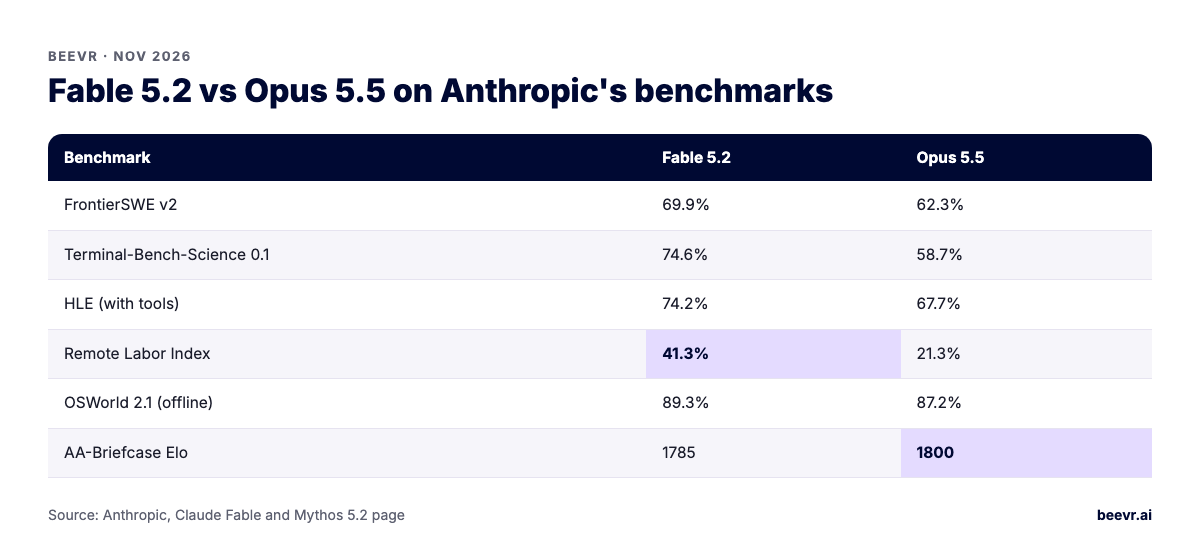
On most of Anthropic's published benchmarks, yes, sometimes by a wide margin. But Opus 5.5 still leads on at least one, and at matched quality Fable can be cheaper per task. "Better" depends on your task and the effort level you run.
| Benchmark (Anthropic-reported) | Fable 5.2 | Opus 5.5 |
|---|---|---|
| FrontierSWE v2 | 69.9% | 62.3% |
| FrontierCode 2.0 | 49.1% (xhigh) | 45.5% |
| Terminal-Bench-Science 0.1 | 74.6% | 58.7% |
| Humanity's Last Exam (with tools) | 74.2% | 67.7% |
| Remote Labor Index | 41.3% (high) | 21.3% |
| OSWorld 2.1 (offline, partial) | 89.3% | 87.2% |
| AA-Briefcase Elo | 1785 | 1800 |
Source: Anthropic's Fable and Mythos 5.2 page. The most useful line on that page is about cost: at high effort, Fable 5.2 scores 45.3% on FrontierCode 2.0, about the same as Opus 5.5's best score of 45.5%, "for roughly half the cost per task". A model with double the token price can still be cheaper per finished task if it needs fewer tokens and fewer retries. Only your own evals tell you which side of that line you are on.
Fable is not better everywhere. Anthropic says it deliberately limited gains in some AI R&D areas, such as accelerator kernel optimisation and LLM architecture work, where Fable 5.2 performs "at about the level of Opus 5.5". And on Zapier's AutomationBench, Gemini 4 Carbon (53.9%) leads Fable 5.2 (51.4%). For a cross-vendor view, see Claude Opus 5.5 vs GPT-6 Sol and our Gemini 4 Carbon vs Hydrogen guide.
What long-running tasks can Claude Fable 5.2 handle?
Fable 5.2 is built for work that runs for hours or days with many agents. Anthropic reports that a team of 1,000 Fable 5.2 agents fully formalised Fermat's Last Theorem in 30 hours, and that the model coordinated over 1,000 subagents for eight days to build a prototype operating system from an empty folder.
For comparison, Anthropic says Opus 5.5 in the same Fermat setup completed 26% in 18 hours. These are Anthropic's showcase results, not typical workloads, but they show what Fable is tuned for: many parallel subagents, long tool-call chains and verification loops.
What changes in your agent harness
The developer notes list behaviours to plan for:
- Turns can end early. On long multistep tasks, the model sometimes stops with a list of what remains or an offer to continue, more often at
lowandmediumeffort. Your harness should detect and resume. - Subagent spend. In harnesses that invite delegation, Fable delegates readily, and subagents can be a large part of a session's cost. Set budgets.
- Quiet tool runs. Long runs of tool calls can pass with little user-facing text. Add progress reporting if users watch.
- Compaction on demand (beta) lets you choose when older turns become a summary, which helps keep history append-only.
What breaks when you switch to Claude Fable 5.2?
Four changes can break existing code: edits to earlier turns now fail a prefix check with a 400 error, Fable 5.2's thinking blocks are readable only by Fable 5.2 and Mythos 5.2, the old computer_20251124 tool errors on every platform except Amazon Bedrock, and an advisor tool paired with a Fable 5.2 executor must also be Fable 5.2 or Mythos 5.2.
The prefix check matters most. If your code changes the system prompt, the tool list or any earlier message mid-conversation, the API returns "The block is bound to a different conversation". If Claude Code, the Agent SDK or Managed Agents builds your requests, nothing changes. If your own code does, keep system and tools fixed, only append to messages, and send assistant turns back exactly as received.
Two more rules apply to every request, as they already do on Opus 5.5: thinking cannot be disabled, and forced tool use (tool_choice of any or a named tool) returns a 400 error. Use strict tool use or JSON outputs instead. Our LLM model migration guide covers how we test these changes before switching.
Routers and fallbacks lose reasoning
If a router moves a conversation from Fable 5.2 to any other model, including Opus 5.5, the other model cannot read Fable's thinking blocks; they are dropped. Refused requests can fall back server-side only to Opus 4.8 or Opus 5. Design your fallback path with that in mind.
What is Claude Mythos 5.2, and who can use it?
Claude Mythos 5.2 is the same model as Fable 5.2 with some cybersecurity and biology safeguards removed. It is available only to organisations verified through Anthropic's programmes, such as the Cyber Verification Program or the Life Sciences Verification Program, at the same $8/$40 price.
Fable 5.2's classifiers block high-risk cyber tasks, such as exploit generation, and most research biology tasks; blocked queries are answered by Opus 4.8 (cyber) or Opus 5 (biology). Anthropic says Fable 5.2 blocks about 55% fewer requests than Fable 5.1. Mythos 5.2 scores 89.6% on Anthropic's CVE Rediscovery evaluation, against 81.3% for Opus 5.5 without safeguards. Claude Enterprise customers can use Mythos 5.2 through Claude Security without separate verification. If your use case is defensive security, see also our explainer on OpenAI's GPT-6-Cyber.
Can you use Claude Fable 5.2 with sensitive or regulated data?
Carefully. Fable 5.2 and Mythos 5.2 require 30-day data retention and are not available under zero data retention unless Anthropic expressly authorises it. Opus 5.5 does support zero data retention. For data that must not be retained, Opus 5.5 is the simpler choice.
Anthropic says the 30-day retention supports safety monitoring. A private beta called Enterprise Frontier Safeguards runs that monitoring inside the customer's infrastructure and is compatible with zero data retention, but it is limited to a few named enterprises. Thinking blocks are also bound to the account that produced them. For healthcare workloads, check your BAA scope per model; our guide to LLM providers that sign a BAA explains what to ask.
Where is Claude Fable 5.2 available?
On the Claude API, Claude Platform on AWS, Amazon Bedrock, both Google Cloud options and Microsoft Foundry. On Bedrock the IDs are global.anthropic.claude-fable-5-2 or us.anthropic.claude-fable-5-2, on the bedrock-runtime endpoint only.
Fast mode ($16/$80, up to 2.5x faster generation) is available on the Claude API, both Google Cloud options and Microsoft Foundry (as claude-fable-5-2-fast on Anthropic-hosted deployments), and in Claude Code. In Anthropic's consumer plans, Fable is included for up to 50% of weekly usage limits on Pro plans and standard Team seats.
When should you use Claude Fable 5.2 instead of Opus 5.5?
Use Fable 5.2 when Opus 5.5 at xhigh or max effort fails your evals, the task runs long enough that fewer retries save money, and you can accept 30-day retention. Otherwise, stay on Opus 5.5 and spend the difference on better evals.
- Good fits: long autonomous coding or migration runs, multi-agent research, hard scientific or maths reasoning, large audits where a missed issue is expensive.
- Poor fits: chat, classification, extraction, short tool calls, anything latency-sensitive, and any flow that requires zero data retention.
- Test first: run Fable 5.2 at
highagainst Opus 5.5 atxhighon the same cases and compare cost per passed task, not per token.
If you wonder whether Fable is simply a bigger model, Anthropic does not say; see what is known about Opus 5.5's parameters.
How BeevR builds this
We rarely run one model for a whole agent. In the systems we build, Fable 5.2 is a step we escalate to, not a default: a planner or verifier for the hardest cases, with Opus 5.5 or Sonnet 5.5 doing most of the work and Haiku 5.5 handling extraction and routing. Each step has its own eval set and cost budget, and our harnesses keep history append-only, so Fable's prefix check is not a problem. For regulated clients we check retention terms per model before any data flows, and keep zero-retention workloads on models that support it.
BeevR is a senior, founder-led team in Hanoi, rated 5.0 on Clutch. We work on fixed scope and fixed price, from $10K per phase, show a working demo every Friday, and you own the code and IP from day one. See our AI agent development work.
Wondering whether Fable 5.2 is worth it for your workload? Book a 30-minute call.