The strongest open-weight coding models in November 2026 are Kimi K3.1 Pro (2.8T parameters), GLM-5.3, DeepSeek V4.1 Flash and V4 Pro, Qwen3.8 and Mistral Large 4. Only DeepSeek and the smaller GLM and Qwen releases come under MIT or Apache 2.0. The flagships need 600 GB to 2.5 TB of weights, which means a full 8-GPU node or more.
Updated 13 November 2026. Every number below comes from the vendor's own Hugging Face model card or license file, read today: release date, parameters, context window and license. Benchmarks are the scores each vendor reports, often run with different harnesses and effort settings. Use them to build a shortlist, not to declare a winner. If you only need a hosted coding agent, read our Cursor vs Claude Code vs Codex vs Devin comparison first. This post is for teams that need weights they control.
What are the best open-weight coding models in late 2026?
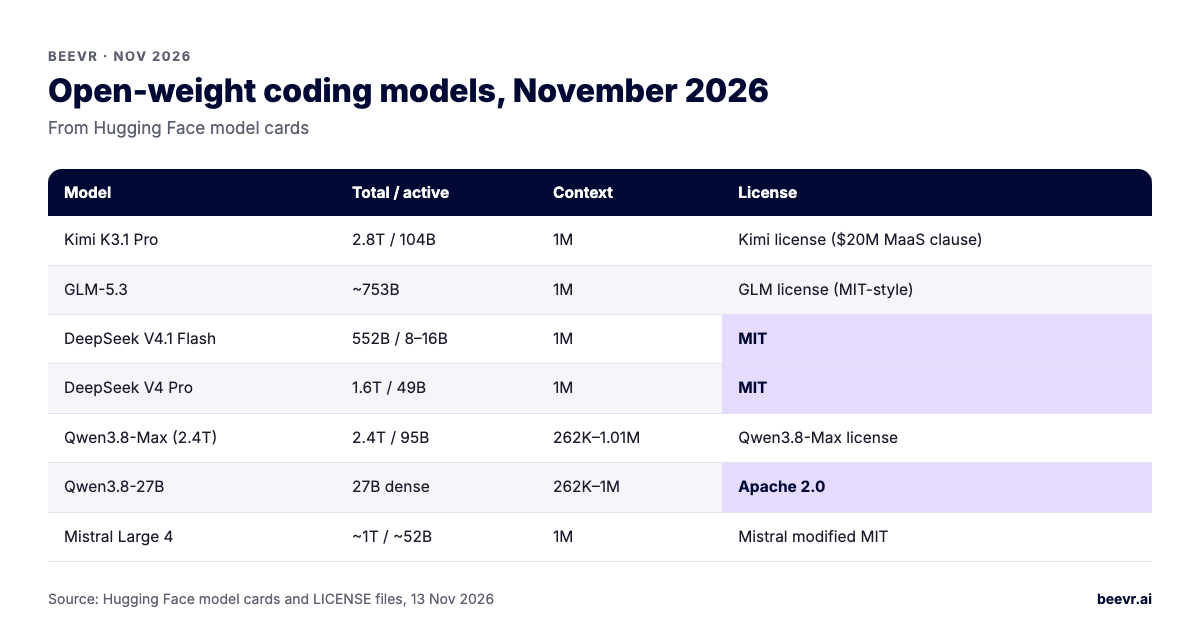
The current frontier of open weights is five model families from five labs. All are mixture-of-experts flagships with context windows of roughly 1M tokens. In vendor-reported agentic coding scores they sit close to the top closed models. The table lists the newest coding-relevant checkpoint from each.
| Model (vendor) | On Hugging Face | Total / active params | Context | License |
|---|---|---|---|---|
| Kimi K3.1 Pro (Moonshot AI) | 2 Nov 2026 | 2.8T / 104B | 1,048,576 | Kimi K3.1 Pro License (MIT-style, revenue clause) |
| GLM-5.3 (Z.ai) | 25 Aug 2026 | ~753B (weight count; active not stated) | 1M (config) | GLM-5.3 License (MIT-style, security review clause) |
| GLM-5.3-Flash (Z.ai) | 25 Aug 2026 | 320B / 18B | Not stated on card | MIT |
| DeepSeek-V4.1-Flash-1017 | 17 Oct 2026 | 552B backbone / 8B–16B | 1M | MIT |
| DeepSeek-V4-Pro-0813 | 13 Aug 2026 | 1.6T / 49B | 1M (config) | MIT |
| Qwen3.8-2.4T-A95B (open Qwen3.8-Max) | 8 Aug 2026 | 2.4T / 95B | 262K native, up to 1.01M | Qwen3.8-Max License (revenue clause) |
| Qwen3.8-27B | 5 Aug 2026 | 27B dense | 262K native, up to 1M | Apache 2.0 |
| Mistral Large 4 | 30 Sep 2026 | ~1T / ~52B | 1M | Mistral Ecosystem Open-Weight License (modified MIT) |
Sources: model cards for Kimi K3.1 Pro, GLM-5.3, DeepSeek-V4.1-Flash, Qwen3.8-27B and Mistral Large 4. Dates are Hugging Face repository creation dates.
Which open-weight model is best for agentic coding?
On the vendor-reported numbers, Kimi K3.1 Pro and DeepSeek V4.1 Flash lead on agentic coding. GLM-5.3, DeepSeek V4 Pro and Qwen3.8-Max are close behind on older terminal benchmarks. The gaps are small, and each vendor uses different harnesses, so run your own evaluation before you commit.
What each vendor reports
- Kimi K3.1 Pro: 65.7 on Terminal-Bench 4.0, against 66.4 for Claude Opus 5.5 and 41.8 for GLM-5.3 in the same table. It also scores 75.5 on DeepSWE v1.1 and 51.7 on SWE Marathon v1.1. All runs use max reasoning effort.
- DeepSeek-V4.1-Flash-1017: 77.0 on DeepSWE v1.1 and 42.3 on Terminal-Bench 4.0. DeepSeek calls it a minor update that also cuts task time and output length.
- GLM-5.3: 88.2 on Terminal Bench 2.1, 28.3 on Terminal Bench 3.0 and 66.9 on DeepSWE. Z.ai says it reaches 84.5 on CyberGym, which is also a warning: its "cyber capability developed faster than we expected."
- DeepSeek-V4-Pro-0813: 87.9 on Terminal Bench 2.1 and 62.7 on DeepSWE, run with DeepSeek's own harness.
- Qwen3.8-Max (2.4T-A95B): 86.6 on Terminal Bench 2.1 and 67.7 on SWE-bench Pro. The small Qwen3.8-27B reports 73.0 and 61.7 on the same two tests, a strong result for a model that fits on one GPU.
- Mistral Large 4: 48% on the Artificial Analysis Coding Agent Index, "effectively tied" with GLM-5.3 according to Mistral, while using 47% fewer tokens per task.
Note what these tables do not show: how secure the code is. In the October 2026 LSCBench study, Kimi K3 produced code that was both working and secure on only 16.4% of tasks. GLM-5.3 managed 21.3%, Qwen3.8-Max 22.0% and DeepSeek V4 Pro 18.0%. The best closed model scored 25.1%. See our breakdown of the coding agent security benchmarks.
Are these models really open source, and can I use them commercially?
Only DeepSeek (MIT), Qwen3.8-27B (Apache 2.0) and GLM-5.3-Flash (MIT) are under standard permissive licenses. The flagships from Moonshot, Z.ai, Qwen and Mistral use MIT-style licenses with extra conditions. Most of those conditions only bite if you resell model access as a service. Read the license file, not the press coverage.
- Kimi K3.1 Pro: if you or your affiliates run a "Model as a Service" business with more than $20 million revenue over 12 months, you need a separate agreement with Moonshot before commercial use.
- GLM-5.3: a Model-as-a-Service business above $10 billion revenue must pass Z.ai's security review. For almost every company, it behaves like MIT.
- Qwen3.8-Max: Model-as-a-Service or "AI Work Assistant" businesses above $50 million revenue need a separate license. Internal use is exempt. Products with more than 100 million monthly users or $20 million monthly revenue must display the model name. The smaller Qwen3.8-Flash-Next uses the Qwen Community License, which requires a separate license for any Model-as-a-Service business.
- Mistral Large 4: any Model-as-a-Service business needs a commercial license from Mistral, whatever its size.
Every license here defines "Model as a Service" so that it excludes end-user products where the model is embedded in specific features. A coding agent used inside your company, or a product feature built on these models, is generally outside that clause. Get counsel to confirm for your case.
How much hardware do you need to self-host an open-weight coding model?
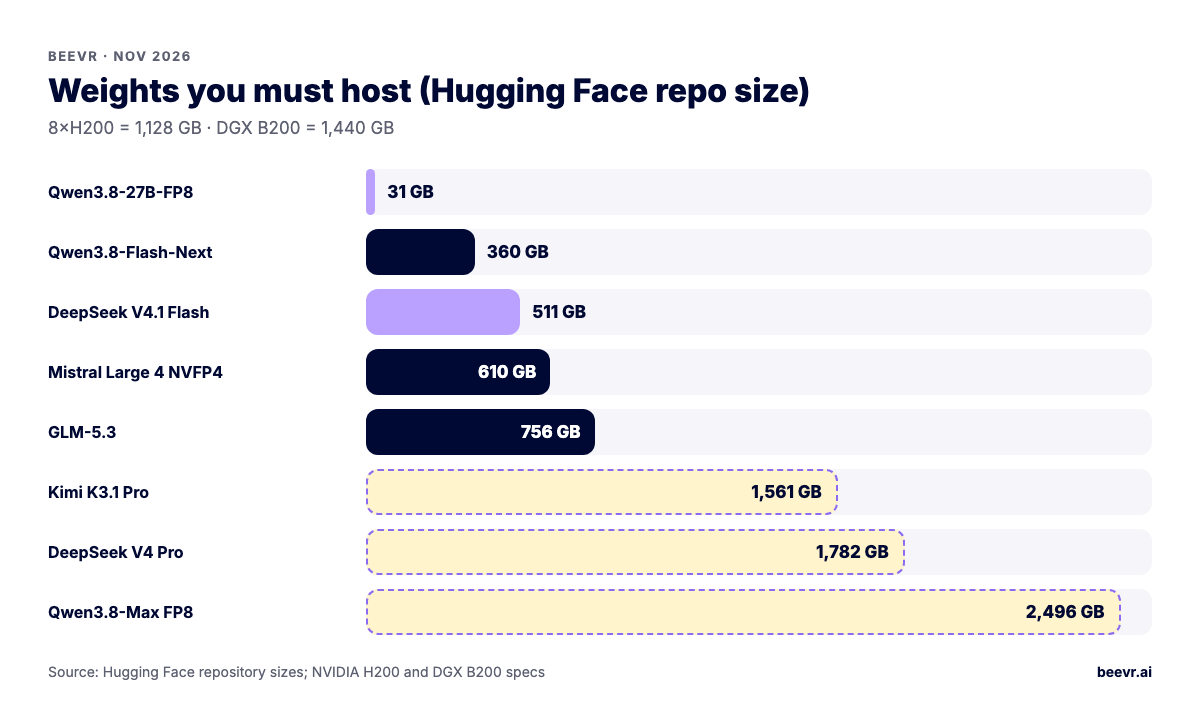
Plan for the whole model in GPU memory, not just the active parameters. The flagship weights on Hugging Face range from about 610 GB to 2.5 TB. That means at least one 8-GPU node of H200 (8 × 141 GB = 1,128 GB) or B200-class hardware (a DGX B200 has 1,440 GB), and often two nodes for the largest models. You also need room for the KV cache.
Repository sizes on Hugging Face, as published (13 November 2026):
- Qwen3.8-27B-FP8: 31 GB. Fits on one 80 GB GPU with room for context.
- Qwen3.8-Flash-Next: 360 GB
- DeepSeek-V4.1-Flash-1017: 511 GB
- Mistral Large 4 NVFP4: 610 GB (the full checkpoint is 1,061 GB)
- GLM-5.3: 756 GB
- Kimi K3.1 Pro: 1,561 GB, already MXFP4-quantized by Moonshot
- DeepSeek-V4-Pro-0813: 1,782 GB
- Qwen3.8-2.4T-A95B-FP8: 2,496 GB
Hardware specs are from NVIDIA's H200 and DGX B200 pages. All the flagships list vLLM and SGLang as supported serving engines, and Mistral's card uses 8-way tensor parallelism as its example.
Why active parameters still matter
Mixture-of-experts models keep every expert in memory, but compute per token scales with the active parameters. DeepSeek V4.1 Flash activates 8B–16B, against Kimi K3.1 Pro's 104B. So once the weights fit, the smaller-active models serve far more tokens per GPU-hour. That matters more for agents than for chat, because an agent run can burn millions of tokens.
Is self-hosting cheaper than paying for a closed model API?
Usually not, unless you run near-constant load or have a hard requirement to keep code on your own hardware. A node that holds one flagship model costs the same whether it is busy or idle. Agent workloads are bursty: heavy in working hours, close to zero at night.
Self-hosting tends to pay off in three cases:
- Data control is mandatory, for example source code that may not leave your network, or a defence or government setting.
- Utilisation is high, such as batch refactors, test generation across many repos, or many developers in several time zones.
- A small model is good enough. Qwen3.8-27B on one GPU can handle lint fixes, test scaffolding and code search while a frontier API handles hard tasks.
Most of these labs also sell a hosted API for the same models (Kimi, Z.ai, Qwen Cloud, Mistral). For bursty agent workloads, that is often the cheaper way to use the same weights. The trade-off is that your code is processed by that vendor, so the data question comes back. Our guide to the cost to run an AI product has the wider framing.
Can you use open-weight models with Claude Code, Codex or Cursor?
Partly. Several vendors evaluate their models inside Claude Code. GLM-5.3, Qwen3.8 and Kimi K3.1 Pro all report results using the Claude Code harness, and Kimi offers an Anthropic-compatible API. In practice, though, the commercial agents limit which models they officially support.
- Codex CLI supports custom model providers in its config. Ollama documents running it against local models.
- Claude Code officially supports Claude models through Anthropic, Bedrock, Vertex and Foundry. Pointing it at other models through a gateway is not a supported setup, so treat it as experimental.
- GitHub Copilot offers Kimi K3 in its model picker, so an open-weight model is available there through GitHub.
- Open-source agents such as OpenHands, Cline and Aider are built to run with any OpenAI-compatible endpoint. That is the cleanest path for self-hosted weights.
If you are wiring a model into your own tools, a Model Context Protocol server keeps the tool layer the same when you swap models. See MCP server development.
How should you choose an open-weight coding model?
Start from your constraint, not the leaderboard. Check the license first, then hardware, then score your own tasks. A two-week evaluation on 50–100 real tickets from your own repos tells you more than any table in this post.
- License fit. If you resell inference, choose MIT (DeepSeek) or Apache 2.0 (Qwen3.8-27B), or negotiate with the vendor.
- Hardware fit. One GPU: Qwen3.8-27B. One 8-GPU node: DeepSeek V4.1 Flash, GLM-5.3 or Mistral Large 4 NVFP4. More than one node: Kimi K3.1 Pro, DeepSeek V4 Pro, Qwen3.8-Max.
- Task fit. Score pass rate, review time and security findings on your own repos, inside the agent harness you will actually use.
- Safety fit. Z.ai flags strong offensive cyber capability in GLM-5.3. Sandbox any agent that can run code, whatever the model. Our AI agent security checklist lists the controls.
How BeevR builds this
BeevR is a senior, founder-led software and AI studio in Hanoi. We build production AI systems where the model is an untrusted, swappable component. That means evaluation sets first, a tool layer that does not depend on any one vendor, and sandboxed execution. For regulated clients, the model can run inside the client's own AWS account. We can benchmark open-weight and closed models on your own codebase and tasks as one fixed-scope phase from $10K, with a working demo every Friday. You own the code, the eval set and the results.
See how we work as an AI development company, or book a 30-minute call to scope a model evaluation.