In November 2026, frontier LLM APIs cost $2 to $10 per million input tokens and $10 to $50 per million output tokens. Budget models cost $0.10/$0.50. In our worked example, an agent doing 10,000 tasks a month costs $112 on Claude Haiku 5.5 or GPT-6 Luna, $2,120 on Sonnet 5.5 or GPT-6.1 Sol, and $4,240 on Opus 5.5. Caching halves the bill.
Updated 13 November 2026. All prices below were read today from the official pricing pages of Anthropic, OpenAI and Google Gemini. They are standard pay-as-you-go rates in US dollars, before negotiated discounts and taxes. List prices change often (two of the models below change price within seven weeks), so check the source before you sign a budget.
How much do LLM APIs cost per million tokens in November 2026?
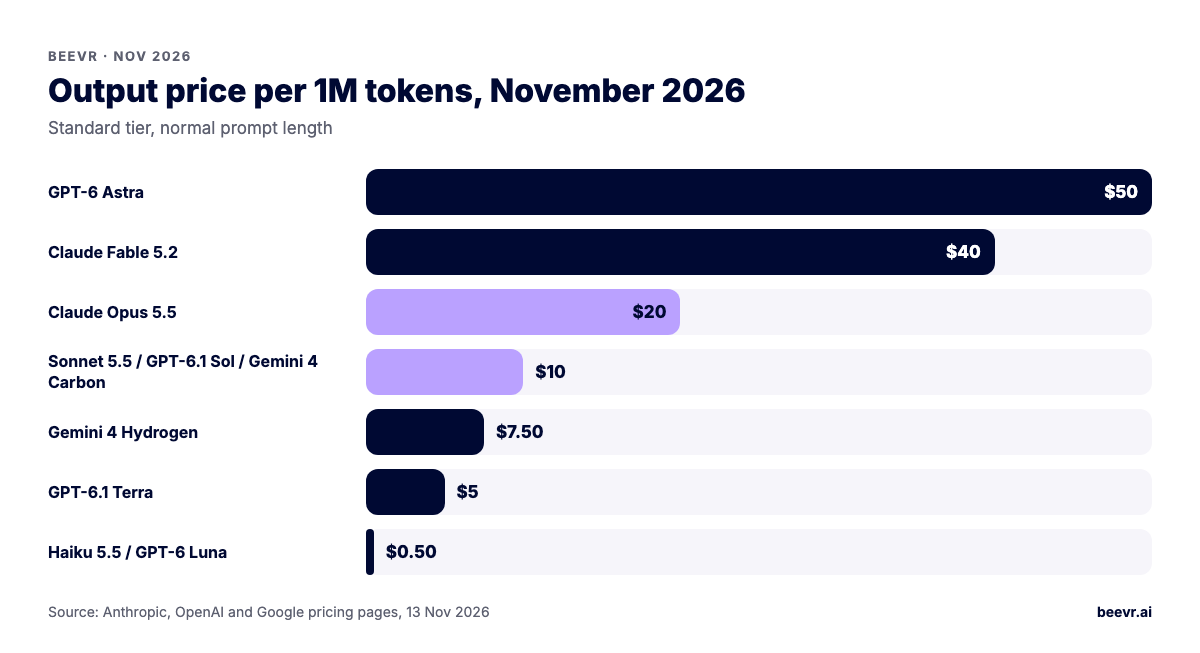
Flagship models cost $4 to $10 per million input tokens and $20 to $50 per million output tokens. Strong mid-tier models (Claude Sonnet 5.5, GPT-6.1 Sol, Gemini 4 Carbon and Argon) cost about $2/$10. Small models (Claude Haiku 5.5, GPT-6 Luna) cost $0.10/$0.50. Output tokens cost four to eight times as much as input on every vendor.
| Model | Input | Cache hit | Output | Batch in / out | Notes |
|---|---|---|---|---|---|
| GPT-6 Astra | $10.00 | $1.00 | $50.00 | $5 / $25 | >272K input: $20 / $75 |
| Claude Fable 5.2 | $8.00 | $0.20 | $40.00 | $4 / $20 | 1M context at one price |
| Claude Opus 5.5 | $4.00 | $0.20 | $20.00 | $2 / $10 | 1M context at one price |
| Gemini 4 Carbon | $2.00 | $0.10 | $10.00 | $1 / $5 | Doubles to $4 / $20 on 1 Dec |
| Gemini 4 Argon | $2.00 | $0.10 | $10.00 | $1 / $5 | Doubles to $4 / $20 on 1 Dec |
| Claude Sonnet 5.5 | $2.00 | $0.10 | $10.00 | $1 / $5 | 1M context at one price |
| GPT-6.1 Sol | $2.00 | $0.10 | $10.00 | $1 / $5 | >272K input: $4 / $15 |
| GPT-6 Sol | $2.00 | $0.20 | $10.00 | $1 / $5 | >272K input: $4 / $15 |
| Gemini 4 Hydrogen | $1.50 | $0.075 | $7.50 | $0.75 / $3.75 | Released 12 Nov |
| GPT-6.1 Terra | $1.00 | $0.05 | $5.00 | $0.50 / $2.50 | >272K input: $2 / $7.50 |
| Gemini 3.8 Flash | $0.75 | $0.075 | $3.75 | $0.375 / $1.875 | Doubles on 1 Jan 2027 |
| Claude Haiku 5.5 | $0.10 | $0.01 | $0.50 | $0.05 / $0.25 | Prompts >100K: $0.50 / $2.50 |
| GPT-6 Luna | $0.10 | $0.01 | $0.50 | $0.05 / $0.25 | >272K input: $0.20 / $0.75 |
All prices are USD per 1 million tokens, standard tier, normal prompt length. Not shown: cache-write charges, Gemini's hourly cache storage fee, and tool fees such as Anthropic's web search at $10 per 1,000 searches.
What is the cheapest LLM API in November 2026?
Among current models from the three big vendors, Claude Haiku 5.5 and GPT-6 Luna tie at $0.10 per million input tokens and $0.50 per million output tokens. Batch halves that to $0.05/$0.25. For prompts between 100K and 272K tokens, GPT-6 Luna is cheaper: Haiku 5.5's price rises 5x above 100K, while Luna's only doubles, and only above 272K.
The two are not equal in capability on Anthropic's tests: on its Haiku 5.5 launch page, Haiku 5.5 scores 39.2% on Terminal-Bench 4.0 against 16.4% for GPT-6 Luna. Those are Anthropic's numbers; run your own. Gemini's cheapest current text model on the pricing page is Gemini 3.1 Flash-Lite at $0.25/$1.50, more than twice the price.
"Cheapest per token" is rarely the useful question. Ask instead which is the cheapest model that passes your eval at the quality bar you need. For classification and extraction that is often a $0.10 model. For multi-step agent planning it usually is not.
How much does prompt caching save on LLM API costs?
A lot, for agents. Cache hits cost 2.5% to 10% of the normal input price on Claude (2.5% on Fable 5.2, 5% on Opus 5.5 and Sonnet 5.5) and 5% to 10% on OpenAI's GPT-6 models. In our worked example below, caching cuts Opus 5.5's monthly bill from $8,800 to $4,240, a 52% saving.
Agents resend the same system prompt, tool definitions and conversation history on every turn, so most of their input tokens are repeats. Caching only works if the repeated part is a stable prefix. Put fixed content first and changing content last, and do not reorder tools between calls.
- Anthropic: cache writes cost 1.25x base input for 5 minutes or 2x for 1 hour. A 5-minute cache pays for itself after one read.
- OpenAI: GPT-6 model pages list cache writes at $2.50 per million for Sol (1.25x input). 12-hour prompt caching has been available since 20 October.
- Google: context caching has a per-token read price plus an hourly storage fee ($0.50 per million tokens per hour for Gemini 3.8 Flash).
How much does the Batch API discount save?
All three vendors charge 50% of the standard rate for batch jobs, on both input and output. On Anthropic the batch discount stacks with prompt caching. OpenAI also sells the same 50% rate as "Flex" for synchronous calls that can wait longer. Batch is right for evals, backfills, document processing and nightly jobs. It does not suit anything a user is waiting on.
The opposite lever is speed. OpenAI's Fast tier costs 2x standard, and GPT-6.1 Sol's Ultrafast mode costs $12/$60. Anthropic's fast mode for Opus 5.5 costs $8/$40, also 2x. Gemini's Priority tier costs 1.8x. Pay for speed only on the user-facing steps where latency shows up in your metrics.
Do long prompts cost more on Claude, GPT and Gemini?
On OpenAI, yes. Above 272K input tokens, GPT-6 models charge 2x input and 1.5x output for the whole request. On Claude 4.6 and later, no: the full 1M window is billed at the standard rate, except Claude Haiku 5.5, which steps up 5x above 100K tokens. On Google, among current text models only Gemini 3.1 Pro Preview lists a higher rate above 200K.
This matters for RAG systems and agents that keep long histories. A 300K-token request on GPT-6.1 Sol pays $4 per million input instead of $2. The same request on Opus 5.5 pays the normal $4. On Sonnet 5.5 it pays the normal $2. Compaction, which replaces old turns with a summary, keeps you below these thresholds and is usually cheaper than paying for the long context.
How much does an AI agent cost to run per month?
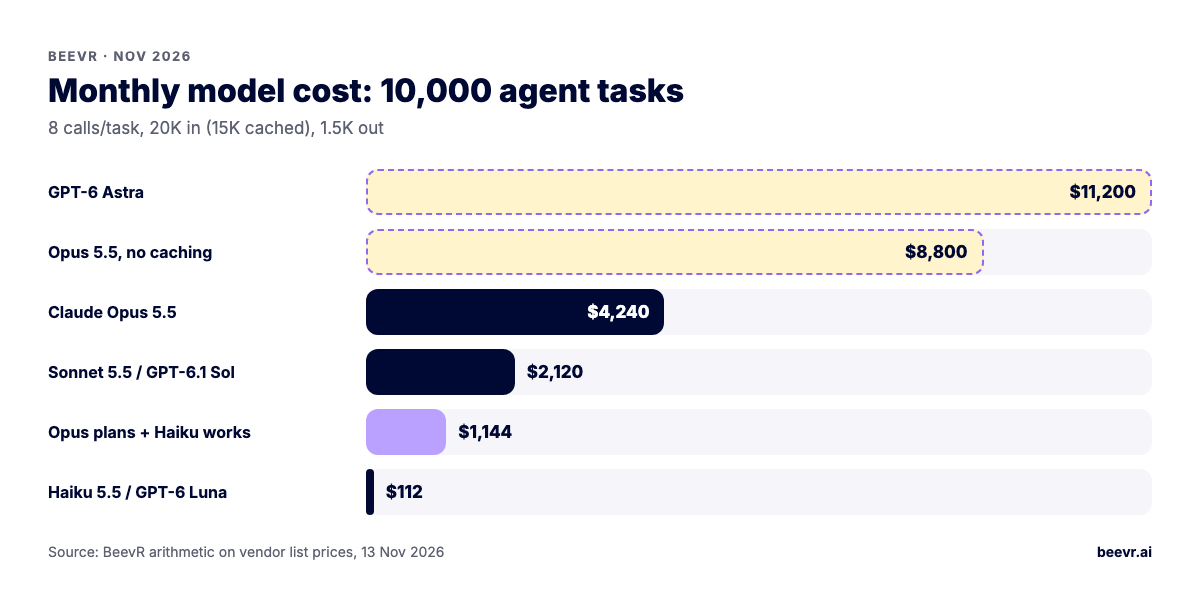
In our worked example, $112 to $11,200 a month in model fees, depending only on the model. The workload is 10,000 agent tasks a month, a typical volume for an internal operations agent or a mid-sized support deployment. Model fees are only part of the cost of running an AI product. Our post on what it costs to run an AI product covers hosting, observability and people.
Assumptions
- 10,000 tasks per month, 8 model calls per task.
- Each call: 20,000 input tokens, of which 15,000 are a cached prefix (system prompt, tools, history) and 5,000 are new. 1,500 output tokens including reasoning.
- Monthly totals: 400M uncached input, 1,200M cached input, 120M output.
- Standard tier, no batch. Cache-write premiums and Gemini storage fees not included.
| Model | Monthly model cost | Per task |
|---|---|---|
| GPT-6 Astra | $11,200 | $1.12 |
| Claude Fable 5.2 | $8,240 | $0.82 |
| Claude Opus 5.5 | $4,240 | $0.42 |
| Gemini 4 Carbon (from 1 Dec) | $4,240 | $0.42 |
| GPT-6 Sol | $2,240 | $0.22 |
| Claude Sonnet 5.5 / GPT-6.1 Sol / Gemini 4 Carbon (Nov) | $2,120 | $0.21 |
| Gemini 4 Hydrogen | $1,590 | $0.16 |
| GPT-6.1 Terra | $1,060 | $0.11 |
| Gemini 3.8 Flash (until 31 Dec) | $840 | $0.08 |
| Claude Haiku 5.5 / GPT-6 Luna | $112 | $0.01 |
Example calculation for Opus 5.5: 400M × $4 + 1,200M × $0.20 + 120M × $20 = $1,600 + $240 + $2,400 = $4,240.
Three caveats that change the answer
- Tokenizers differ. Anthropic says Claude 4.7 and later produce about 30% more tokens for the same text than older Claude models. The same prompt is not the same token count across vendors.
- Turns differ. A stronger model may finish in 5 calls where a weaker one needs 12, or never finishes. Cost per completed task is the real number.
- Routing beats picking. If Opus 5.5 handles 2 planning calls per task and Haiku 5.5 handles the other 6, the bill is about $1,060 + $84 = $1,144, down from $4,240. Anthropic documents this pattern as executor/advisor and orchestrator/worker setups.
Which LLM prices change in December 2026 and January 2027?
Gemini 4 Carbon and Gemini 4 Argon double on 1 December 2026, from $2/$10 to $4/$20. Gemini 3.8 Flash and 3.6 Flash double on 1 January 2027, from $0.75/$3.75 to $1.50/$7.50. Also on 1 December, requests to gemini-2.5-pro start routing to Gemini 3.8 Flash and are billed at its rates.
On the Anthropic and OpenAI side, the relevant changes are retirements, not price rises. Claude Sonnet 4.5 retires on 30 November 2026 ($3/$15; its replacement Sonnet 5.5 is $2/$10). OpenAI removes the GPT-5 and o3 snapshots on 11 December. Our November 2026 model roundup lists every date. For handling the switch, see the LLM model migration guide.
How do you cut LLM API costs without losing quality?
Measure first, then change one lever at a time against a fixed eval set. In our experience the order that saves the most is: cache the stable prefix, route easy steps to a small model, lower effort where evals allow, batch anything offline, and compact long histories. Switching vendors to chase a cheaper per-token rate comes last.
- Log tokens per task, by step. You cannot cut what you cannot see. See AI agent evaluation and observability.
- Cache aggressively. Keep system prompt and tool list stable and at the front.
- Route by difficulty. Small models for classify, extract and route; a big model for plan and decide.
- Tune effort. On Claude and GPT-6 models, effort changes how many reasoning tokens you pay for. Opus 5.5 defaults to
medium, Sonnet 5.5 tohigh. - Batch the offline work. Evals and backfills at 50% off.
- Re-test after every price change. The cheapest model in November is not necessarily the cheapest in January.
For the full build budget around these numbers, see how much an AI agent costs and AI app development cost in 2026.
How BeevR builds this
We treat model cost as an engineering metric from the first sprint. Every agent we ship logs tokens, cache hits, cost and latency per step, and a dashboard shows cost per completed task next to the eval pass rate. That lets clients see what a model or effort change does to quality and spend before it reaches production. We design prompts for caching, route easy steps to small models, and keep the model behind a thin interface so a price change becomes a config change. For regulated clients, the model can run inside the client's own AWS account under the AWS BAA, so the token bill and the data stay on their side.
BeevR is a senior, founder-led team in Hanoi. We work on fixed scope and fixed price from $10K per phase, with a working demo every Friday, no per-user fees, and you own the code and IP from day one. See our AI agent development work.
Want a cost model for your own agent workload? Book a 30-minute call.