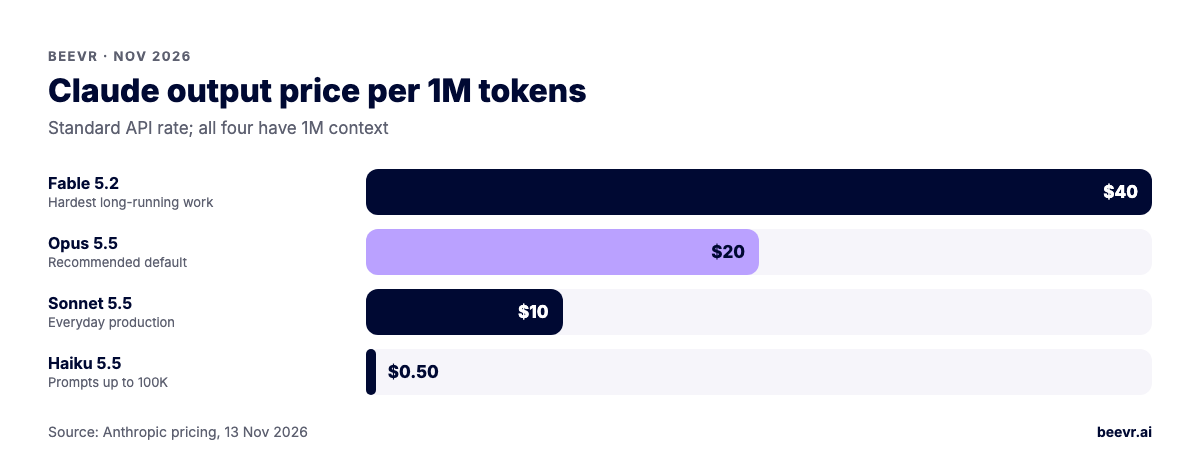
As of November 2026, Anthropic's current Claude lineup is Fable 5.2 ($8/$40 per million tokens), Opus 5.5 ($4/$20), Sonnet 5.5 ($2/$10) and Haiku 5.5 (from $0.10/$0.50). All four have a 1M-token context window. Start with Opus 5.5, drop to Sonnet 5.5 or Haiku 5.5 where your evals allow, and use Fable 5.2 only for the hardest long-running work.
Updated 13 November 2026. Anthropic replaced most of its lineup in seven weeks: Opus 5.5 on 22 September, Sonnet 5.5 on 28 September, Haiku 5.5 on 7 October and Fable 5.2 on 9 November. If your code still points at a 4.x model, or you are unsure what "Fable" is, this guide maps each model to the work it suits. Every price, ID and limit comes from Anthropic's own documentation.
What Claude models are available in November 2026?
Four models are generally available: Claude Fable 5.2, Claude Opus 5.5, Claude Sonnet 5.5 and Claude Haiku 5.5. A fifth, Claude Mythos 5.2, is the same model as Fable 5.2 with fewer safeguards, and only verified organizations can use it. All current models take text and image input, support tool use, and offer a 1M-token context with 128K maximum output.
| Fable 5.2 | Opus 5.5 | Sonnet 5.5 | Haiku 5.5 | |
|---|---|---|---|---|
| Anthropic's description | Demanding reasoning, long-horizon agentic work | Long-running agentic coding and knowledge work | Best combination of speed and intelligence | High-volume, latency-sensitive tasks |
| Released | 9 Nov 2026 | 22 Sep 2026 | 28 Sep 2026 | 7 Oct 2026 |
| Input / output per 1M | $8 / $40 | $4 / $20 | $2 / $10 | $0.10 / $0.50 (prompts up to 100K) |
| Cache hit per 1M | $0.20 | $0.20 | $0.10 | $0.01 |
| Relative latency | Moderate | Moderate | Fast | Fastest |
| Default effort | high | medium | high | medium |
| Thinking | Always on | Always on | Adaptive | Adaptive |
| Context / max output | 1M / 128K | 1M / 128K | 1M / 128K | 1M / 128K |
| Knowledge cutoff | Jun 2026 | Jun 2026 | Jun 2026 | Jun 2026 |
| Not retired before | 9 Nov 2027 | 22 Sep 2027 | 28 Sep 2027 | 7 Oct 2027 |
Source: Claude models overview and Claude pricing, read 13 November 2026.
Which Claude model should I use?
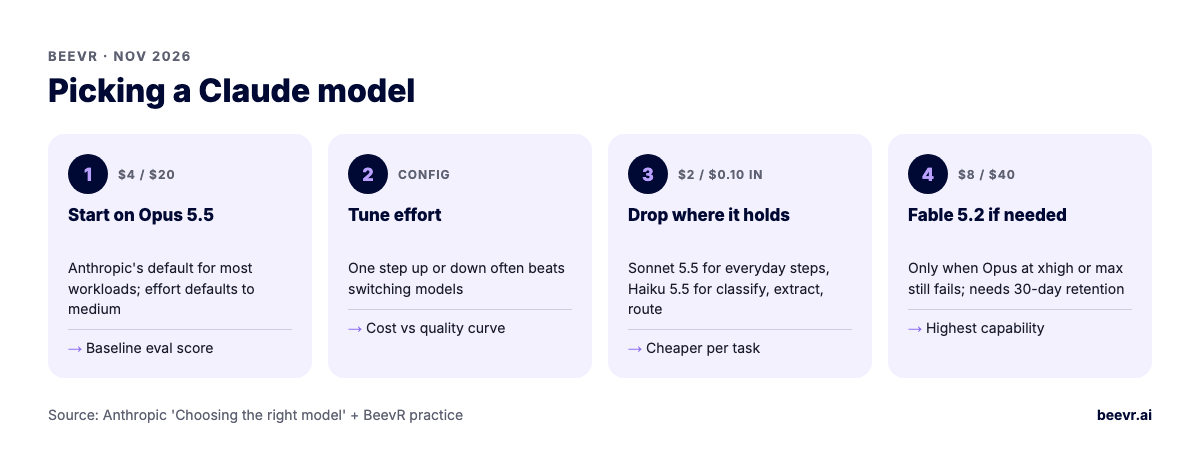
Anthropic's own advice is to start most workloads on Claude Opus 5.5. From there, lower the effort or move to Sonnet 5.5 or Haiku 5.5 when evals show quality holds. Move up to Fable 5.2 only when Opus 5.5 at xhigh or max effort still falls short on demanding reasoning or long-horizon agent work.
Anthropic's model selection guide maps the four models to jobs. Here is our version, with the cases we see in client work:
- Fable 5.2: agent sessions that run for hours, multistep research, analysis carried through to a finished document or spreadsheet. Use it when a failed run costs more than the tokens.
- Opus 5.5: multihour coding agents, large refactors, complex systems work, vision-heavy workflows and computer use. Good default for an agent's "planner" role.
- Sonnet 5.5: everyday code generation, data analysis, document drafting and agentic tool use. Often the right production default once you have evals.
- Haiku 5.5: classification, extraction, routing, summarization and context compaction, live customer support, and subagent work under a bigger model.
Anthropic also says that tuning effort is often a better lever than switching models. Before you change model, try one effort step up or down and re-run your evals.
What is the difference between Claude Fable and Claude Opus?
Fable is Anthropic's highest-capability tier open to all customers. Opus is the recommended default for most work. Fable 5.2 costs twice as much as Opus 5.5 ($8/$40 vs $4/$20) and defaults to high effort rather than medium. On Anthropic's launch benchmarks it leads Opus 5.5 by 7.6 points on FrontierSWE v2 (69.9% vs 62.3%) and 15.9 points on Terminal-Bench-Science 0.1 (74.6% vs 58.7%).
What changes when you move to Fable 5.2
- Strict conversation history. If your code edits the system prompt, tools or any earlier message, the request fails with a 400 error. Claude Code, the Agent SDK and Managed Agents handle this for you; custom harnesses must keep history append-only.
- Thinking blocks are model-bound. Only Fable 5.2 and Mythos 5.2 can read Fable 5.2's reasoning. Routing a conversation to Opus 5.5 or a fallback model drops it.
- Data retention. According to Anthropic's Fable 5.2 notes, Fable 5.2 requires 30-day data retention and is not available under zero data retention unless Anthropic expressly authorizes it. Opus 5.5 and Sonnet 5.5 are available with ZDR.
- Computer use. The older
computer_20251124tool returns an error everywhere except Amazon Bedrock. Use thecomputer_toolset_20260801toolset instead.
For regulated workloads, the retention rule usually settles the question before benchmarks do.
Is Claude Sonnet 5.5 good enough instead of Opus 5.5?
Often, yes. On Anthropic's Sonnet 5.5 launch page, Sonnet 5.5 scores within a few points of Opus 5.5 on most rows (GDPval-AA 1844 vs 1846, OSWorld 2.1 80.1% vs 81.8%) and beats it on Terminal-Bench 4.0 (70.6% vs 66.4%), at half the per-token price. Anthropic still says Opus 5.5 is stronger on complex, open-ended work.
Two cost details matter. Sonnet 5.5 cache reads were cut to $0.10 per million on 7 October, which Anthropic says lowers its cost on most agentic tasks by about 20%. And Anthropic reports Sonnet 5.5 uses fewer tokens per task than Sonnet 5, costing up to 30% less per task in its testing. For a cache-heavy agent loop, Sonnet 5.5 is often the cheapest model that passes.
One trap when you migrate from Sonnet 5: thinking cannot be fully disabled. To turn off up-front thinking, use thinking: {"type": "between_tools"}. "disabled" now returns a 400 error.
When should you use Claude Haiku 5.5?
Use Haiku 5.5 for high-volume, cost-sensitive steps where speed matters more than depth: classification, extraction, routing, summaries, database queries, live support and subagent tasks. It costs $0.10/$0.50 per million tokens for prompts up to 100,000 tokens, and $0.50/$2.50 above that. Anthropic does not recommend it for complex agentic coding.
The jump from Haiku 4.5 is large. Anthropic's Haiku 5.5 page reports 39.2% on Terminal-Bench 4.0 (Haiku 4.5: 0.0%) and 72.4% on the OSWorld 2.1 offline subset (Haiku 4.5: 15.7%). Haiku 5.5 also beats GPT-6 Luna on every benchmark both models list. It is the first Haiku with an effort setting (low to max), and Anthropic puts its average cost about 75% below Haiku 4.5.
Watch the 100K threshold. Each request is priced on its whole prompt, including cache reads. One 101K-token request pays five times the input rate. If you use Haiku as a summarizer over long documents, chunk below 100K or budget for the higher tier.
What are the Claude model IDs on the API, Bedrock, Google Cloud and Foundry?
On the Claude API, the IDs are claude-fable-5-2, claude-opus-5-5, claude-sonnet-5-5 and claude-haiku-5-5. Since the 4.6 generation, each dateless ID is a pinned snapshot, not a moving alias. Google Cloud, Microsoft Foundry and Claude Platform on AWS use the same IDs; Amazon Bedrock adds a prefix.
| Model | Claude API / Google Cloud / Foundry | Amazon Bedrock |
|---|---|---|
| Fable 5.2 | claude-fable-5-2 | global.anthropic.claude-fable-5-2 (bedrock-runtime only) |
| Opus 5.5 | claude-opus-5-5 | anthropic.claude-opus-5-5 |
| Sonnet 5.5 | claude-sonnet-5-5 | anthropic.claude-sonnet-5-5 |
| Haiku 5.5 | claude-haiku-5-5 | anthropic.claude-haiku-5-5 |
Retirement dates above are Anthropic's commitment for platforms it operates. Bedrock and Google-managed Vertex set their own lifecycle dates, so check those separately if you deploy there. The Models API returns a line field (for example opus). Use it to group models in a picker instead of parsing IDs.
How much do Claude models cost per million tokens?
Standard rates are $8/$40 for Fable 5.2, $4/$20 for Opus 5.5, $2/$10 for Sonnet 5.5 and $0.10/$0.50 for Haiku 5.5 (under 100K-token prompts). The Batch API halves all of them. Cache reads are discounted harder on the new models: 0.025x base input on Fable 5.2, 0.05x on Opus 5.5 and Sonnet 5.5, and 0.1x elsewhere.
- Cache writes: 1.25x base input for a 5-minute cache, 2x for 1 hour.
- Long context: no surcharge up to 1M tokens on Claude 4.6 and later, except Haiku 5.5's 100K threshold.
- US-only inference: 1.1x on all token categories with
inference_geo: "us". - Fast mode: up to 2.5x faster output at $16/$80 (Fable 5.2) or $8/$40 (Opus 5.5). Not available with Batch.
- Tokenizer: Claude 4.7 and later produce about 30% more tokens for the same text than older models, so a straight price comparison with a 4.5-era bill understates the new cost per request.
We compare these with OpenAI and Google, and work through a monthly agent bill, in LLM API pricing compared (November 2026).
What is Claude Mythos, and who can use it?
Claude Mythos 5.2 is the same model as Fable 5.2 with fewer cybersecurity and biology safeguards. Only organizations verified through Anthropic's programs, such as the Cyber Verification Program or the Life Sciences Verification Program, can use it. It costs the same $8/$40. Claude Enterprise customers also reach it through Claude Security, which runs on Mythos 5.2.
If you build security tooling and keep hitting refusals on legitimate work, applying is worth the paperwork. Anthropic reports Mythos 5.2 at 89.6% on CVE Rediscovery. OpenAI's equivalent is GPT-6-Cyber, covered in GPT-6 Cyber explained.
Which older Claude models are being retired?
The urgent one is Claude Sonnet 4.5 (claude-sonnet-4-5-20250929), which retires on the Claude API on 30 November 2026; Anthropic recommends Sonnet 5.5. Fast mode on Opus 4.8 is also removed that day. Claude Opus 4, Opus 4.1 and Sonnet 4 are already retired on the Claude API but may still run on some cloud platforms.
Older models such as Opus 4.5 to 4.8, Opus 5, Sonnet 4.6, Sonnet 5 and Haiku 4.5 remain listed, but the newer models cost the same or less: Opus 5 is $5/$25 against Opus 5.5's $4/$20. Moving up is mostly an engineering task (thinking always on, new default effort, rejected parameters). We cover it in our LLM model migration guide. If you are comparing across vendors, see Claude Opus 5.5 vs GPT-6 Sol.
How BeevR builds this
In production we rarely use one Claude model for everything. A typical agent we build uses Opus 5.5 or Sonnet 5.5 to plan and make decisions, Haiku 5.5 for classification, extraction and compaction, and Fable 5.2 only where evals prove it pays for itself. Each step has its own eval set and its own cost and latency budget, and the model choice is configuration, so the next release is a test run, not a rewrite. For healthcare and other regulated clients, we check retention terms per model and can run the model inside the client's own AWS account under the AWS BAA. Our AI agent security checklist covers the rest.
BeevR is a senior, founder-led team in Hanoi with a 5.0 rating on Clutch. We work on fixed scope and fixed price from $10K per phase, with a working demo every Friday, and you own the code and IP from day one. See our AI agent development work.
Want help picking and testing the right Claude model for your product? Book a 30-minute call.