Claude Opus 5.5 scores higher than GPT-6 Sol on the few benchmarks where both appear: 1846 vs 1487 Elo on GDPval-AA v2.1, in Anthropic's own testing. GPT-6 Sol costs half as much per token ($2/$10 vs $4/$20 per million). Both have roughly 1M-token context. Neither vendor discloses parameter counts. For a new build in November 2026, compare Opus 5.5 with GPT-6.1 Sol, not GPT-6 Sol.
Updated 13 November 2026. Both models launched on the same day, 22 September 2026. Every number below comes from Anthropic's or OpenAI's own model pages, pricing pages and system cards, and we name the source for each. We also answer the three questions people keep searching for: how many parameters Opus 5.5 has, whether it is a regression, and what "Sol" means.
Is Claude Opus 5.5 better than GPT-6 Sol?
On published benchmarks, yes. On cost per token, no: GPT-6 Sol is half the price. Which one is "better" for you depends on whether the quality gap shows up in your own tasks, and on whether it is worth paying about twice as much per token.
A quick side-by-side of what each vendor publishes:
| Claude Opus 5.5 | GPT-6 Sol | GPT-6.1 Sol (newer) | |
|---|---|---|---|
| API ID | claude-opus-5-5 | gpt-6-sol | gpt-6.1-sol |
| Released | 22 Sep 2026 | 22 Sep 2026 | 29 Sep 2026 |
| Input / output per 1M tokens | $4 / $20 | $2 / $10 | $2 / $10 |
| Cache hit per 1M | $0.20 | $0.20 | $0.10 |
| Batch | 50% off ($2 / $10) | 50% off ($1 / $5) | 50% off ($1 / $5) |
| Context window | 1M tokens | 1.05M (922K max input) | 1.05M (922K max input) |
| Max output | 128K | 128K | 128K |
| Long-prompt surcharge | None (1M at standard price) | Above 272K input: 2x input, 1.5x output | Same as GPT-6 Sol |
| Knowledge cutoff | June 2026 | 20 April 2026 | 30 April 2026 |
| Reasoning control | Effort low → max, default medium; thinking always on | Effort none → max, default medium | Effort low → max, default medium (no "none") |
| Parameters | Not disclosed | Not disclosed | Not disclosed |
Sources: Claude models overview, Claude pricing, OpenAI model pages for GPT-6 Sol and GPT-6.1 Sol, read 13 November 2026.
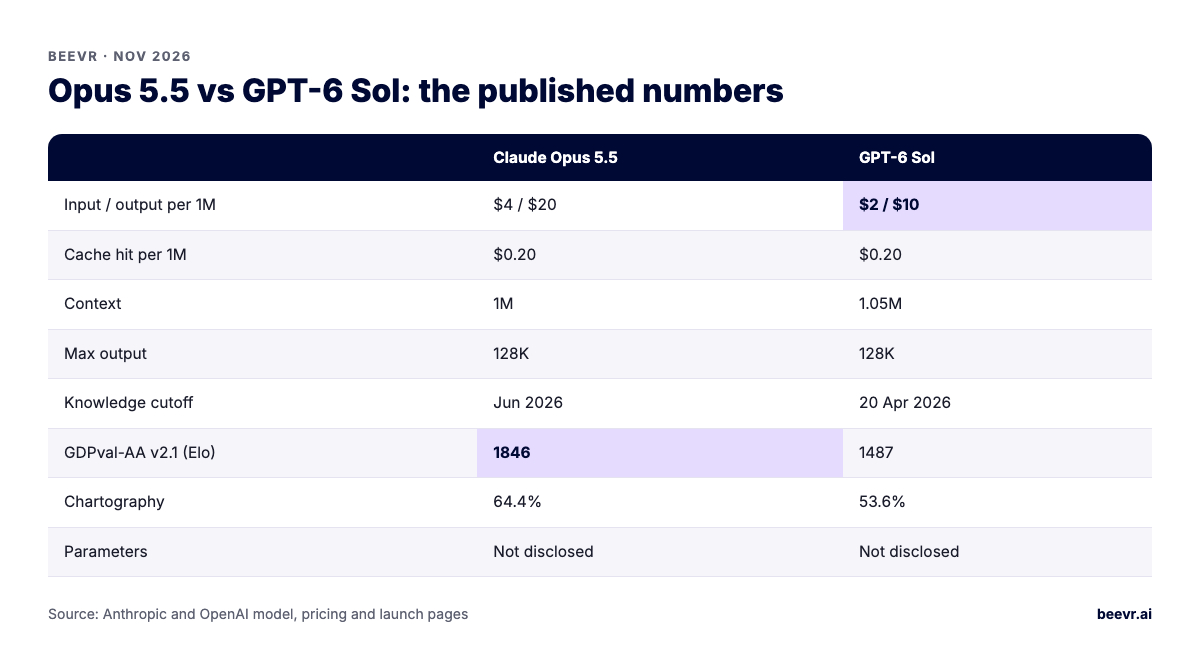
How do Claude Opus 5.5 and GPT-6 Sol compare on benchmarks?
The only direct comparison is on Anthropic's Claude Sonnet 5.5 launch page. Opus 5.5 leads GPT-6 Sol on all three shared rows: GDPval-AA v2.1 (1846 vs 1487 Elo), AA-Briefcase v1.1 (1822 vs 1483) and Chartography (64.4% vs 53.6%). OpenAI's GPT-6 Sol announcement has no benchmark numbers in text that we could compare.
Read these with two caveats. First, the comparison was run by Anthropic. Its Sonnet 5.5 page notes that GPT-6 Sol scores may not reflect the latest fixes (OpenAI fixed an image-encoding bug in GPT-6 Sol on 25 September). Second, Anthropic itself says on the Opus 5.5 page that benchmark margins have become a less reliable guide to real-world differences.
Where the two vendors do publish numbers
- Opus 5.5 vs OpenAI's top model: on Anthropic's page, Opus 5.5 scores 66.4% on Terminal-Bench 4.0 against 57.9% for GPT-6 Astra. Astra leads on AutomationBench (41.4% vs 40.0%) and Terminal-Bench-Science (64.6% vs 58.7%).
- GPT-6 Sol vs GPT-6.1 Sol: OpenAI's GPT-6.1 Sol system card shows the newer model ahead on SEC-Bench Pro (78.8% vs 66.3%), ExploitGym (35.1% vs 22.1%) and HealthBench (58.5 vs 53.2). It is slightly behind on coding deception rate (1.50% vs 1.30%; lower is better).
The honest summary is this: no neutral, same-harness benchmark of Opus 5.5 against GPT-6 Sol exists on either vendor's site. Your own eval set is the only comparison that counts.
How much do Claude Opus 5.5 and GPT-6 Sol cost per million tokens?
Claude Opus 5.5 costs $4 per million input tokens and $20 per million output tokens. GPT-6 Sol costs $2 and $10. Cache hits are $0.20 on both, and both offer a 50% batch discount. Above 272K input tokens, GPT-6 Sol doubles its input price and multiplies output by 1.5 for the whole request. Opus 5.5 keeps the same rate across its full 1M window.
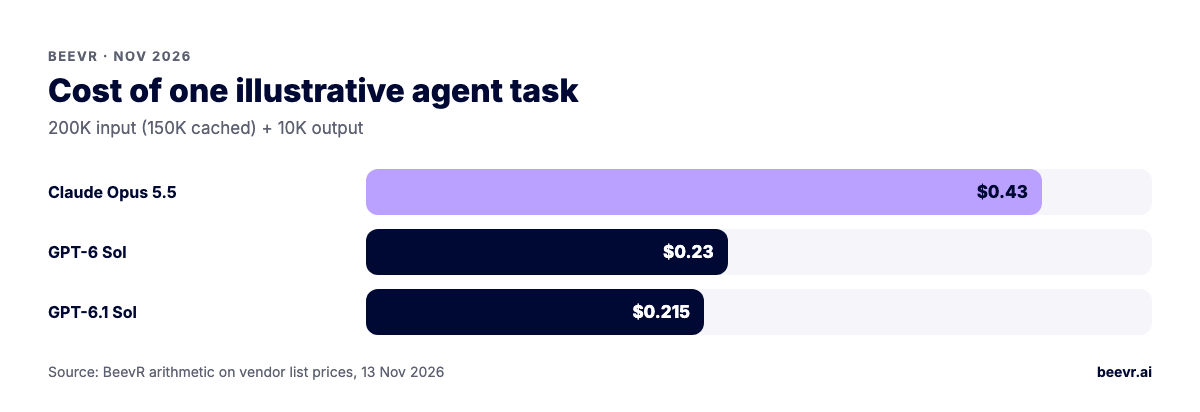
Per-token price is not per-task price. Here is an illustrative agent task: 200K input tokens across all turns, 150K of them served from cache, and 10K output tokens.
- Opus 5.5: 50K × $4 + 150K × $0.20 + 10K × $20 = $0.43 per task
- GPT-6 Sol: 50K × $2 + 150K × $0.20 + 10K × $10 = $0.23 per task
- GPT-6.1 Sol: 50K × $2 + 150K × $0.10 + 10K × $10 = $0.215 per task
Three things move this result in practice. The two vendors use different tokenizers, and Anthropic says its current tokenizer produces about 30% more tokens for the same text than its pre-4.7 one. Thinking tokens are billed as output on Claude. And a stronger model may finish in fewer turns: Anthropic says Opus 5.5 costs about 40% less than Opus 5 on typical workloads at default settings. Measure tokens per completed task on your own traffic. Our LLM API pricing comparison runs the same arithmetic across 11 models.
What is the context window of Claude Opus 5.5 and GPT-6 Sol?
Claude Opus 5.5 has a 1M-token context window and up to 128K output tokens. GPT-6 Sol has a 1,050,000-token context window with a 922K maximum input and 128K maximum output. In practice they are the same size. The difference is price: Opus 5.5 charges the same per token at 900K as at 9K, while GPT-6 Sol charges long-context rates above 272K.
On Claude's Message Batches API, Opus 5.5 can produce up to 300K output tokens with the output-300k-2026-03-24 beta header. A large window is not the same as good recall at the far end of it, so test retrieval at your real document sizes before you rely on it.
How many parameters does Claude Opus 5.5 have?
Anthropic has not disclosed it. The Opus 5.5 launch page, the models overview and the pricing documentation contain no parameter count, model size or architecture details. OpenAI does not publish parameter counts for GPT-6 Sol either. Any number you see for "Opus 5.5 parameters" is a third-party estimate, not a fact.
Closed frontier labs stopped publishing model size years ago. What they do publish is more useful when you are choosing a model:
- Limits: context window, max output, knowledge cutoff (June 2026 for Opus 5.5, April 2026 for GPT-6 Sol).
- Price and speed: per-token rates, cache and batch discounts, and relative latency. Anthropic rates Opus 5.5 "Moderate" and says it generates output more than 30% faster than Opus 5.
- Behaviour and safety: system cards with safety evaluations, such as OpenAI's Preparedness ratings and Anthropic's alignment results.
- Lifecycle: Anthropic commits not to retire Opus 5.5 before 22 September 2027.
Parameter counts do get published for open-weight models. For example, Mistral's changelog lists Z.ai's GLM 5.3 Flash as a 320B-parameter mixture-of-experts model with 18B active. Even there, active parameters say little about how a model performs on your task.
Is Claude Opus 5.5 a regression compared with Opus 5?
Not on Anthropic's published benchmarks: Opus 5.5 beats Opus 5 on every row of its launch table, for example 66.4% vs 52.3% on Terminal-Bench 4.0. Most of the "Opus 5.5 regression" reports trace back to API behaviour changes that break existing integrations, plus safety fallbacks on some requests.
Changes that look like regressions
- Lower default effort. Opus 5.5 defaults to
mediumeffort, where Opus 5 defaulted tohigh. If you never set effort, you get less reasoning per request. Set it explicitly. - Thinking cannot be turned off.
thinking: {"type": "disabled"}returns a 400 error. Code that readscontent[0].textcan break because responses may start with a thinking block. - Rejected parameters. Forced
tool_choice, non-default temperature/top_p/top_k and assistant prefill are rejected. - Safety fallbacks. Anthropic says some cybersecurity tasks in its benchmarks were completed by Opus 4.8, and some biology tasks by Opus 5, because production safeguards stepped in. If your workload touches those areas, some answers may come from an older model.
We cover each breaking change and an eval-driven migration plan in Claude Opus 5.5 and GPT-6 Sol migration: avoid regressions. If you see a real quality drop after fixing these, pin your eval set and compare effort levels before you blame the model.
What does "Sol" mean in OpenAI model names?
"Sol" is one tier in OpenAI's naming scheme, not a separate kind of LLM. Starting with GPT-5.6, OpenAI names models by capability and cost: Astra is the most capable (GPT-6 only), Sol is the strong general model for complex coding and agent work, Terra is the faster, cheaper middle, and Luna is the most efficient for high-volume tasks.
So "GPT-6 Sol" is the Sol tier of the GPT-6 generation, and "GPT-6.1 Sol" is its update. OpenAI's models page describes GPT-6.1 Sol as giving "near-Astra performance for complex work at lower cost". Its pricing page lists GPT-6 Astra at $10/$50, both Sol models at $2/$10, GPT-6.1 Terra at $1/$5 and GPT-6 Luna at $0.10/$0.50.
Should we use GPT-6 Sol or GPT-6.1 Sol?
For new work, GPT-6.1 Sol: same $2/$10 price, half the cache-hit price ($0.10), a later knowledge cutoff and better scores in OpenAI's own system card. Stay on GPT-6 Sol only if you rely on reasoning.effort: "none", which GPT-6.1 Sol does not support, or on function calling through Chat Completions at that effort level.
GPT-6 Sol is also the named replacement for gpt-5.1 and gpt-5.3-codex, which OpenAI removes on 1 April 2027, so it will stay around for a while. It has no announced shutdown date.
Which should we pick for a production AI agent?
Pick Opus 5.5 when task success is worth paying about twice as much per token: long multi-step agent runs, complex code changes, or work where a wrong answer costs more than the tokens. Pick GPT-6.1 Sol when volume is high, tasks are well scoped and your evals show the gap is small. Many production systems use both and route by task.
- Regulated data: check the data terms before the benchmarks. Both vendors offer BAAs and zero data retention under conditions. US-only inference costs 1.1x on Claude, and OpenAI adds 10% for regional processing. See LLM providers that sign a BAA.
- Coding agents: if you mainly need a developer tool rather than an API, compare the agent products, not only the models. See AI dev agent platforms in 2026.
- Smaller tiers: before choosing either flagship, test Sonnet 5.5 ($2/$10) and GPT-6.1 Terra ($1/$5). Our Claude lineup guide covers when the smaller model is enough.
How BeevR builds this
When clients ask us "Opus or Sol?", we answer with their data, not ours. We build an eval set from 200 to 500 real cases, run both models at two or three effort levels, and report pass rate, cost per completed task and p95 latency. Behind that sits a thin model interface, so the choice stays a config value and switching later is cheap. In regulated projects we also check retention, region and BAA terms per model before any test data leaves the client's environment. Where needed, the model runs inside the client's own AWS account under the AWS BAA.
We are a senior, founder-led team in Hanoi, working on fixed scope and fixed price from $10K per phase, with a working demo every Friday. You own the code and IP from day one. More on our AI agent development work.
Want a model comparison run on your own tasks? Book a 30-minute call.