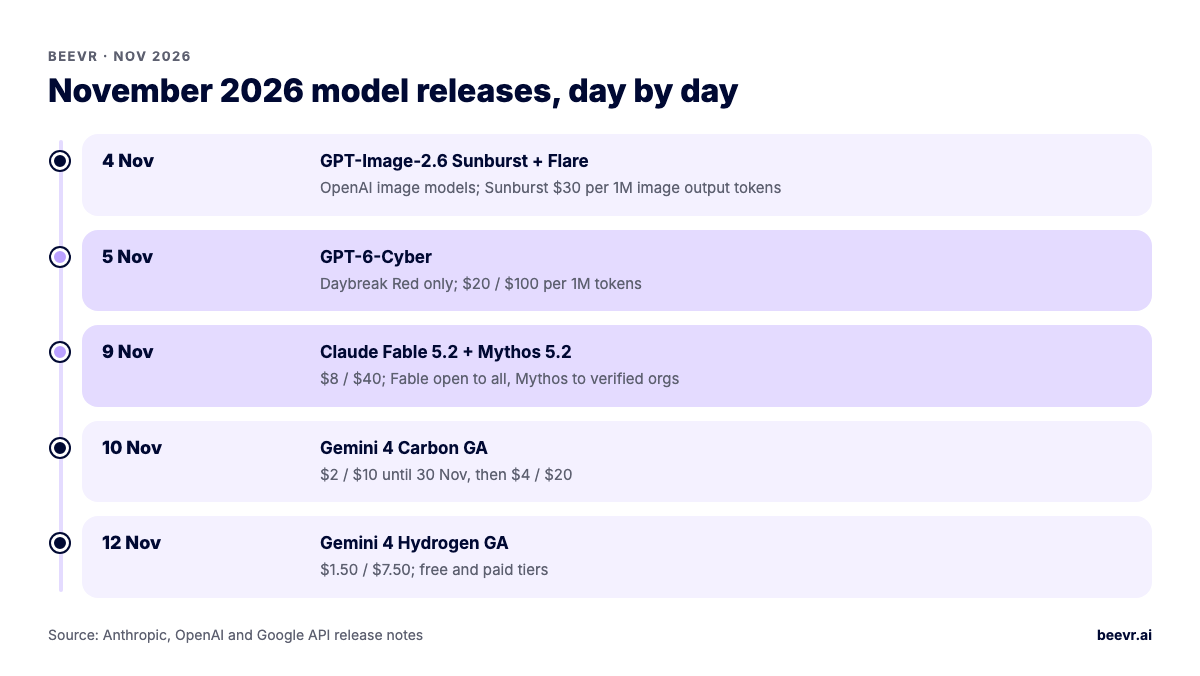
Between 1 and 13 November 2026, three vendors shipped models you can call by API: Anthropic released Claude Fable 5.2 and Mythos 5.2 (9 Nov, $8/$40 per million tokens), OpenAI released GPT-6-Cyber (5 Nov, approved security teams only), and Google made Gemini 4 Carbon (10 Nov) and Gemini 4 Hydrogen (12 Nov) generally available. Fable 5.2 is the one most teams can actually use today.
Updated 13 November 2026. This roundup lists only releases we could confirm on the vendor's own changelog, model page, pricing page or system card. Rumoured models, leaked codenames and aggregator claims are left out on purpose. We build production AI agents for clients, so each entry ends with the practical question: does this change what you should run in production?
Which new AI models were released in November 2026?
Five text or multimodal models reached developers in the first 13 days of November: Claude Fable 5.2, Claude Mythos 5.2, GPT-6-Cyber, Gemini 4 Carbon and Gemini 4 Hydrogen. OpenAI also shipped two image models (GPT-Image-2.6 Sunburst and Flare), and Google shipped a video model and a decision-making API.
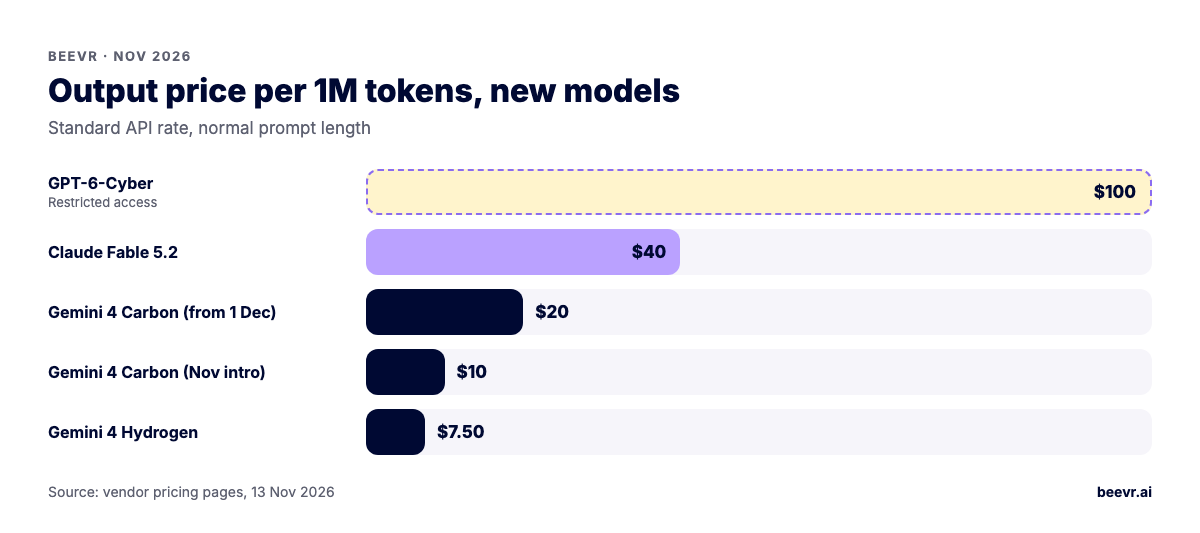
Prices below are standard per-million-token API rates (input / output) for prompts in the normal range, read from the vendors' pricing pages on 13 November 2026.
| Vendor | Model (API ID) | Date | Context | Price in / out | Who can use it |
|---|---|---|---|---|---|
| Anthropic | Claude Fable 5.2 (claude-fable-5-2) | 9 Nov | 1M in, 128K out | $8 / $40 | All API customers; also AWS, Google Cloud, Microsoft Foundry |
| Anthropic | Claude Mythos 5.2 (claude-mythos-5-2) | 9 Nov | 1M in, 128K out | $8 / $40 | Only organizations verified through Anthropic's verification programs |
| OpenAI | GPT-6-Cyber (gpt-6-cyber) | 5 Nov | 1.05M (922K max input), 128K out | $20 / $100 | Approved Daybreak Red organizations |
| OpenAI | GPT-Image-2.6 Sunburst and Flare | 4 Nov | Image model | Sunburst: $5 text in, $8 image in, $30 image out | All API customers (Images endpoints) |
Gemini 4 Carbon (gemini-4-carbon) | GA 10 Nov | 1M in | $2 / $10 until 30 Nov, then $4 / $20 | Paid Gemini API, Gemini for business, AI Ultra | |
Gemini 4 Hydrogen (gemini-4-hydrogen) | GA 12 Nov | 1M in | $1.50 / $7.50 | Free and paid Gemini API tiers | |
Gemini Decision 1 (gemini-decision-1) | 11 Nov | — | See pricing page | Gemini API (Decisions API) | |
| Gemini Omni 1.2 Flash (video) | 5 Nov | Up to 15 s video | See pricing page | Gemini API, GA |
Sources: Claude API release notes, OpenAI API changelog, Gemini API release notes and each vendor's pricing page.
What is Claude Fable 5.2, and should we switch to it?
Claude Fable 5.2 is Anthropic's most capable model open to all customers, built for demanding reasoning and long-horizon agentic work, and it costs 20% less than Fable 5.1 ($8/$40 versus $10/$50). Most teams should not switch by default: Anthropic itself says to start with Claude Opus 5.5 and move to Fable 5.2 only when evals at higher effort still fall short.
On Anthropic's launch page, Fable 5.2 scores 69.9% on FrontierSWE v2 (Opus 5.5: 62.3%, GPT-6 Astra: 65.5%, Gemini 4 Carbon: 61.2%) and 74.6% on Terminal-Bench-Science 0.1 (Opus 5.5: 58.7%). It does not win every row: Gemini 4 Carbon leads AutomationBench at 53.9% against Fable's 51.4%. These are vendor-run numbers at each vendor's chosen effort level.
The engineering catches
- History edits now fail. If your code changes the system prompt, tools or an earlier message mid-conversation, Fable 5.2 returns a 400 error ("The block is bound to a different conversation"). Agent frameworks that trim or rewrite history need testing before you switch.
- Model routers lose reasoning. Only Fable 5.2 and Mythos 5.2 can read Fable 5.2 thinking blocks. A router that moves a conversation to Opus 5.5 drops that reasoning.
- No zero data retention by default. According to Anthropic's docs, Fable 5.2 and Mythos 5.2 require 30-day data retention unless Anthropic expressly authorizes otherwise. For teams handling PHI or financial data under ZDR terms, that alone can rule it out.
What is the difference between Claude Fable 5.2 and Claude Mythos 5.2?
They are the same underlying model with different safeguards. Fable 5.2 carries strong cybersecurity and biology safeguards and is open to everyone. Mythos 5.2 has fewer of those safeguards and is limited to vetted organizations through Anthropic's Cyber and Life Sciences Verification Programs.
Anthropic reports Mythos 5.2 at 89.6% on CVE Rediscovery, against 81.3% for Opus 5.5 without safeguards. For everyone else, the useful detail is that Fable 5.2's classifiers block about 55% fewer requests than Fable 5.1's did. That cuts false refusals on legitimate security and biomedical work.
What is GPT-6-Cyber, and can any developer use it?
No. GPT-6-Cyber is a cybersecurity variant of GPT-6 Astra for authorized vulnerability research, exploit development and fix verification. OpenAI's model page says your organization needs Daybreak Red access and approval before it can call it.
OpenAI's system card rates it Critical in cybersecurity under its Preparedness Framework and reports 48.45% on ExploitGym, against 42.43% for GPT-6 Astra. It is the most expensive model on this list at $20/$100 per million tokens, and it does not support the Batch API. We cover access rules and the trade-offs in GPT-6 Cyber explained.
What are Gemini 4 Carbon and Gemini 4 Hydrogen?
Gemini 4 Carbon is Google's strongest reasoning model, aimed at complex software engineering, multimodal knowledge work, science and cyber defense. Gemini 4 Hydrogen is the faster, cheaper Gemini 4 model for everyday coding and agent workflows. Both have a 1M-token input window.
Carbon was announced on 28 October and became generally available in the API on 10 November. Google's availability post sets introductory pricing of $2/$10 through 30 November and $4/$20 after that. The Gemini pricing page says Gemini 4 Argon doubles on the same date, 1 December. If you are load-testing Carbon this month, budget on the December price, not the November one.
Hydrogen went GA on 12 November on both free and paid tiers at $1.50/$7.50. Google's release notes say it adds an xhigh thinking level and is now the default model for the Antigravity agent. We found no blog.google launch post for Hydrogen at the time of writing, so treat the docs as the source of truth.
Which AI models were released in late October 2026?
The second half of October matters because several of these models are what November releases are compared against. Confirmed on vendor pages:
- Claude Haiku 5.5 (7 Oct): $0.10/$0.50 for prompts up to 100K tokens, 1M context.
- Mistral Large 4 (6 Oct, public preview): a multimodal mixture-of-experts model with a 1M context window, according to Mistral's changelog.
- Gemini 4 Argon (GA 13 Oct): $2/$10, doubling on 1 December.
- GPT-6.1 Terra (26 Oct): a fast model for visual reasoning and computer use at $1/$5.
- GPT-6 Rosalind (30 Oct): a life-sciences model, limited to organizations approved through OpenAI's trusted-access program.
We could not confirm a new November model from Meta, xAI, Mistral or DeepSeek on their own changelogs or blogs, so none appears in the table. Mistral's most recent changelog entry is 22 October.
Which model deprecations and price changes are coming in December 2026?
Several deadlines land within the next four weeks. They matter more to a production system than any new launch. The biggest are Claude Sonnet 4.5 retiring on 30 November and Gemini 4 Carbon and Argon prices doubling on 1 December.
- 30 Nov:
claude-sonnet-4-5-20250929retires on the Claude API (move to Sonnet 5.5). Fast mode for Opus 4.8 is removed. OpenAI's Evals platform, Agent Builder and reusable prompts (v1/prompts) shut down (OpenAI deprecations). - 1 Dec: Gemini 4 Carbon and Argon prices double.
gemini-2.5-proroutes to Gemini 3.8 Flash andgemini-2.5-flashto Gemini 3.5 Flash-Lite. Older GPT Image models (gpt-image-1.5,gpt-image-1-mini) are removed. - 11 Dec: OpenAI removes the
gpt-5-2025-08-07family ando3snapshots. - 1 Jan 2027: Gemini 3.8 Flash and 3.6 Flash prices double.
Routing changes like Gemini 2.5's are silent upgrades: your requests keep working, but on a different model. Our LLM model migration guide covers how to catch regressions before a forced switch.
Should we change our production model after the November 2026 releases?
For most teams, no. If you are on Claude Opus 5.5, GPT-6.1 Sol or Gemini 4 Argon, the November releases do not justify a switch without your own evals. The exceptions: try Fable 5.2 for long-horizon agent work that already fails at high effort, and re-price anything on Gemini 4 before 1 December.
A practical decision rule we use with clients:
- Run your own eval set first. 200 to 500 real cases from production logs beat any vendor benchmark. See how to test LLMs in regulated industries.
- Price the task, not the token. A model that costs twice as much per token but finishes in half the turns can be cheaper. We show the arithmetic in LLM API pricing compared (November 2026).
- Check data terms before benchmarks. Retention rules (Fable 5.2's 30-day retention), regional processing uplifts and BAA coverage decide more healthcare and fintech choices than a 3-point benchmark gap. Our list of LLM providers that sign a BAA is a good starting point.
- Keep the model behind an interface. If changing models takes more than a config change plus an eval run, that is the first thing to fix.
If you are choosing inside the Claude family, our Claude model lineup guide maps Fable, Opus, Sonnet and Haiku to workloads. For the most-searched head-to-head, see Claude Opus 5.5 vs GPT-6 Sol.
How BeevR builds this
We build AI agents for production, often in healthcare and fintech, so model releases reach us as engineering work: a provider-neutral model layer, an eval suite built from the client's real cases, and cost and latency tracking per task. When a model like Fable 5.2 ships, we can run it against a client's eval set in a day and show the quality, cost and latency difference before anyone changes production. We prefer to keep the model behind a small interface because, as this month shows, prices and lineups change every few weeks.
BeevR is a senior, founder-led team in Hanoi. We work on fixed scope and fixed price, from $10K per phase, and you get a working demo every Friday. You own the source code and IP from day one. See how we approach AI agent development.
Not sure which of this month's models fits your workload? Book a 30-minute call and we will look at your use case and tell you whether a switch is worth it.