Use Gemini 4 Hydrogen ($1.50/$7.50 per million tokens) as the default for coding and agent work. Move hard planning or multi-hour background runs to Gemini 4 Carbon, which doubles to $4/$20 on 1 December 2026. Gemini 4 Argon is still available, but Google's current guide points interactive hard work to the newer Neon ($3/$15).
Updated 24 November 2026. Google shipped four Gemini 4 models in five weeks: Argon on 13 October, Carbon on 10 November, Hydrogen on 12 November and Neon on 18 November. The names say nothing about rank, prices are about to change, and Google's own guidance shifted along the way. This guide uses only Google's documentation, pricing page, changelog and official blog posts to explain what each model is for, what it will cost after 1 December, and how to pick one.
What is the difference between Gemini 4 Carbon and Gemini 4 Hydrogen?
Carbon is Google's strongest reasoning model, built for long-horizon asynchronous work and deep verification. Hydrogen is the fast, cheaper model for everyday coding and agentic workflows. Both have a 1M-token context window and the same tool set, but Carbon costs more and thinks longer.
Google's choosing-a-model guide (read 24 November 2026) puts it plainly. Hydrogen is "fast and cost-efficient for everyday coding and agentic workflows". Carbon is "built for long-horizon asynchronous work and deep verification", with multi-hour background runs, deep research and security audits as examples. The Hydrogen launch post frames it the same way: Carbon and Argon for "deep, long-horizon reasoning on your hardest problems", Hydrogen for "rapid execution across diverse agentic workflows".
Which Gemini 4 models are available in November 2026?
Four, all stable and none deprecated: Gemini 4 Argon, Carbon, Hydrogen and Neon. Each takes text, image, video, audio and PDF input, returns text, and has a 1,048,576-token context window shared between input and output.
| Hydrogen | Neon | Carbon | Argon | |
|---|---|---|---|---|
| Model ID | gemini-4-hydrogen | gemini-4-neon | gemini-4-carbon | gemini-4-argon |
| Release (GA) | 12 Nov 2026 | 18 Nov 2026 | 10 Nov 2026 | 13 Oct 2026 |
| Google's description | Everyday coding and agentic work | Complex, interactive engineering and knowledge work | Long-horizon async work, deep verification | Efficient frontier reasoning; fewer tokens per turn than Carbon |
| Price per 1M (in / out), now | $1.50 / $7.50 | $3 / $15 | $2 / $10 | $2 / $10 |
| Price from 1 Dec 2026 | $1.50 / $7.50 | $3 / $15 | $4 / $20 | $4 / $20 |
| Free tier | Yes | No | No | No |
| Thinking levels | low, medium, high, xhigh | low, medium, high, xhigh | low, medium, high | low, medium, high |
| Default thinking | high | high | medium | Not stated in guide |
| Speed (Google) | Fast | Moderate | Deliberate | Faster than Carbon |
| Context / max output | 1,048,576 / 65,536 by default, up to 1,048,576 with long decode | |||
Sources: Gemini API pricing, models page and per-model pages, changelog and deprecations page, all read 24 November 2026. The old ai.google.dev/gemini-api/docs URLs now redirect to these AI Studio pages.
How much will Gemini 4 Carbon cost after 1 December 2026?
From 1 December 2026, Gemini 4 Carbon costs $4 per million input tokens and $20 per million output tokens, double the introductory $2/$10. Cached input goes from $0.10 to $0.20, and Batch and Flex rise from $1/$5 to $2/$10. Gemini 4 Argon gets exactly the same increase on the same day.
Google announced the introductory price in the Carbon launch post on 10 November: $2/$10 "through November 30", then $4/$20. The pricing page lists the full schedule:
| Carbon and Argon, per 1M tokens | Until 30 Nov 2026 | From 1 Dec 2026 |
|---|---|---|
| Standard input / output | $2.00 / $10.00 | $4.00 / $20.00 |
| Cached input | $0.10 | $0.20 |
| Batch and Flex input / output | $1.00 / $5.00 | $2.00 / $10.00 |
| Priority input / output | $3.60 / $18.00 | $7.20 / $36.00 |
Output prices include thinking tokens. Hydrogen and Neon have no scheduled change. One more date to watch: Gemini 3.8 Flash doubles from $0.75/$3.75 to $1.50/$7.50 on 1 January 2027, the same price as Hydrogen today.
What it means for a real workload
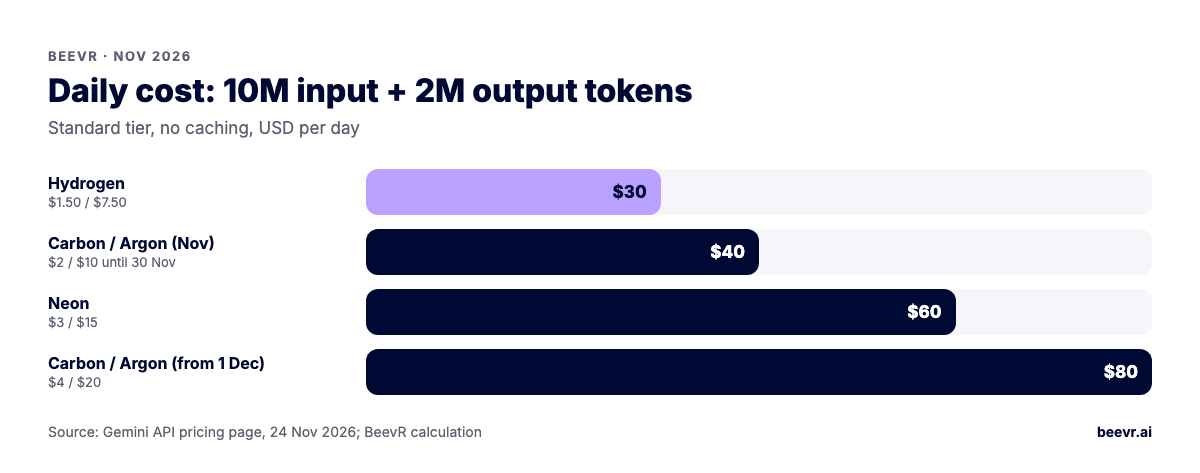
Take an agent that sends 10 million input tokens and receives 2 million output tokens a day, with no caching. On Carbon that is $40 a day in November and $80 a day from December. On Neon it is $60, and on Hydrogen $30. After 1 December, Argon and Carbon become the most expensive Gemini 4 models per token, more than Neon.
Is Gemini 4 Argon still worth using?
Only if your evals show it beats Hydrogen or Neon on your task. Argon is not deprecated, but from 1 December it costs $4/$20, more than Neon at $3/$15, and Google's current choosing-a-model guide no longer lists it among the recommended options.
The guidance moved fast. On 10 November, the Carbon post said "Argon remains the ideal choice for the majority of software engineering and knowledge work." By 24 November, the guide recommends Hydrogen as the default, Neon for complex interactive engineering, and Carbon for the hardest long-horizon work, with no mention of Argon. The Hydrogen launch post also reports that Hydrogen scores 51 on the Artificial Analysis Intelligence Index at high thinking, against 50 for Argon, at a lower price.
If you already run Argon in production, it keeps working: the deprecations page lists "No shutdown date announced". Budget for the 1 December price increase, then test Hydrogen and Neon against it.
Where does Gemini 4 Neon fit between Carbon and Hydrogen?
Neon sits in the middle: it is for complex, interactive software engineering, dense knowledge work and science, where a person is waiting on the answer. Google says Neon at its default high setting costs 32% less per task than Carbon, at $3/$15 per million tokens.
The Neon launch post (18 November) reports, among others, 61 on the Artificial Analysis Intelligence Index at xhigh, 65.2% on Terminal-Bench 4.1 and 56.3% on Zapier AutomationBench. For comparison, Google reports Hydrogen at 57% on Terminal-Bench 4.1. These are vendor-reported numbers; treat them as a shortlist, not a decision. The guide suggests escalating from Neon to Carbon when Neon at high or xhigh gets stuck.
Which Gemini 4 model should I use for coding agents?
Start with Hydrogen for most coding and agent steps, and pair it with Neon or Carbon for hard planning. Google recommends exactly this split: Carbon or Neon plans on the first turn, then Hydrogen implements, chained with previous_interaction_id.
Google's own data supports the mix. In Google Antigravity, an Orchestrator that switches between Carbon and Hydrogen in one session reached near-Carbon task success on Terminal-Bench 4.0 while using about 24% less quota and finishing about 19% faster on average, according to the Hydrogen post. Hydrogen is also now the default model for the Antigravity agent in Gemini Managed Agents (changelog, 12 November).
A simple routing rule
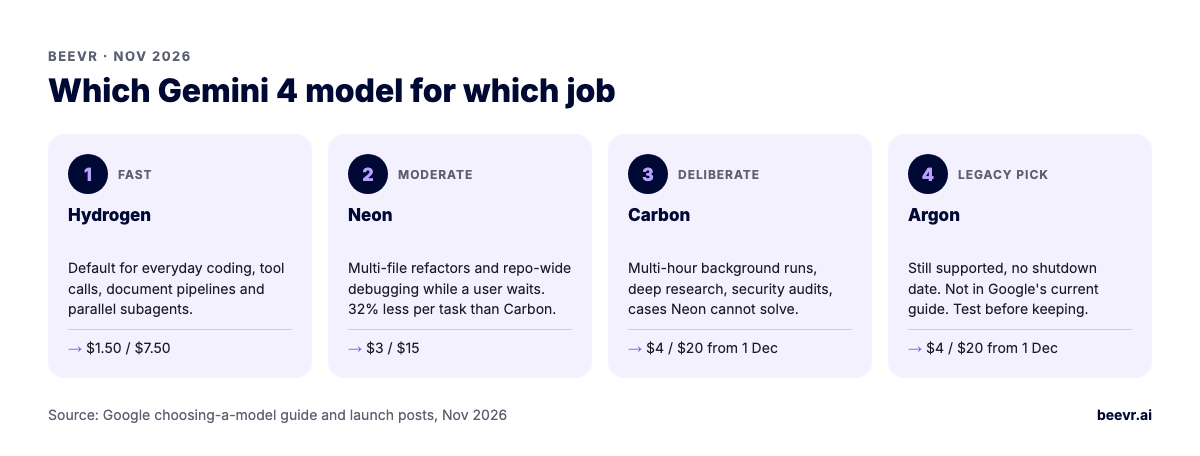
- Hydrogen: routine edits, tool calls, document pipelines, parallel subagents.
- Neon: multi-file refactors and repo-wide debugging with a user waiting.
- Carbon: overnight runs, deep research, security audits, and the cases Neon fails.
- Gemini 3.5 Flash-Lite ($0.30/$2.50): high-volume translation, summarisation and extraction.
Do Gemini 4 models support caching, batch and long outputs?
Yes, with one catch: caching is implicit only. Explicit context caching is not supported on any Gemini 4 model. Implicit caching gives a 95% discount on cached input for prompts of 4,096 tokens or more, and Batch or Flex cuts 50% for non-urgent work.
All four models support function calling, code execution, Google Search and Maps grounding, URL context, file search, structured outputs, computer use and the Batch API. None support the Live API, audio generation or image generation. Default synchronous output is 65,536 tokens; long decode raises it to 1,048,576. Google advises setting max_output_tokens to at least 65,536 during evals so answers are not cut off.
Search grounding has its own bill: 5,000 free search requests a month, shared across Gemini 3 and newer models, then $14 per 1,000. For agents that search on every turn, this can cost more than the tokens.
Is Gemini 4 Hydrogen free to use?
Yes, on the Gemini API free tier, with rate limits. It is the only Gemini 4 model with a free tier; Carbon, Argon and Neon are paid only. On the free tier, Google marks Hydrogen data as "used to improve our products"; on the paid tier it is not.
That matters for anything with customer or patient data. Do not send personal, financial or health data through the free tier. Use the paid tier, and for regulated data check your agreement with Google before you send anything. Our guide to LLM providers that sign a BAA covers the healthcare side.
What else changes on 1 December 2026 for Gemini API users?
Gemini 2.5 Pro and 2.5 Flash are deprecated, and from 1 December their requests route automatically: 2.5 Pro to gemini-3.8-flash, 2.5 Flash to gemini-3.5-flash-lite, billed at the new model's rates. If you still call 2.5 models, your outputs and costs will change that day without a code change.
Google's migration advice: move 2.5 Pro to Hydrogen, or Carbon for the hardest problems; 3.8 Flash and older Flash models to Hydrogen; 3.1 Pro Preview to Neon or Carbon. Run your evals before 1 December, not after. Our LLM model migration guide covers the checklist we use when swapping models.
How do Gemini 4 models compare with Claude and GPT?
On list price, Hydrogen ($1.50/$7.50) is cheaper than Claude Sonnet 5.5 ($2/$10), and Carbon after 1 December ($4/$20) matches Claude Opus 5.5 ($4/$20). Benchmarks are mixed and mostly vendor-reported, so compare on your own tasks.
Anthropic's own Fable 5.2 table shows Gemini 4 Carbon leading on Zapier AutomationBench, 53.9% against 51.4% for Fable 5.2, while Fable 5.2 leads on FrontierSWE v2. For full price tables, see our LLM API pricing comparison; for Claude, our Claude model lineup guide; and for everything released this month, our November 2026 model releases roundup.
How BeevR builds this
We build agents so the model is a per-step setting, not a hard-coded choice. A typical setup routes planning to a stronger model and execution to a faster one, with an eval set for each step and a cost budget per task. When prices change, as they do for Carbon and Argon on 1 December, we re-run the evals and move steps to whichever model now gives the lowest cost per passed task. We also track search-grounding and caching costs separately, because on agent workloads they often matter more than the headline token price.
BeevR is a senior, founder-led team in Hanoi, rated 5.0 on Clutch. We work on fixed scope and fixed price, from $10K per phase, with a working demo every Friday, and you own the code and IP from day one. See our AI agent development work.
Planning a move to Gemini 4 before the 1 December price change? Book a 30-minute call.