From 13 to 24 November 2026, the biggest model releases were OpenAI's GPT-6.2 Astra and GPT-6.2 Sol (17 Nov, $8/$40 and $2/$10 per million tokens), Google's Gemini 4 Neon (18 Nov, $3/$15), Alibaba's Qwen4-Max (16 Nov) and Microsoft's MAI Code 2 (17 Nov). The main open-weight releases were Inkling 2 Mini (20 Nov) and Sarvam-105B-1711 (22 Nov).
Updated 24 November 2026. This is our running log of AI model releases in November 2026, with a section for each day and one summary table for the whole month. It lists only releases we could confirm on the vendor's own changelog, model page, pricing page, press release or model card. Rumoured models, leaked codenames and aggregator claims are left out on purpose. We build production AI agents for clients, so we also answer the practical question: does any of this change what you should run in production?
Which new AI models were released in November 2026?
Between 1 and 24 November 2026 we confirmed 27 model releases from 13 vendors: frontier LLMs (Claude Fable 5.2, GPT-6.2 Astra and Sol, Gemini 4 Carbon, Hydrogen and Neon, Qwen4-Max), coding models (MAI Code 2), open-weight models (Inkling 2 Mini, SenseNova Loop-9B, Sarvam-105B-1711) and image, video, world and voice models.
Prices are standard API rates per million tokens (input / output) for normal-length prompts, read from each vendor's page on the date shown. "Open" means the vendor published downloadable weights. "Restricted" means you need approval first.
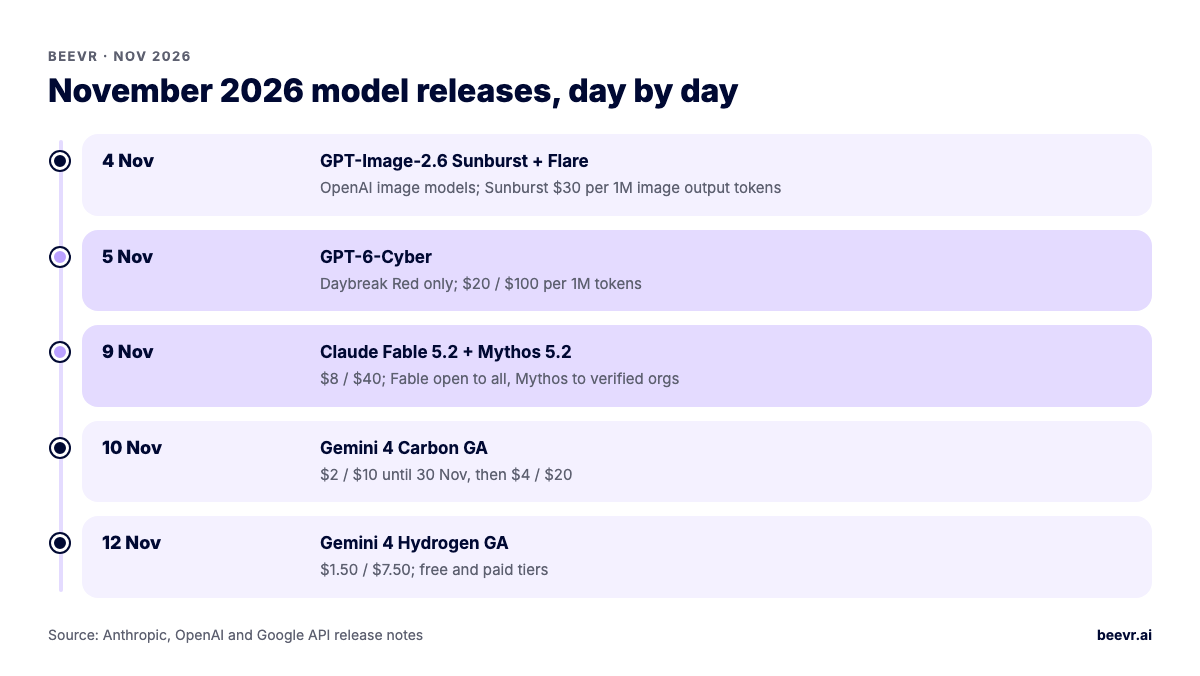
| Date | Vendor | Model | Type | Open / closed | Price (in / out) | Source |
|---|---|---|---|---|---|---|
| 4 Nov | OpenAI | GPT-Image-2.6 Sunburst and Flare | Image | Closed | Sunburst: $5 text in, $30 image out | changelog |
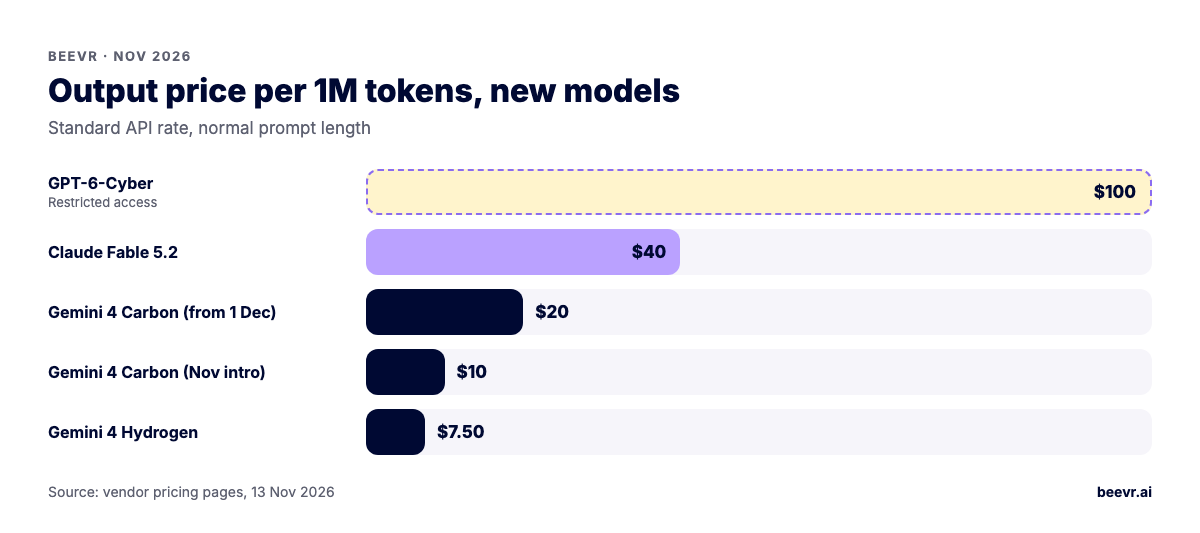
| 5 Nov | OpenAI | GPT-6-Cyber | LLM (security) | Closed, restricted | $20 / $100 | model page |
| 5 Nov | Gemini Omni 1.2 Flash | Video | Closed | See pricing page | release notes | |
| 9 Nov | Anthropic | Claude Fable 5.2 | LLM | Closed | $8 / $40 | release notes |
| 9 Nov | Anthropic | Claude Mythos 5.2 | LLM | Closed, restricted | $8 / $40 | release notes |
| 10 Nov | Gemini 4 Carbon (GA) | LLM | Closed | $2 / $10 to 30 Nov, then $4 / $20 | pricing | |
| 11 Nov | Gemini Decision 1 | Decision model | Closed | See pricing page | release notes | |
| 12 Nov | Gemini 4 Hydrogen (GA) | LLM | Closed | $1.50 / $7.50 (free tier too) | pricing | |
| 16 Nov | Alibaba | Qwen4-Max | LLM (multimodal) | Closed (API only) | See QwenCloud pricing | press release |
| 16 Nov | OpenAI | omni-moderation-csam-latest | Image classifier | Closed, restricted | Free for approved orgs | changelog |
| 17 Nov | OpenAI | GPT-6.2 Astra | LLM | Closed | $8 / $40 | model page |
| 17 Nov | OpenAI | GPT-6.2 Sol | LLM | Closed | $2 / $10 | model page |
| 17 Nov | Microsoft | MAI Code 2 and MAI Code 2 Flash | Coding LLM | Closed | Usage-based in GitHub Copilot | announcement |
| 17 Nov | Microsoft | MAI Image 2.7 and 2.7 Flash (preview) | Image | Closed | About $35 and $10 per 1,000 images | announcement |
| 17 Nov | Microsoft | MAI Realtime 1 (limited preview) | Voice (speech-to-speech) | Closed, restricted | From $0.01 per audio minute, plus $1 / $5 reasoning | announcement |
| 17 Nov | Tencent | Hy4 flash | LLM (multimodal) | Closed (open release planned) | About $0.070 / $0.281 | press release |
| 17 Nov | SenseTime | SenseNova Loop-9B | Multimodal LLM | Open weights | Free download | announcement |
| 18 Nov | Gemini 4 Neon (GA) | LLM | Closed | $3 / $15 | announcement | |
| 18 Nov | AssemblyAI | STT-3.7, 3.7-Realtime, 3.7-Realtime-Agent | Speech-to-text | Closed | $0.21 to $0.45 per hour | announcement |
| 18 Nov | Reson8 | Rumble-2-Flash (0.5B) | Speech-to-text | Open (Apache 2.0) | Free download | model blog |
| 19 Nov | Genie 4 (GA in Gemini API) | World / video model | Closed | $1.50 in, $9 text out, $17.50 video out | release notes | |
| 19 Nov | OpenAI | GPT-Live-1.1 | Voice | Closed | Not listed in changelog | changelog |
| 20 Nov | Thinking Machines Lab | Inkling 2 Mini (26.4B) | LLM | Open weights | Free download; hosted on Tinker | announcement |
| 20 Nov | Baseten | bison-1 and groundhog-1 | Decision models | Open weights | $0.10 and $0.035 per 1M tokens | announcement |
| 20 Nov | AMD | Nitro-P (679M) | Image | Open weights | Free download | ROCm blog |
| 22 Nov | Sarvam AI | Sarvam-105B-1711 | LLM | Open weights | Sarvam API pricing | announcement |
| 23 Nov | Alibaba | qwen-audio-3.1-live | Voice (realtime) | Closed | Not given | Model Studio |
AI model releases on November 13, 14 and 15, 2026
We found no new model launch confirmed on a vendor page for 13, 14 or 15 November. The news on those days was about access to models released earlier: Gemini 4 Hydrogen reached GitHub Copilot on 13 November, and DeepSeek added web search, file input, speech and safety APIs around its existing deepseek-flash model on 13 November, according to its API updates page.
AI model releases on November 16, 2026
Alibaba released Qwen4-Max, which it calls the most capable Qwen model so far. Its press release gives 2.4 trillion total parameters with about 71 billion active per token. Qwen4-Max is available only through QwenCloud's API and Token Plan, not as downloadable weights. Alibaba says smaller open-weight Qwen4 models will follow, without a date.
OpenAI also added omni-moderation-csam-latest, a free image classifier for approved organizations that helps prioritise suspected child sexual abuse material for human review.
AI model releases on November 17, 2026
17 November was the busiest day of the month. OpenAI shipped GPT-6.2 Astra and GPT-6.2 Sol, Microsoft announced five MAI models at Ignite, Tencent launched Hy4 flash and SenseTime published open weights for SenseNova Loop-9B.
- GPT-6.2 Astra and GPT-6.2 Sol (OpenAI). Both are in the API, ChatGPT and Codex from launch day. Details are in the next section.
- MAI Code 2 and MAI Code 2 Flash (Microsoft). Coding models for multi-file work and high-volume edits. Both are in GitHub Copilot, and Flash is in limited preview in Microsoft Foundry. Microsoft's announcement says MAI Code 2 reaches 98% of GPT-6.1 Sol's average score on four coding benchmarks, at about 40% of its price (a 50% promotional price). These are Microsoft's own numbers.
- MAI Image 2.7 and 2.7 Flash (Microsoft). Image generation and editing models in public preview on Foundry, at about $35 and $10 per 1,000 images.
- MAI Realtime 1 (Microsoft). Microsoft's first speech-to-speech model for voice agents, compatible with the OpenAI Realtime API. It is in limited-access preview. Base usage starts at $0.01 per audio minute.
- MAI Cyber 2 Flash (Microsoft). Announced only. It is a security model with a 1M-token context that goes into Microsoft security products from mid-December, not a general API.
- Hy4 flash (Tencent). A 224B-parameter mixture-of-experts model with 12B active parameters and up to 1M tokens of context, priced at about $0.070 input and $0.281 output per million tokens. Tencent says it plans to open-source it, but the weights were not out at launch.
- SenseNova Loop-9B (SenseTime). An open-weight 9B multimodal model with up to 512K tokens of context. Its official 4-bit weights are about 4.9 GB.
What are GPT-6.2 Astra and GPT-6.2 Sol?
GPT-6.2 Astra is OpenAI's new most capable model, at $8/$40 per million tokens, 20% cheaper than GPT-6 Astra. GPT-6.2 Sol is the everyday model for coding and agents, at the same $2/$10 as GPT-6.1 Sol. Both have a 1.05M-token context (922K max input) and 128K max output.
From the launch post and model pages:
- Knowledge cutoff: 18 May 2026 for Astra and 1 June 2026 for Sol.
- Cache: cached input is $0.40 on Astra (60% lower than GPT-6 Astra) and $0.10 on Sol.
- Long prompts: above 272K input tokens, input doubles and output costs 1.5x for the whole request.
- API changes: both reject
reasoning.effort: "none". Tool calling needs the Responses API, according to the changelog, even though Chat Completions is supported for plain requests. - Safety rating: OpenAI rates both models Critical for cybersecurity under its Preparedness Framework and ships them with stricter cyber safeguards, which limit some legitimate security research.
OpenAI's benchmark claims are vendor-run. One example: on FrontierCode 2.0 at max effort, Sol is within 0.5 points of Astra at about one-fifth of the cost. OpenAI's models page now lists GPT-6.2 Astra, GPT-6.2 Sol, GPT-6.1 Terra and GPT-6 Luna as the current lineup. On 17 November OpenAI also opened two-hour and eight-hour background windows in the Responses API, at 30% and 40% below standard rates. We compare Sol with Claude in Claude Opus 5.5 vs GPT-6 Sol.
AI model releases on November 18, 2026
Google made Gemini 4 Neon generally available, AssemblyAI released its STT-3.7 speech-to-text family and Reson8 open-sourced Rumble-2-Flash, a 0.5B speech recognition model for more than 40 languages under Apache 2.0.
AssemblyAI's three models cost $0.21 per hour for recorded audio, $0.30 for realtime and $0.45 for the voice-agent variant. They replace AssemblyAI's Universal models, and Universal-3.5 Pro Realtime retires on 1 February 2027.
What is Gemini 4 Neon?
Gemini 4 Neon is Google's mid-tier Gemini 4 model for complex coding, analysis and enterprise workflows. It sits between Carbon (hardest long-horizon work) and Hydrogen (fast everyday tasks). It costs $3/$15 per million tokens and has a 1M-token context.
Google's announcement says Neon costs about 32% less per task than Carbon at its default high thinking level. It reports 65.2% on Terminal-Bench 4.1 and 90.5% on SEC-bench Pro, both vendor-run. Neon is in the paid Gemini API, Gemini for business, Antigravity, GitHub Copilot and the Gemini app for AI Pro and Ultra subscribers. Note the price order: from 1 December, Carbon ($4/$20) costs more per token than Neon ($3/$15), and Neon costs more than Carbon does in November ($2/$10).
AI model releases on November 19, 2026
Google made Genie 4, its world model that generates interactive video with audio, generally available in the Gemini API's Interactions API on the paid tier. It costs $1.50 per million input tokens, $9 per million text output tokens and $17.50 per million video output tokens, which Google estimates at about $0.10 per second of video. Genie 4 was first shown as a research preview on 27 October.
OpenAI released GPT-Live-1.1 for its Live API. It improves pronunciation, accent consistency and transcription in multilingual voice conversations, and adds a standby mode that pauses inference when nobody is speaking.
AI model releases on November 20, 2026
20 November was the main day for open-weight releases: Thinking Machines Lab's Inkling 2 Mini, Baseten's bison-1 and groundhog-1, and AMD's Nitro-P image model.
- Inkling 2 Mini (Thinking Machines Lab). A 26.4B-parameter looped transformer that runs its middle layers three times per token. The announcement says it is small enough to run on a laptop (Ollama on Macs with at least 32 GB of RAM) and supports vLLM and SGLang. The page gives two different active-parameter figures (3.4B and 5.4B) and no license name, so check the model card.
- bison-1 and groundhog-1 (Baseten). Decision models built on Google's Gemma 4: bison-1 has 31B parameters, groundhog-1 is a 26B mixture-of-experts with about 4B active. Weights are on Hugging Face, and hosted prices are $0.10 and $0.035 per million tokens.
- Nitro-P (AMD). A 679M-parameter text-to-image model that works directly on pixels instead of a VAE latent space. AMD published weights and full training code.
AI model releases on November 21 to 24, 2026
Only two confirmed releases landed in these four days. On 22 November, Sarvam AI published Sarvam-105B-1711, a new open-weight checkpoint of its 105B model aimed at customer support and voice agents, with a 65 GB NVFP4 version that runs on one workstation GPU. On 23 November, Alibaba added qwen-audio-3.1-live to Model Studio, a realtime voice model that keeps talking to the user while a background model works on a task.
We found no confirmed model launch on 21 or 24 November as of this update. Z.ai's GLM-5.4 and a "Kimi K3.1 Pro Prime" appear on some trackers, but we could not confirm either on the vendor's own pages, so they are not in the table.
Which open-source AI models were released in November 2026?
Seven open-weight releases in the 13 to 24 November window are confirmed on vendor pages: Inkling 2 Mini, SenseNova Loop-9B, Sarvam-105B-1711, bison-1, groundhog-1, Rumble-2-Flash and Nitro-P. None of the frontier labs (Anthropic, OpenAI, Google) released open weights this month.
Two caveats before you build on them. First, "open weights" is not the same as an open-source license: only Rumble-2-Flash names one (Apache 2.0) on its launch page, so read each model card's license before commercial use. Second, the big Chinese releases this month, Qwen4-Max and Hy4 flash, are API-only for now, with open versions only promised. For coding work specifically, our guide to open-weight coding models covers which ones are usable in practice.
What is Claude Fable 5.2, and should we switch to it?
Claude Fable 5.2 is Anthropic's most capable model open to all customers, built for demanding reasoning and long-horizon agentic work, and it costs 20% less than Fable 5.1 ($8/$40 versus $10/$50). Most teams should not switch by default: Anthropic itself says to start with Claude Opus 5.5 and move to Fable 5.2 only when evals at higher effort still fall short.
On Anthropic's launch page, Fable 5.2 scores 69.9% on FrontierSWE v2 (Opus 5.5: 62.3%, GPT-6 Astra: 65.5%, Gemini 4 Carbon: 61.2%) and 74.6% on Terminal-Bench-Science 0.1 (Opus 5.5: 58.7%). It does not win every row: Gemini 4 Carbon leads AutomationBench at 53.9% against Fable's 51.4%. These are vendor-run numbers at each vendor's chosen effort level.
The engineering catches
- History edits now fail. If your code changes the system prompt, tools or an earlier message mid-conversation, Fable 5.2 returns a 400 error ("The block is bound to a different conversation"). Agent frameworks that trim or rewrite history need testing before you switch.
- Model routers lose reasoning. Only Fable 5.2 and Mythos 5.2 can read Fable 5.2 thinking blocks. A router that moves a conversation to Opus 5.5 drops that reasoning.
- Retention needs a plan. According to Anthropic's docs, Fable 5.2 and Mythos 5.2 require 30-day data retention unless Anthropic expressly authorizes otherwise. On 23 November Anthropic launched Enterprise Frontier Safeguards in beta, which gives eligible organizations zero data retention on its most capable models by sending encrypted safety copies to a bucket in the customer's own cloud account.
What is the difference between Claude Fable 5.2 and Claude Mythos 5.2?
They are the same underlying model with different safeguards. Fable 5.2 carries strong cybersecurity and biology safeguards and is open to everyone. Mythos 5.2 has fewer of those safeguards and is limited to vetted organizations through Anthropic's Cyber and Life Sciences Verification Programs.
Anthropic reports Mythos 5.2 at 89.6% on CVE Rediscovery, against 81.3% for Opus 5.5 without safeguards. For everyone else, the useful detail is that Fable 5.2's classifiers block about 55% fewer requests than Fable 5.1's did. That cuts false refusals on legitimate security and biomedical work.
What is GPT-6-Cyber, and can any developer use it?
No. GPT-6-Cyber is a cybersecurity variant of GPT-6 Astra for authorized vulnerability research, exploit development and fix verification. OpenAI's model page says your organization needs Daybreak Red access and approval before it can call it.
OpenAI's system card rates it Critical in cybersecurity under its Preparedness Framework and reports 48.45% on ExploitGym, against 42.43% for GPT-6 Astra. At $20/$100 per million tokens it is still the most expensive model on this list, and it does not support the Batch API. We cover access rules and the trade-offs in GPT-6 Cyber explained.
What are Gemini 4 Carbon and Gemini 4 Hydrogen?
Gemini 4 Carbon is Google's strongest reasoning model, aimed at complex software engineering, multimodal knowledge work, science and cyber defense. Gemini 4 Hydrogen is the faster, cheaper Gemini 4 model for everyday coding and agent workflows. Both have a 1M-token input window.
Carbon was announced on 28 October and became generally available in the API on 10 November. Google's availability post sets introductory pricing of $2/$10 through 30 November and $4/$20 after that. The Gemini pricing page still shows Gemini 4 Argon doubling on the same date, 1 December. If you are load-testing Carbon this month, budget on the December price, not the November one.
Hydrogen went GA on 12 November on both free and paid tiers at $1.50/$7.50. Google's release notes say it adds an xhigh thinking level and is now the default model for the Antigravity agent.
Which AI models were released in late October 2026?
The second half of October matters because several of these models are what November releases are compared against. Confirmed on vendor pages:
- Claude Haiku 5.5 (7 Oct): $0.10/$0.50 for prompts up to 100K tokens, 1M context.
- Mistral Large 4 (6 Oct, public preview): a multimodal mixture-of-experts model with a 1M context window, according to Mistral's changelog.
- Gemini 4 Argon (GA 13 Oct): $2/$10, doubling on 1 December.
- GPT-6.1 Terra (26 Oct): a fast model for visual reasoning and computer use at $1/$5.
- GPT-6 Rosalind (30 Oct): a life-sciences model, limited to organizations approved through OpenAI's trusted-access program.
As of 24 November we could not confirm a new November model from Meta, xAI, Mistral or DeepSeek on their own changelogs or blogs. Mistral's most recent changelog entry is 29 October, and DeepSeek's last model update is DeepSeek-V4.1-Flash-1017 from 17 October.
Which model deprecations and price changes are coming in December 2026?
Several deadlines land in the next few weeks, and they matter more to a production system than any new launch. The biggest are Claude Sonnet 4.5 retiring on 30 November, Gemini 4 Carbon and Argon prices doubling on 1 December, and OpenAI removing the gpt-5 family and o3 on 11 December.
- 30 Nov:
claude-sonnet-4-5-20250929retires on the Claude API (move to Sonnet 5.5). Fast mode for Opus 4.8 is removed. OpenAI's Evals platform, Agent Builder and reusable prompts (v1/prompts) shut down (OpenAI deprecations). Tencent's Hy4 flash launch discount ends. - 1 Dec: Gemini 4 Carbon and Argon prices double.
gemini-2.5-proroutes to Gemini 3.8 Flash andgemini-2.5-flashto Gemini 3.5 Flash-Lite. Older GPT Image models (gpt-image-1.5,gpt-image-1-mini) are removed. - 11 Dec: OpenAI removes the
gpt-5-2025-08-07family ando3snapshots. The named replacement is GPT-6.1 Sol. - 1 Jan 2027: Gemini 3.8 Flash and 3.6 Flash prices double.
- 11 Jan 2027: GPT-5.2, GPT-5.4 and GPT-5.4 mini with EU data residency on fast or priority tiers shut down (notice dated 18 November).
- 22 Jan 2027: Claude Opus 4.5 retires on the Claude API. Anthropic deprecated it on 23 November and recommends Opus 5.5.
- 10 Feb 2027:
gpt-image-2shuts down, replaced by GPT-Image-2.6 Sunburst or Flare.
Routing changes like Gemini 2.5's are silent upgrades: your requests keep working, but on a different model. Our LLM model migration guide covers how to catch regressions before a forced switch.
Should we change our production model after the November 2026 releases?
For most teams, not without your own evals. The cheapest test to run is GPT-6.2 Sol if you are on GPT-6.1 Sol: same price, later cutoff, but check that your tool calls already use the Responses API. Try Fable 5.2 or GPT-6.2 Astra only for long-horizon agent work that already fails at high effort, and re-price anything on Gemini 4 before 1 December.
A practical decision rule we use with clients:
- Run your own eval set first. 200 to 500 real cases from production logs beat any vendor benchmark. See how to test LLMs in regulated industries.
- Price the task, not the token. A model that costs twice as much per token but finishes in half the turns can be cheaper. We show the arithmetic in LLM API pricing compared (November 2026).
- Check data terms before benchmarks. Retention rules (Fable 5.2's 30-day retention unless you qualify for zero retention), regional processing uplifts and BAA coverage decide more healthcare and fintech choices than a 3-point benchmark gap. Our list of LLM providers that sign a BAA is a good starting point.
- Keep the model behind an interface. If changing models takes more than a config change plus an eval run, that is the first thing to fix.
If you are choosing inside the Claude family, our Claude model lineup guide maps Fable, Opus, Sonnet and Haiku to workloads. For coding tools rather than raw models, see our AI coding agent updates for November 2026.
How BeevR builds this
We build AI agents for production, often in healthcare and fintech, so model releases reach us as engineering work: a provider-neutral model layer, an eval suite built from the client's real cases, and cost and latency tracking per task. When a model like GPT-6.2 Sol or Gemini 4 Neon ships, we can run it against a client's eval set in a day and show the quality, cost and latency difference before anyone changes production. We keep the model behind a small interface because, as this month shows, prices and lineups change every few weeks.
BeevR is a senior, founder-led team in Hanoi. We work on fixed scope and fixed price, from $10K per phase, and you get a working demo every Friday. You own the source code and IP from day one. See how we approach AI agent development.
Not sure which of this month's models fits your workload? Book a 30-minute call and we will look at your use case and tell you whether a switch is worth it.