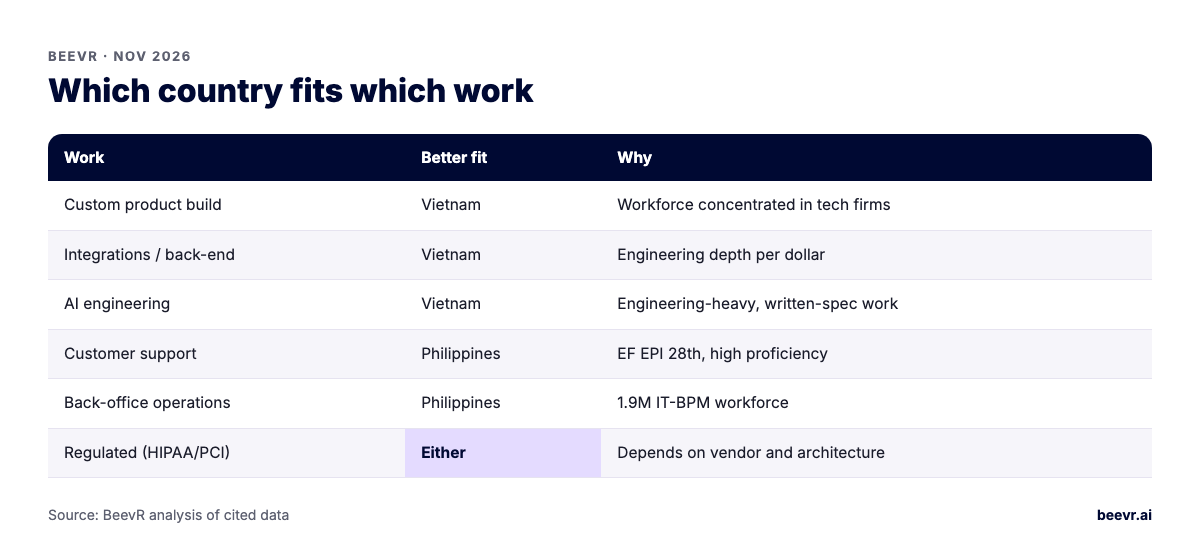
Choose Vietnam for engineering-heavy product work: building software, integrations and AI features where engineering depth per dollar matters most. Choose the Philippines when English-first communication with customers, support and operations is part of the job. Both price within Asia's senior range of roughly $31–$41 an hour. The Philippines leads on English, 28th vs 64th in EF's 2025 index.
Vietnam and the Philippines come up on almost every Southeast Asia shortlist, and they are often compared as if they sold the same thing. They don't. The Philippines built the world's best-known IT-BPM industry around English-language service. Vietnam built a software engineering workforce that mostly works on code. This comparison uses official and published figures where they exist, and says so where a commonly repeated number could not be verified.
Is Vietnam or the Philippines better for software development?
Vietnam is usually the better pick for building software: custom products, back-end systems, integrations and AI engineering. The Philippines is usually the better pick when the work is mostly English-language operations, such as customer support, QA tied to customer journeys, or back-office teams that sit next to a product. Many companies use both, each for its strength.
The deciding factor is the shape of your work. If most of the hours go into writing and reviewing code, the engineering depth of the talent pool matters most. If most of the hours go into talking to your customers or running processes in English, language and service culture matter most.
How do Vietnam and the Philippines compare on cost in 2026?
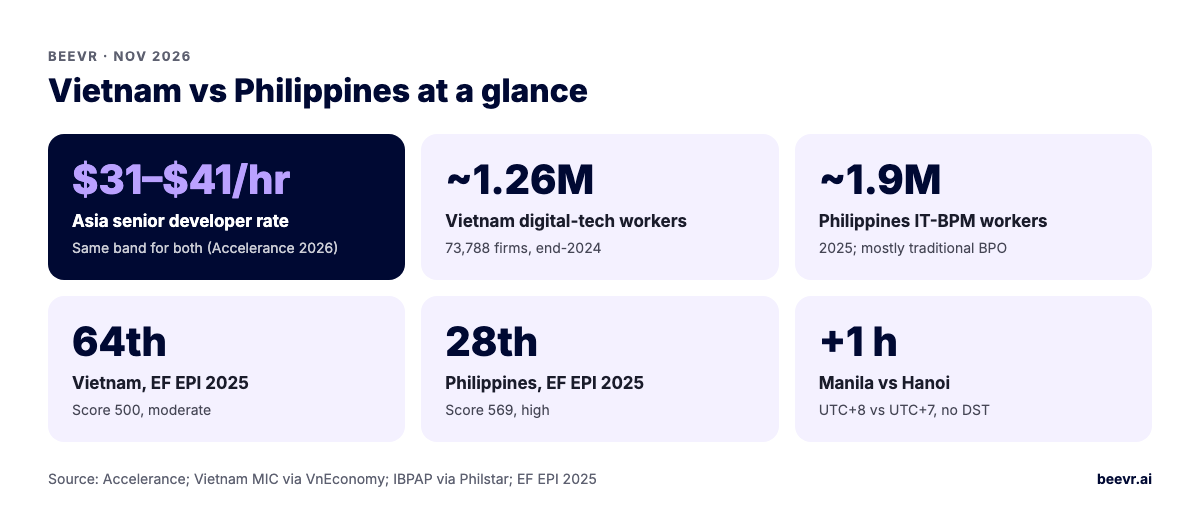
They sit in the same price band: Accelerance's 2026 rates guide puts Asian senior developers at about $31–$41 an hour and juniors at $24–$31, without a separate band for either country. FullStack Labs puts Southeast Asian agencies at $25–$65 an hour. Differences between vendors in the same country are bigger than the gap between the two countries.
| Factor | Vietnam | Philippines |
|---|---|---|
| Senior developer rate (Asia benchmark) | $31–$41/hr; juniors $24–$31/hr (Accelerance 2026, regional average) | |
| Agency rates (Southeast Asia) | $25–$65/hr (FullStack Labs 2026) | |
| Workforce headline | ~1.26M digital-tech workers, 73,788 firms (end-2024) | ~1.9M IT-BPM workers, $40B+ export revenue (2025) |
| What that workforce mostly does | Software and digital-tech businesses | Traditional BPO is still most of the sector |
| English (EF EPI 2025) | 64th of 123, score 500, "moderate" | 28th of 123, score 569, "high" |
| Time zone | UTC+7, no DST | UTC+8, no DST |
| Default copyright in commissioned work | Commissioning party holds economic rights unless agreed | Stays with the creator unless a written stipulation says otherwise |
| Data protection law | PDP Law No. 91/2025/QH15, in force 1 Jan 2026 | Data Privacy Act of 2012 (RA 10173) |
Sources are linked in the sections below. Rates are regional averages. Treat any "Vietnam rate" or "Philippines rate" quoted to the dollar without a method as a vendor estimate. More on Vietnamese pricing is in our Vietnam rates guide.
Which country has the bigger software talent pool?
The Philippines has the larger tech-enabled services workforce, about 1.9 million people. Most of them work in business process outsourcing, not software engineering. Vietnam's roughly 1.26 million digital-tech workers are concentrated in technology businesses.
For hiring software engineers specifically, Vietnam's pool is deeper, though senior engineers are scarce in both.
On Vietnam, the Ministry of Information and Communications counted 73,788 digital technology businesses and nearly 1.26 million workers at the end of 2024. A 2025 report estimated a shortfall of about 200,000 skilled IT workers and roughly 50,000 IT graduates a year.
On the Philippines, the IT and Business Process Association of the Philippines (IBPAP) reported more than $40 billion in 2025 export revenue and 1.9 million workers, up from 1.82 million in 2024. The same report notes that traditional BPO still makes up most of the sector, and that global capability centers (about 160 of them) are growing faster than the rest. We could not find an official, current count of software developers alone in either country. Figures that claim one are usually vendor estimates.
Which country has better English for working with US and EU teams?
The Philippines does, clearly. In EF's 2025 English Proficiency Index the Philippines ranked 28th of 123 countries with a "high" score of 569, and Vietnam ranked 64th with a "moderate" 500. For engineering work, what matters is written English in specs, pull requests and tickets.
Senior Vietnamese engineers who work with Western clients usually handle that well.
The index (EF EPI; the 2026 edition is due on 18 November 2026) measures self-selected test-takers, not whole populations, so treat it as directional. Two practical points follow. If your engineers will talk to your customers live, the Philippines' advantage is real. If they work from written specs and a weekly demo, test written English in the interview: ask the lead engineer to write a short design note on your problem.
How do time zones compare with the US and Europe?
Both countries are ahead of the US and Europe and neither uses daylight saving. Vietnam is UTC+7 and the Philippines UTC+8, one hour further ahead. Vietnam has slightly more natural overlap with Europe.
Many Philippine support operations work night shifts on US hours. If you want engineers on US hours in either country, ask the vendor directly what it costs.
| Client city (winter) | Behind Hanoi (UTC+7) | Behind Manila (UTC+8) |
|---|---|---|
| London | 7 h | 8 h |
| Berlin / Paris | 6 h | 7 h |
| New York | 12 h | 13 h |
| San Francisco | 15 h | 16 h |
Subtract one hour from each figure during northern-hemisphere summer time. For US engineering work in either country, plan one shared hour a day and do the rest asynchronously. See our offshore guide to Vietnam for how good teams run the US time gap.
Who owns the code under Vietnamese and Philippine law?
Sign an explicit written assignment in both countries, because the default rules differ. Vietnam's IP law gives the economic rights in a commissioned work to the commissioning party unless agreed otherwise. Under the Philippine IP Code, copyright in a commissioned work stays with the creator unless a written stipulation says otherwise.
The Vietnamese rule is Article 39 of the Law on Intellectual Property No. 50/2005/QH11 (as amended). The Philippine rule is Section 178.4 of the Intellectual Property Code (RA 8293), which says the commissioning person owns the work itself while copyright stays with the creator unless stipulated in writing. Work created by an employee as part of regular duties belongs to the employer under Section 178.3. Either way, the chain is the same: engineer to vendor in the employment contract, vendor to you in the services contract, and repositories in your name. Read do you own the code? for the contract language to look for.
Data protection
The Philippines' Data Privacy Act of 2012 (RA 10173) created the National Privacy Commission and can apply outside the country in certain cases. Vietnam's Personal Data Protection Law took effect on 1 January 2026 and includes cross-border transfer assessments. For regulated work in either country, keep production data in your own cloud account and give the team audited access instead of copies.
Which country suits healthcare and fintech software?
Both can work, because compliance depends on the vendor and the architecture, not the country. For building HIPAA or PCI DSS systems, pick the vendor that signs a BAA, keeps PHI or card data in your cloud, and shows production work in your industry. The flag on the map matters less.
IBPAP names health care among the growth drivers of the Philippine IT-BPM sector, which is mostly operations work. That is useful if you need people to run a process. For engineering a regulated system, such as an EHR integration, a FHIR API or an AI agent with audit trails, look for named engineers who have shipped one. Our country shortlist and Vietnam vs India comparison cover the other common options.
Can you use Vietnam and the Philippines together?
Yes, and many companies do: engineering in Vietnam, English-language support and operations in the Philippines. It works when each team owns a clear part of the system and they share one ticketing system, one written runbook and one escalation path.
The usual failure is a vague boundary. Support agents report bugs that engineers can't reproduce, and nobody owns the fix. Three habits prevent most of that:
- One ticket format. Every bug report includes steps, the account or record ID (never raw personal data in the ticket) and the expected result.
- Shared observability. Support staff can see the same error IDs and traces the engineers see, with access limited to what their role needs.
- A weekly joint review. The top recurring tickets turn into either a product fix or a runbook change, and both teams see the result.
Contracts should match the split: an engineering agreement with IP assignment and, for regulated data, a BAA or data processing agreement, and a separate services agreement for operations with its own access rules.
How BeevR builds this
We are a senior, founder-led software and AI studio in Hanoi, so we are on one side of this comparison. That is exactly why we'll tell you when the Philippines is the better choice: if your main need is English-language support or operations staffing, hire there. For engineering, we work fixed scope, fixed price per phase (from $10K per phase), with a working demo every Friday. You own the source code and IP from day one, with repositories and cloud accounts in your name and no per-user fees.
For regulated clients we sign a BAA as a business associate and keep production data inside your own AWS account. Our proof: a multi-tenant EHR live across four US clinics at around 300 patients a day, and a 5.0 rating on Clutch. More about us as a Vietnam software development company.
Deciding between the two? Book a 30-minute call and we'll look at the shape of your work with you, honestly.