Offshore software development in Vietnam works best for a scoped product phase or a long-running dedicated team. Senior engineers bill at Asia rates (about $31–$41 an hour on Accelerance's 2026 benchmark), Hanoi is UTC+7 with 3–4 hours of natural overlap with Europe, and US teams need one planned overlap hour. Put the IP assignment in the contract.
This is the buyer's guide: why companies pick Vietnam, what it costs, how time zones work in practice, who owns the IP, which engagement model to choose, and what goes wrong. For a full rate breakdown by role, see our Vietnam offshore rates for 2026. For a head-to-head comparison with India, see Vietnam vs India. This page connects those pieces and helps you decide whether Vietnam is right for you.
Why do companies offshore software development to Vietnam?
For three reasons: senior engineering at Asian prices, a large and growing technical workforce, and a stable working culture used to Western clients. The trade-offs are a time-zone gap with the US, working English that varies by company, and a shortage of senior engineers that makes good vendors selective.
The size of the workforce is real. Vietnam's Ministry of Information and Communications counted 73,788 digital technology businesses employing nearly 1.26 million people at the end of 2024. That figure covers the whole ICT sector, not only software engineers. The supply side is tighter than it looks. A May 2025 report estimated a shortfall of about 200,000 skilled IT workers. It also found that universities and colleges train roughly 50,000 IT students a year, of whom only about 30% are immediately employable. In practice there are plenty of developers, and senior ones are scarce. You have to select the vendor carefully.
How much does offshore software development in Vietnam cost in 2026?
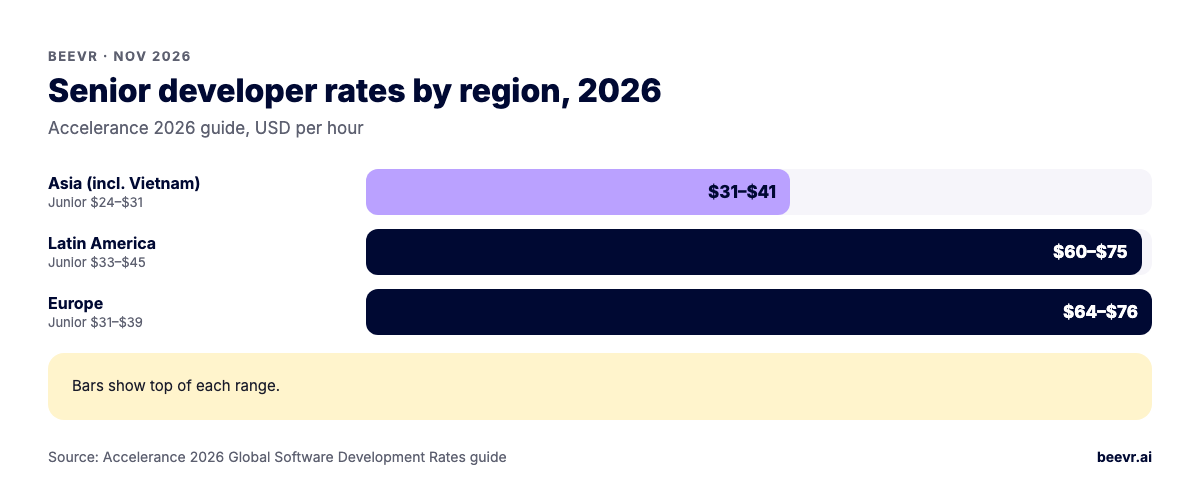
Senior developers in Asia bill about $31–$41 an hour and juniors $24–$31, according to Accelerance's 2026 rates guide. Southeast Asian agencies quote $25–$65 an hour depending on seniority and how much project management is bundled in. A fixed-price product phase avoids the hourly question altogether.
| Region | Junior ($/hr) | Senior ($/hr) | Hanoi time difference |
|---|---|---|---|
| Asia (incl. Vietnam) | $24–$31 | $31–$41 | — |
| Europe | $31–$39 | $64–$76 | 5–7 hours behind Hanoi |
| Latin America | $33–$45 | $60–$75 | About 10–13 hours behind Hanoi |
| US (reference) | Median developer salary $135,980/yr (BLS), not a bill rate | 11–15 hours behind Hanoi | |
Rates are from the Accelerance 2026 guide (published November 2025), and the US salary is from the BLS (May 2025). Accelerance does not publish a Vietnam-only band. Be careful with online figures that claim one.
What Vietnamese engineers earn
Salary explains what a rate covers. ITviec's 2025–2026 salary report puts the median senior back-end developer (8+ years) at about 54.9 million VND a month, around $2,100. Tech leads earn about 68.45 million VND (~$2,630) and QA engineers about 38.5 million VND (~$1,480). The gap between salary and bill rate covers social insurance, benefits, bench time, management, QA and margin. Ask any vendor what is inside its rate. Our rates guide has the full table by role and seniority.
What is the time-zone overlap between Vietnam and the US or Europe?
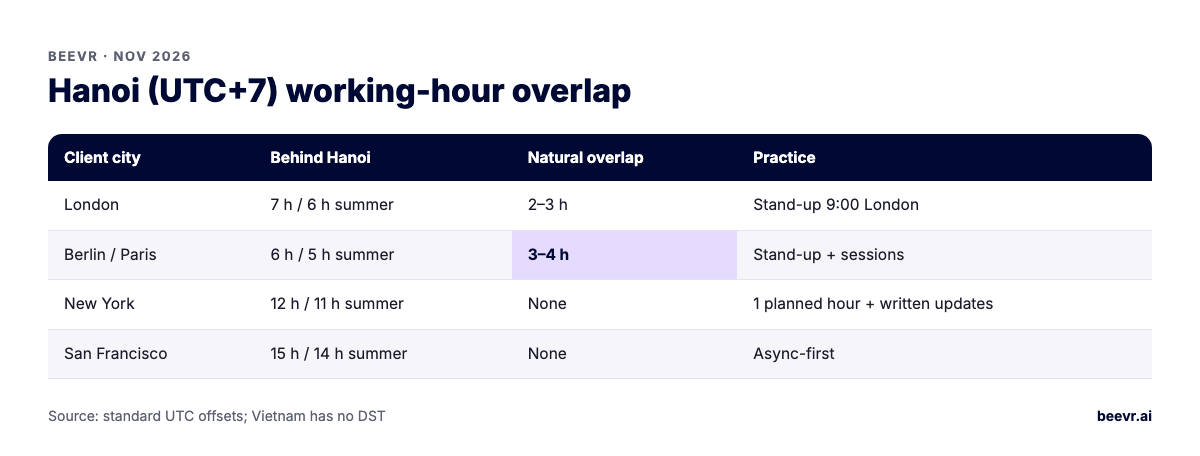
Vietnam is UTC+7 all year with no daylight saving. A Hanoi afternoon overlaps a European morning by 3–4 hours with nobody working odd hours. The US has no natural overlap, so the team plans one shared hour, usually Hanoi early morning and US late afternoon or evening, and runs everything else asynchronously.
| Client location | Behind Hanoi | Natural overlap (9:00–18:00 both sides) | How good teams handle it |
|---|---|---|---|
| London | 7 h (winter) / 6 h (summer) | 2–3 h | Daily stand-up at London 9:00 |
| Berlin / Paris | 6 h (winter) / 5 h (summer) | 3–4 h | Stand-up plus working sessions in the overlap |
| New York | 12 h (winter) / 11 h (summer) | None | One planned hour (Hanoi 7:00–8:00 ≈ NY 19:00–20:00 in winter) plus written updates |
| San Francisco | 15 h (winter) / 14 h (summer) | None | SF late afternoon ≈ Hanoi early morning; async-first |
For US teams the gap can work in your favour. You write feedback at the end of your day, and the fix is waiting the next morning. This only works with discipline: a written spec, a daily written update, and a demo you can click every week. If your process depends on ad-hoc calls all afternoon, an offshore team in any Asian country will frustrate you.
Who owns the IP when you outsource software development to Vietnam?
You should, so the contract needs an explicit assignment of code, documentation and IP to your company. Vietnam's Law on Intellectual Property gives the economic rights in a commissioned work to the organisation that contracts the author, unless agreed otherwise. Don't rely on that default.
On top of that clause, keep the repositories in your name from the start.
The default rule is in Article 39 of the Law on Intellectual Property No. 50/2005/QH11, which has been amended several times, most recently by Law No. 07/2022/QH15 with effect from 1 January 2023. In practice your protection comes from three places:
- The contract. An assignment clause covering source code, designs, documentation and inventions. Governing law and a dispute forum you can actually use, often Singapore arbitration for cross-border deals. Ask a lawyer in your jurisdiction.
- The vendor's employment contracts. Engineers must assign work product to the vendor, so the vendor can assign it to you. Ask to see the clause.
- Your infrastructure. Repositories, cloud accounts, domains and API keys in your name from day one. Ownership on paper means little if the vendor holds the only admin login. See do you own the code?
Data protection
Vietnam's Personal Data Protection Law (No. 91/2025/QH15) was enacted on 26 June 2025 and took effect on 1 January 2026. It has extraterritorial reach and requires impact assessments for cross-border transfers. The simplest design for foreign clients is to keep production data in your own cloud region and give the offshore team audited, role-based access instead of copies. For regulated work (HIPAA, PCI DSS) this is required anyway.
Which engagement model should you choose in Vietnam?
Choose fixed price for a defined product phase, a dedicated team for a continuous roadmap, staff augmentation if you already have strong engineering leads, and an offshore development center (ODC) or build-operate-transfer only when you plan to run 15–20+ engineers in Vietnam for years.
| Model | You pay for | Who carries overrun risk | Best for |
|---|---|---|---|
| Fixed price per phase | A defined outcome with acceptance criteria | Vendor | MVPs, integrations, AI assistants, rebuilds |
| Dedicated team | Named people per month | You (vendor manages delivery) | Long-running product roadmaps |
| Staff augmentation | Individual engineers per month | You (you manage them) | Teams with strong in-house leads |
| ODC / build-operate-transfer | A team built for you, optionally transferred to your own entity later | Shared; you carry setup cost | Large, multi-year programs |
A "Vietnam offshore development center" can mean a dedicated floor at a vendor's office or your own legal entity in Vietnam. Setting up your own entity involves investment registration, local employment contracts and social insurance. Only do it at real scale, and with local legal advice. Our fixed price vs time and materials guide covers the first two models in depth.
What are the risks of offshoring to Vietnam, and how do you reduce them?
The main risks are a junior team behind a senior sales pitch, communication gaps, poor visibility into progress, weak ownership terms, and losing key engineers. All five can be handled with contract terms and delivery habits you can check before signing.
| Risk | Mitigation you can check |
|---|---|
| Junior bench, senior pitch | Name the engineers in the contract; interview them; review their code |
| Communication gaps | Written spec, daily written update, one planned overlap hour |
| No visibility | Working demo every week on a staging URL you control |
| Weak ownership | IP assignment clause; repos and cloud in your name from day one |
| Key-person loss | Code review on every change, documentation in the repo, vendor replaces at its own cost |
| Security | No production data on laptops; MFA; access logged; BAA or DPA where required |
How do you choose an offshore software development company in Vietnam?
Shortlist three vendors. Ask each for a reference from a client in your industry and timezone, interview the actual engineers, and run a short paid discovery with your favourite before committing to the full build. A two-week discovery tells you more than any proposal.
Five checks before you sign
- Named seniors. The contract lists the engineers who will write your code, and replacing one needs your approval.
- A real reference. One client in your industry and time zone, on a call, who can tell you what went wrong and how it was fixed.
- Your accounts. Repositories, cloud and third-party keys are created in your name during week one, not at handover.
- A visible cadence. A written update every day and a demo you can click every week, on a staging URL you control.
- A clean exit. You can take the work in-house or to another vendor at any time, with documentation and no transfer fee.
Use the same questions for every vendor: who writes the code, what is fixed, who owns what, how you will see progress, and what happens when someone leaves. Our guide to choosing a development partner has the full checklist. If you are still choosing a country, compare Vietnam vs the Philippines and the best countries for offshore development.
How BeevR builds this
We are a senior, founder-led software and AI studio in Hanoi, working with US and EU clients in regulated industries. We work fixed scope, fixed price per phase, from $10K per phase: a short paid discovery first, then a working demo every Friday on a staging environment you control. You own the source code and IP from day one, with repositories and cloud accounts in your name and no per-user fees. For healthcare clients we sign a BAA, and production data stays in your own AWS account.
The proof we can share: a multi-tenant EHR live across four US clinics at around 300 patients a day, and a 5.0 rating on Clutch. More on how we work as a Vietnam software development company.
Considering Vietnam? Book a 30-minute call. We'll tell you whether a fixed-price phase, a dedicated team or neither is the right fit.