Buy an off-the-shelf agent like OpenAI Dots or Meta Muse when the work is one person's own work: inbox, research, scheduling, drafts, and admin across apps they already use. Build a custom agent when it serves your customers, touches regulated data, has to follow a fixed process, or writes to your system of record. For a team of five, a dot costs about $500–$625 a month in seats. A custom agent costs $15,000–$75,000 to build before it saves anything. Once the agent runs inside your product at 100,000 tasks a month, the off-the-shelf options stop being options at all.
This guide compares the two always-on agents launched in September 2026 with building your own, using the vendors' own launch pages and help centres as of 7 October 2026. For agent build costs in detail, see how much an AI agent costs. If you have already decided to build, see our guide to AI agent frameworks in 2026.
What are OpenAI Dots and Meta Muse?
Both are always-on personal agents. They keep working after you close the chat, they act in other apps on your behalf, and they ask before sensitive actions. They are aimed at different buyers.
- OpenAI Dots were announced on 29 September 2026. A dot runs on GPT-6 Astra, has its own cloud computer, connects to more than 4,000 apps through ChatGPT's plugin ecosystem, and can be reached in ChatGPT, Slack or Teams. Your first dot is included in ChatGPT Pro and Business Premium. Pro users in the EEA, Switzerland and the UK are excluded for now. Business Premium users get dots in all supported ChatGPT regions. Enterprise workspaces, including Edu and Healthcare, get a beta that is off by default until an admin turns it on.
- Meta Muse launched on 8 September 2026 as a consumer agent on iOS, Android and muse.ai in the US. Muse for Small Business followed on 29 September for the US and Canada. It connects to Asana, Box, Canva, Dropbox, Figma, Granola, HighLevel, Intuit QuickBooks, Klaviyo, Lovable, Notion, Shopify, Slack, Stripe and Zoom, plus Facebook, Instagram and Meta ad accounts. Meta's page for the small-business version states that nothing publishes, sends or spends without your approval. Muse is free up to a usage limit, with Power ($20/month) and Maximum ($100/month) plans.
Neither product is something you embed in your own app for your own customers. Both act for the account holder. That one fact settles most build-versus-buy questions before cost comes into it.
How do Dots, Muse, a DIY platform agent and a custom agent compare?
There are four realistic paths. "DIY on a vendor platform" means building your own agent on hosted agent infrastructure, such as OpenAI's Agents API (public beta since 10 September 2026, with computer use, hosted execution and multi-agent support) or Claude Managed Agents (billed as tokens plus $0.08 per session-hour). "Custom" means an agent whose code you own, built by your team or a studio.
| Criterion | OpenAI Dots | Meta Muse for Small Business | DIY on a vendor platform | Custom agent |
|---|---|---|---|---|
| Who it works for | An employee, inside ChatGPT, Slack or Teams | A small-business owner (US and Canada) | Your users, inside your product | Your users and your systems |
| Time to first value | Minutes | Minutes | Weeks | 6–12 weeks for a single agent |
| Price model | Per seat: first dot included in Pro or Business Premium; extra dots not yet priced | Per person: free, $20 or $100 a month | Tokens plus platform fees plus your engineering time | Build cost plus tokens |
| Regulated data (PHI, card data) | Enterprise and Healthcare beta, off by default; confirm in writing that your BAA covers dots | No compliance commitments in the launch materials | Possible where the vendor signs a BAA for that API | Designed in: masking, scoped access, audit logs |
| Fixed, repeatable process | Learns preferences; not a workflow engine | Goal-driven; not a workflow engine | You code the process | You code the process; the model proposes, code validates |
| Writes to your system of record | Through plugins and their permissions | Through its connectors | Through tools you write | Through tools you write, with idempotency and limits |
| Approvals | Default rules plus Custom Rules; password changes and money transfers need you to take over | Nothing publishes, sends or spends without approval | Whatever you build | Whatever your risk policy requires |
| Lock-in | High: tied to a ChatGPT plan | High: tied to a Meta account | Medium: tied to a vendor SDK and runtime | Low, if the code is yours and the model can be swapped |
The lock-in row is not hypothetical. OpenAI's own deprecations page shows Agent Builder, the visual builder announced with AgentKit, was deprecated on 3 June 2026 and shuts down on 30 November 2026. Teams that built on it now have to move to the Agents SDK or ChatGPT workspace agents. Any hosted agent product can change under you on the vendor's schedule.
When is an off-the-shelf agent enough?
More often than agencies like to admit. Our own AI agent development page says the most useful thing an agent builder can tell you is when you don't need one. Buy first if most of these are true:
- The work belongs to one person. Triage an inbox, prepare meeting briefs, chase invoices, compile research, draft posts.
- The tools are mainstream SaaS. If your stack is Slack, Notion, QuickBooks, Shopify and Stripe, Muse or a dot can already reach it.
- A human approves anything that matters. Both products ask before sending, spending or publishing, and that matches the risk.
- No regulated data is involved, or your enterprise agreement explicitly covers the agent.
- Volume is per person, not per customer. Seat pricing is cheap when the number of seats is small.
- You are still finding out what the job is. A month on a dot is a cheap way to learn which tasks are worth automating properly.
When do you still need a custom AI agent?
When the agent is part of your product or your operations rather than one employee's assistant. In practice, one of these is usually true:
- Your customers use it. A support agent, an onboarding agent or an agent in your app has to run under your brand, your auth and your terms. Dots and Muse don't do that.
- It handles regulated data. PHI, cardholder data or data that must stay in a region needs controls you can show an auditor. Our HIPAA-compliant AI agent builds use PHI masking, BAA-backed infrastructure, tamper-evident audit logs and human review. More detail is in HIPAA-compliant AI agents.
- The process must run the same way every time. Claims intake, KYC checks or order exceptions follow rules. The model can interpret the input, but code should decide what is allowed.
- It writes to your system of record. An agent that creates orders, changes patient records or moves money needs scoped permissions, retries that don't double-charge, and a log of every action.
- Volume is high. At tens of thousands of tasks a month, paying per token with routing and caching beats paying per seat.
- You need an audit trail you control. You decide what is logged, how long it is kept and who can read it.
There is a middle path too. If your goal is for other people's dots to use your product, you don't need an agent. You need a clean API or an MCP server that agents can call. We cover that in MCP server development.
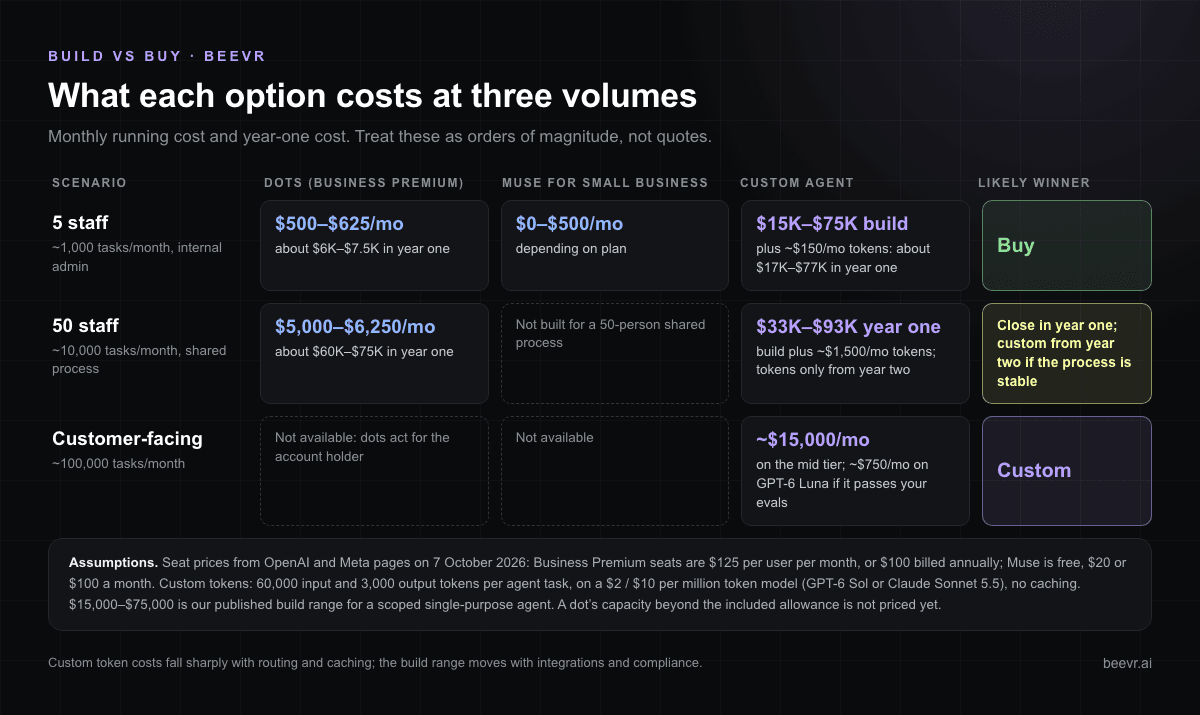
What does each option cost at three volumes?
The table compares monthly running cost plus year-one cost in three scenarios. Seat prices come from OpenAI and Meta pages on 7 October 2026: ChatGPT Pro starts at $100 a month, and Business Premium seats are $125 per user per month, or $100 billed annually. Custom-agent token costs use the assumptions in our AI app cost guide: 60,000 input and 3,000 output tokens per agent task, on a $2 / $10 per million token model (GPT-6 Sol or Claude Sonnet 5.5), with no caching. The custom build range of $15,000–$75,000 is the one we publish for a scoped single-purpose agent.
| Scenario | Dots (Business Premium) | Muse for Small Business | Custom agent | Likely winner |
|---|---|---|---|---|
| 5 staff, ~1,000 tasks/month, internal admin | $500–$625/mo, about $6K–$7.5K in year one | $0–$500/mo, depending on plan | $15K–$75K build plus ~$150/mo tokens: about $17K–$77K in year one | Buy |
| 50 staff, ~10,000 tasks/month, shared process | $5,000–$6,250/mo, about $60K–$75K in year one | Not built for a 50-person shared process | Build plus ~$1,500/mo tokens: about $33K–$93K in year one, tokens only from year two | Close in year one; custom from year two if the process is stable |
| Customer-facing, ~100,000 tasks/month | Not available: dots act for the account holder | Not available | ~$15,000/mo on the mid tier; ~$750/mo on GPT-6 Luna if it passes your evals | Custom |
Treat these as orders of magnitude, not quotes. OpenAI hasn't published a dot's monthly capacity beyond the included allowance, so a busy dot may need extra capacity that isn't priced yet. Custom token costs fall sharply with routing and caching. And the build range moves with integrations and compliance. Our MVP cost page puts compliance at +15–25% when it is designed in and +40–80% when it is bolted on later.
What should you check before you buy an off-the-shelf agent?
Run this checklist before you give a dot or Muse access to company systems:
- Region. Is the product available where your staff are? Dots exclude Pro users in the EEA, Switzerland and the UK for now. Muse for Small Business covers the US and Canada.
- Plan and admin control. On Enterprise, dots are off until an admin enables them. Decide who may turn them on and for which groups.
- Data agreement. If you handle PHI or other regulated data, get written confirmation that your BAA or DPA covers the agent itself, not only the chat product.
- Connector scope. Connect the fewest apps with the narrowest permissions. Enabling dots does not grant access to every app, but each connector you add widens what the agent can reach.
- Approval rules. Review the defaults and set Custom Rules so that sending, paying, deleting and publishing always need a human.
- Credentials. Never give an agent a shared admin login. Use per-user connections that you can revoke.
- Logging. Find out what the vendor logs for agent actions, how long it keeps the logs and how you export them.
- Exit plan. Write down which tasks the agent does, so you can move them if the product, price or terms change.
- Measure the result. Track hours saved and error rate for a month. That number is your budget ceiling if you later build.
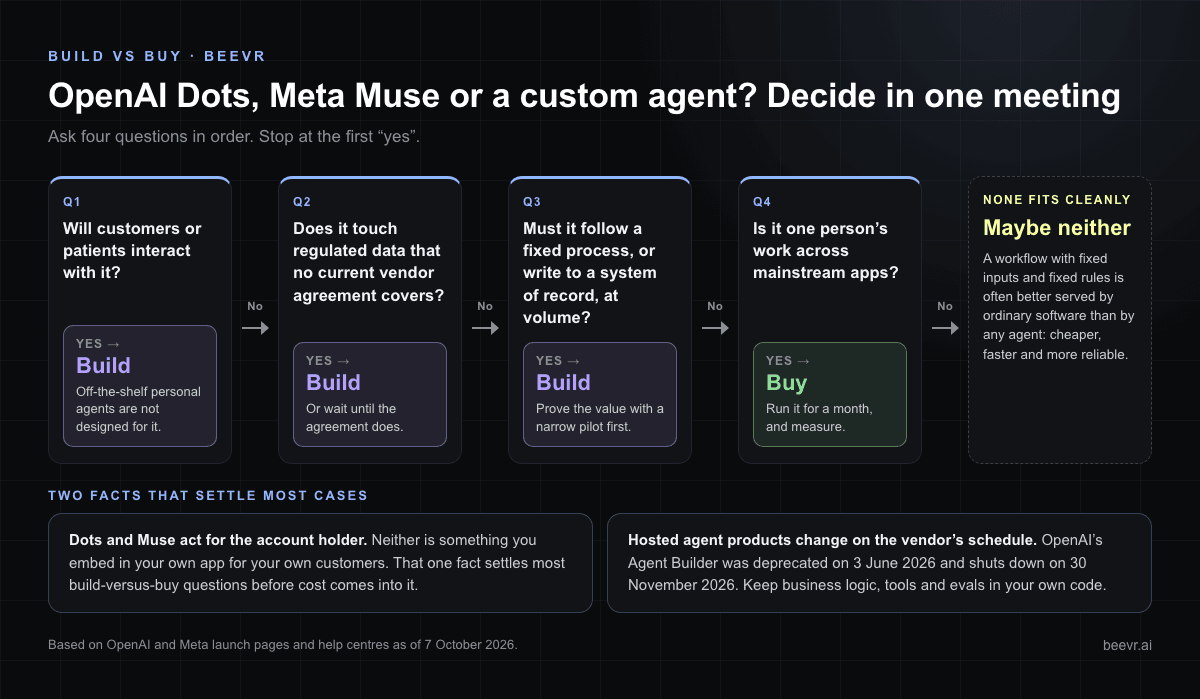
How do you decide in one meeting?
Ask four questions in order. Stop at the first "yes".
- Will customers or patients interact with it? Then build. Off-the-shelf personal agents are not designed for it.
- Does it touch regulated data that no current vendor agreement covers? Then build, or wait until the agreement does.
- Must it follow a fixed process, or write to a system of record, at volume? Then build. Prove the value with a narrow pilot first.
- Is it one person's work across mainstream apps? Then buy, run it for a month, and measure.
If none of these fit cleanly, the honest answer may be neither. A workflow with fixed inputs and fixed rules is often better served by ordinary software than by any agent, and it will be cheaper, faster and more reliable.
How does BeevR build custom agents without lock-in?
We build agents whose code you own, on a design you can inspect:
- Kite, our open-source agent framework (MIT), treats the LLM as an untrusted component. A kernel validates every proposed action. It has a kill switch, idempotency keyed on operation IDs, hybrid retrieval, and prompt A/B testing with statistical confidence intervals on real traffic. Because it is open source, you are not renting a black box.
- Fixed price per phase. Our AI agent development work is priced by phase from $10K. If the agent is the core of a new product, our published packages are the Pitch Demo at $4K (about 10 days), the Investor MVP at $18K (about 6 weeks) and the Flagship Sprint at $38K (about 10 weeks). Details are on the MVP cost page.
- Evals from the start, so you can change models when prices drop or a model is retired. Our LLM testing plan for regulated industries shows what that looks like when an auditor is involved.
- Regulated by default. HIPAA, PCI DSS and SOC 2 controls are built in from the first phase rather than added at the end.
FAQ
Can OpenAI Dots replace a custom AI agent?
For one person's own work across mainstream apps, often yes. For anything your customers use, anything that must follow a fixed process, or anything that touches regulated data without a covering agreement, no. A dot acts for the ChatGPT account holder and is not something you embed in your product.
How much do OpenAI Dots cost?
Your first dot is included in ChatGPT Pro (from $100 a month) and Business Premium ($125 per user per month, or $100 billed annually). OpenAI says you will later be able to add more dots and more speed or capacity, but it hasn't published those prices. Enterprise, Edu and Healthcare workspaces get a beta that an admin has to enable.
Is Meta Muse safe for small-business finances?
Meta says nothing publishes, sends or spends without your approval, that purchases use one-time card numbers, and that conversations are not shared with Meta's ad systems. Those are good defaults. Still connect only the accounts it needs, review every payment it proposes, and keep your own records.
Are Dots or Muse HIPAA compliant?
Muse's launch materials make no HIPAA commitment. OpenAI offers a BAA for eligible ChatGPT Enterprise and Healthcare customers, and dots are in beta for those workspaces. Confirm in writing that your agreement covers dots before any PHI goes near them.
Should we build on OpenAI's Agents API or on our own code?
A hosted agent platform gets you running faster but ties you to that vendor's runtime and roadmap. OpenAI's Agent Builder is shutting down on 30 November 2026, which shows the risk. Keep your business logic, tools and evals in your own code, so the hosted pieces can be swapped.
BeevR is a senior, founder-led AI studio in Hanoi, Vietnam. We build custom AI agents at a fixed price per phase, you own the code and IP from day one, and we build for regulated industries. If you're weighing a dot against a custom build, tell us about the workflow. We'll tell you honestly whether you need us.