Pick Cursor if your developers live in an IDE and want to choose models. Pick Claude Code for terminal-first work and the deepest admin controls. Pick Codex if you are already on ChatGPT Business or Enterprise. Pick Devin for fully delegated cloud tasks, even in a single-tenant VPC. Team seats cost $25–$40 a month; usage drives the real bill.
Updated 13 November 2026. All four products now run in more than one place: a local terminal or IDE, a vendor cloud, and CI. So the useful questions are where your code executes, which models you may use, and what your admins can enforce. Every price and control below was read from the vendor's own pricing page or docs today. We do not rank tools by benchmark scores. Vendor benchmarks are not comparable, and your repo is the only benchmark that matters. For the wider landscape, including open-source agents, see our AI dev agent platforms guide.
What is the difference between Cursor, Claude Code, Codex and Devin?
Cursor is an AI-first code editor with cloud agents. Claude Code is Anthropic's agent for the terminal, IDE, desktop and web. Codex is OpenAI's agent, sold with ChatGPT plans. Devin is Cognition's autonomous agent, built around delegated cloud sessions. They overlap more each month. The differences that last are model access, where the code runs, and enterprise controls.
| Cursor | Claude Code | OpenAI Codex | Devin | |
|---|---|---|---|---|
| Main surface | IDE (VS Code fork) + cloud agents | Terminal, VS Code, JetBrains, desktop app, web | CLI (open source), IDE, desktop app, web, iOS | Web app, Devin Desktop, CLI, Slack |
| Runs in the cloud? | Yes, cloud agents on paid plans | Yes, cloud sessions and scheduled tasks | Yes, Codex Cloud | Yes, by default (Devbox VMs) |
| Models | Grok, plus Claude, GPT and others at API list price from Premium; own Composer models | Claude only (Anthropic, Bedrock, Vertex, Foundry) | OpenAI GPT-6.x family; other providers via API-key and custom-provider config | Models from Anthropic, OpenAI, Google and Cognition; no third-party API keys |
| Entry individual plan | Plus $8/mo (Grok only); Premium $30/mo | Pro $20/mo ($17 billed annually) | ChatGPT Plus $20/mo | Pro $20/mo |
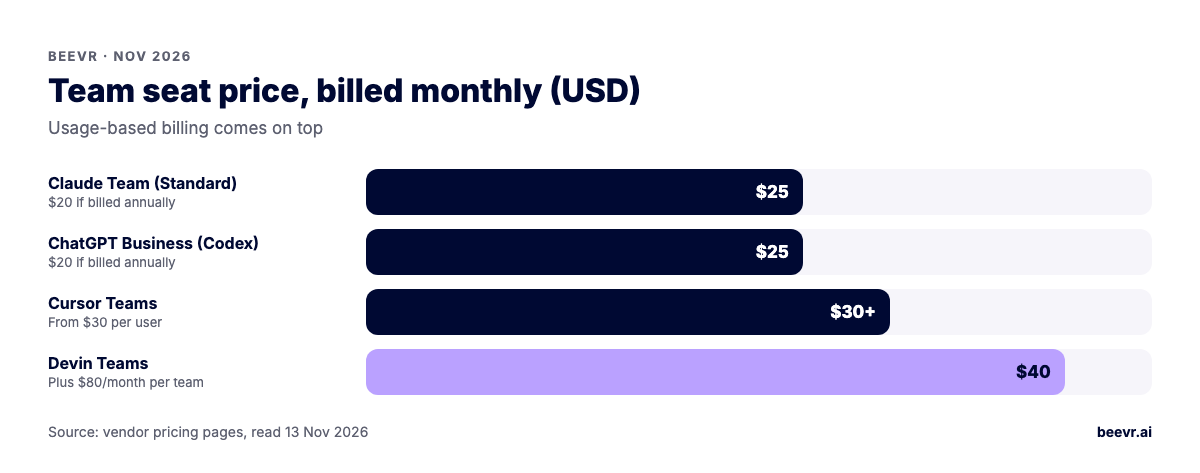
| Team plan | Teams $30+/user/mo | Team Standard $25/seat/mo ($20 annual); Premium $125 ($100 annual) | Business $25/user/mo ($20 annual) | Teams $80/mo + $40/dev seat, up to 100 users |
| Enterprise | Custom; SCIM, audit logs, model/MCP/repo access controls | $20/seat/mo annual, 20-seat minimum, plus API-rate usage; SCIM, audit logs, spend limits | Contact sales; SCIM, RBAC, Compliance API, retention and residency controls | Custom; SCIM, RBAC, single-tenant VPC option |
Sources: Cursor pricing, Claude pricing, Codex pricing, Devin pricing, all read 13 November 2026. Prices exclude tax and change often.
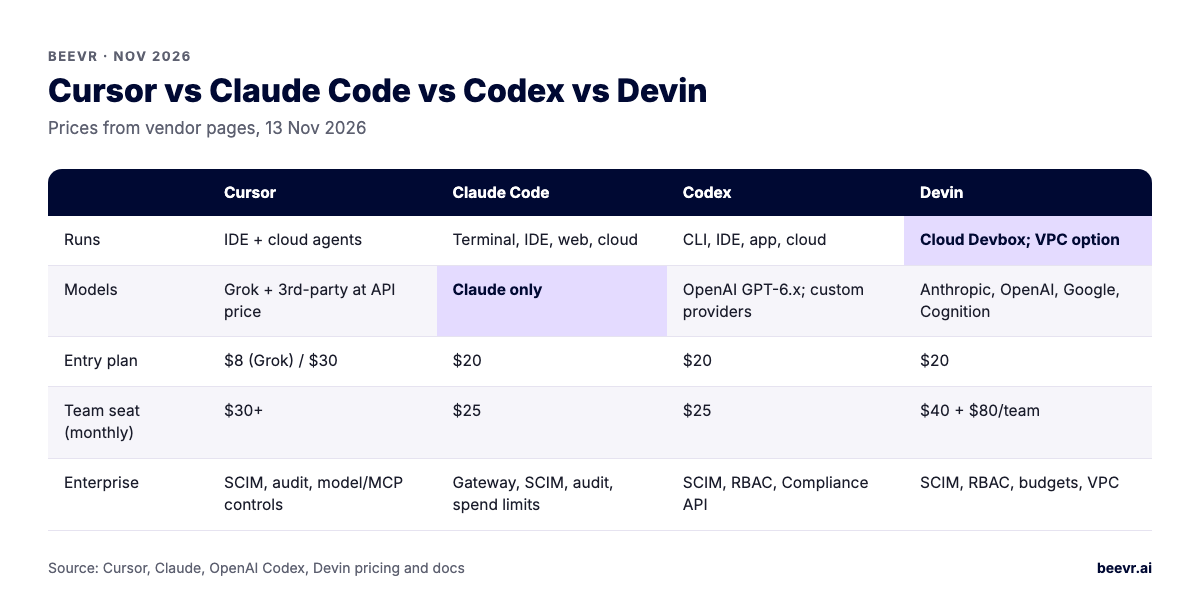
Which AI coding agents run in the cloud instead of on a developer's laptop?
All four can run in the cloud now. Devin is cloud-first by design: every session runs in a remote "Devbox". Claude Code, Codex and Cursor run locally by default and offer cloud sessions as an option. GitHub Copilot's cloud agent is the other main cloud option if your code is on GitHub.
- Devin: Enterprise Cloud runs both Devin's "brain" and the Devbox in Cognition's multi-tenant cloud. Customer Dedicated runs the Devbox in a single-tenant VPC, connected over AWS PrivateLink or an IPSec tunnel (Devin deployment docs). The brain always runs in Cognition's cloud.
- Claude Code: web sessions at claude.ai/code and cloud scheduled tasks keep running when your laptop is off.
claude --cloudhands a terminal task to the cloud (Claude Code docs). A self-hosted runner option exists for teams that want cloud-style sessions on their own hosts. - Codex: Codex Cloud runs tasks remotely, and you can follow them from the web or iOS. API-key mode has no cloud features.
- Cursor: cloud agents run in isolated environments of up to 300 repositories. Since 5 November 2026 they can also host the web apps they build.
Cloud execution is not only about convenience. It decides where your source code, secrets and test data sit while the agent works. If you work in a regulated industry, that question comes before any feature comparison.
Which AI coding agents let you use any AI model?
None of the four lets you use any model with no limits. Cursor is the most open on models, with GitHub Copilot close behind. Codex can be pointed at other providers in API-key mode. Claude Code runs Claude models only. Devin picks from its own supported list and does not accept your third-party API keys.
- Cursor sells plans through "The X Subscription" since joining SpaceX. Plus ($8) is Grok-only. From Premium ($30), third-party models such as Claude and GPT are billed at API list price from prepaid credit. Enterprise adds model access controls.
- Claude Code uses Claude through Anthropic, Amazon Bedrock, Google Cloud Vertex AI or Microsoft Foundry. That is model choice within one family, but provider choice for data residency.
- Codex on ChatGPT plans uses OpenAI's GPT-6.x models (GPT-6.1 Sol, GPT-6.1 Terra, GPT-6 Sol, Luna, Astra). The CLI's model catalog also covers Vertex AI and Bedrock, and its config supports custom providers. Ollama documents running Codex against local models.
- Devin supports "the latest and greatest models from Anthropic, OpenAI, Google, and Cognition", and enterprise admins can restrict which ones are available. Its deployment docs say it "does not currently support third-party LLM API keys."
If "any model" really means open-weight models on your own GPUs, look at open-source agents (OpenHands, Cline, Aider) or Codex with a custom provider. Our guide to open-weight coding models covers which models are good enough to try.
How much do Cursor, Claude Code, Codex and Devin cost in November 2026?
The entry paid plan is $20 a month for Claude, ChatGPT (Codex) and Devin. Cursor starts at $8 for Grok-only use or $30 for third-party models. Team seats run from $25 to $40 a month when billed monthly. Heavy agent use moves everyone onto usage-based billing, so the seat price is rarely the real cost.
Where usage-based billing kicks in
- Claude: Max is $100 a month and Ultra $200. Enterprise is $20 per seat plus usage at API rates, with spend limits per user, group and organization.
- Codex: Pro plans are $100, $200 or $500 a month. Plus has five-hour message limits that vary by model; for example, the docs estimate 15–160 local messages per five hours on GPT-6.1 Sol. You can buy credits on top.
- Cursor: Premium includes 4× Plus usage, Super ($100) 15× and Ultra ($200) 50×. Third-party models are always billed at API list price.
- Devin: Max is $200 a month. Overage on every plan is billed at API pricing, and cost per message varies with model and task size.
Budget for usage per developer, not per seat. Then set hard caps. We explain why agent bills grow faster than headcount in the cost to run an AI product.
What are the best coding agents for Fortune 500 engineering teams?
For large enterprises, the shortlist is the four vendors Gartner named Leaders in its May 2026 Magic Quadrant for Enterprise AI Coding Agents: GitHub, Anthropic, Cursor and OpenAI. Devin is the strongest choice when you need fully delegated agents inside a single-tenant VPC. What decides between them is identity, data residency, model policy and audit fit, not raw capability.
GitHub reported the Leaders in its announcement of the report (dated 20 May 2026). Here is what each offers a large enterprise, from vendor docs:
- Claude Code: a self-hosted Claude apps gateway for Bedrock, Vertex or Foundry. It handles SSO sign-in, model allow-lists and managed settings per IdP group, OTLP telemetry, spend limits and a cost-report API. Claude Enterprise adds SCIM and audit logs.
- Codex / ChatGPT Enterprise: SCIM, EKM, domain verification, RBAC with custom roles, audit via the Compliance API, and retention and residency controls. FedRAMP API keys route to government endpoints.
- Cursor Enterprise: SCIM, granular and group-level spend limits, auto-run, browser and network controls, repository, model and MCP access controls, audit logs and service accounts. Also check the effect of the new SpaceX ownership on your vendor review.
- Devin Enterprise: SAML/OIDC SSO (self-serve since 30 October), SCIM, RBAC, budget hierarchies, a customer-dedicated VPC, and customer-managed keys under Enterprise Assured.
Many large teams run two: an IDE or terminal agent for daily work, plus a cloud agent for backlog tasks. How to govern both is covered in governing AI coding agents in the enterprise.
Which is better for a startup: Cursor, Claude Code, Codex or Devin?
For a team under 20 engineers, start with whatever subscription your developers already pay for, then trial one other tool on a real backlog for two weeks. Claude Code and Codex both come with $20 plans that most developers already have. Cursor suits teams that want one editor with many models. Devin pays off once you have well-specified tickets to hand off in bulk.
Three practical tests:
- Your test suite. Every agent is far better on a repo with fast, reliable tests. Without them, no tool will save you. That is the main lesson of taking a vibe-coded app to production.
- Your review capacity. If one senior engineer reviews everything, a fast cloud agent will just build a queue.
- Your data. If customer data or secrets live in the dev environment, local agents with sandboxing are easier to defend than cloud agents.
Should you use more than one AI coding agent?
Yes, usually, but govern them as one fleet. Many teams pair an interactive agent (Cursor or Claude Code) with a delegated cloud agent (Devin, Codex Cloud or Copilot's cloud agent). Each extra tool adds a model policy, a budget, an identity integration and a review path to maintain.
Keep one repo-level instruction file (AGENTS.md is read by most agents, and Claude Code can read it in place of CLAUDE.md). Use one set of CI checks and one rule that no agent merges its own work. The October security benchmarks show why the last rule matters: the agent's code usually works, but is rarely secure by default.
What changed in these tools recently that affects the choice?
Three things changed between August and November 2026. Cursor is now owned by SpaceX and its plans changed. Devin added budgets and self-serve SSO. Claude Code added group budgets and a cost API.
Older comparisons that quote a "$20 Cursor Pro" plan are out of date. Legacy Pro still exists for existing subscribers but is closed to new customers. Model line-ups also turn over monthly: GitHub retired 10 Copilot models in October and 3 more go on 16 November. See our November 2026 AI coding agent update for the dated list.
How BeevR builds this
BeevR is a senior, founder-led software and AI studio in Hanoi. We build production AI agents and treat every model as an untrusted component, the same rule behind our open-source Kite framework. When a client wants to roll out coding agents, we help choose and pilot two tools on their real repository. We measure merged, reviewed work rather than demos, then set up the guardrails: model allow-lists, budgets, sandboxing and review gates. Work is fixed scope and fixed price per phase, from $10K. You see a working demo every Friday, and you own the code and IP from day one.
If you want a second opinion before you sign a seat contract, see how we work as an AI development company, or book a 30-minute call.