In late 2026 only a few public LLM benchmarks still separate frontier models: Terminal-Bench 4.1, the new FrontierCode and agent-work evals, ARC-AGI-3 and Arena preference rankings. SWE-bench Verified is retired: OpenAI found flawed tests in 59.4% of the hard problems it audited, and Vals stopped running it at 97%. For choosing a model, run 100–200 of your own tasks.
Updated 24 November 2026. Every score below comes from an official leaderboard, a vendor launch page or the benchmark authors, with the date we read it. Vendors pick their own effort levels, harnesses and tool access, so a number on a launch page is a claim, not a measurement you can repeat. The last sections show how to build an eval that answers your own question.
Which LLM benchmarks still matter in late 2026?
The ones that still matter test long, multi-step agent work on fresh or refreshed tasks: Terminal-Bench 4.1, FrontierCode, ARC-AGI-3, GDPval-style knowledge-work evals and, for chat quality, Arena. Multiple-choice knowledge tests like GPQA Diamond and the original Humanity's Last Exam now mostly tell you a model is in the top group, not which one is best.
Here is where each major benchmark stands as of 24 November 2026:
| Benchmark | What it measures | Status, Nov 2026 | Top published score (who ran it, date) |
|---|---|---|---|
| SWE-bench Verified | Fixing 500 real GitHub issues in Python repos | Retired: saturated and contaminated | 97.00%, Claude Opus 5 (Vals archive, last run 1 Sep 2026) |
| SWE-bench Pro (public) | 731 harder, longer issues in copyleft repos | Usable with care; ~30% of tasks broken per OpenAI | 61.5% ± 3.1, Muse Spark 1.1 (Scale leaderboard, read 24 Nov 2026) |
| Terminal-Bench 4.1 | 66 hard tasks run in a real terminal, agent + model together | Active, hardened verifiers | 71.2% ± 2.9, GitHub Copilot with Copilot Fusion (17 Nov 2026) |
| FrontierCode 2.0 | Whether code changes meet maintainers' standard for merging | New, vendor-reported only | 49.1%, Claude Fable 5.2 (Anthropic, 9 Nov 2026) |
| GPQA Diamond | 198 graduate-level science multiple-choice questions | Near ceiling | 87%, Grok 4 already in July 2025 (Epoch run); PhD experts 69.7% |
| Humanity's Last Exam | 2,500 expert questions across fields | Rated "Flawed" by Epoch (46% of sampled items had errors) | 74.2% with tools, Claude Fable 5.2 (Anthropic, 9 Nov 2026) |
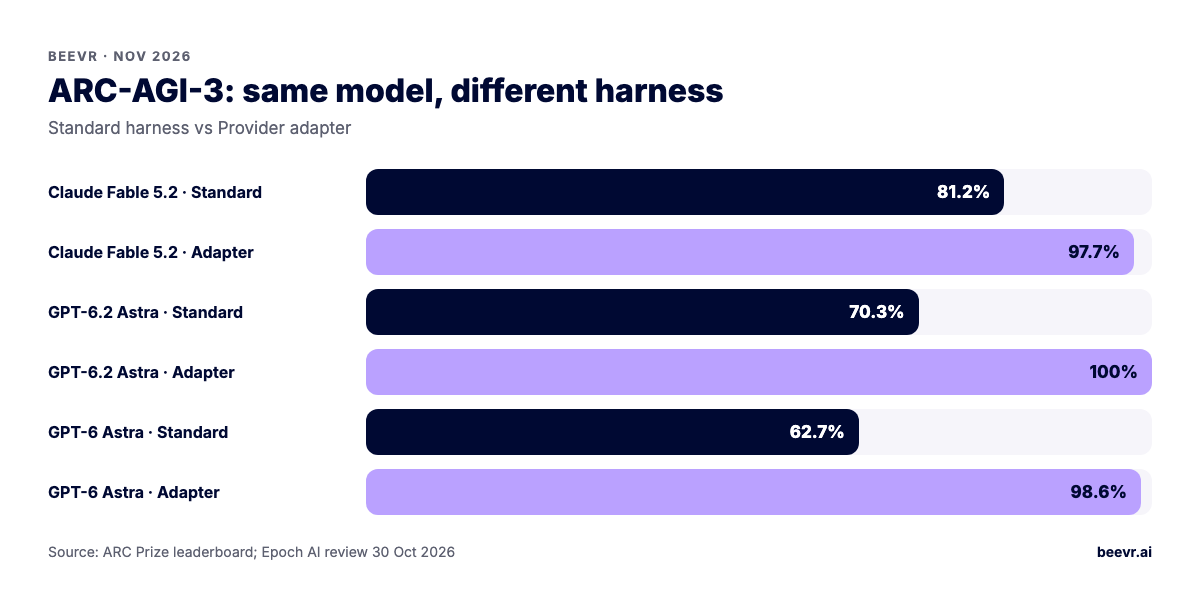
| ARC-AGI-3 | Learning new interactive game environments on the fly | Active; harness changes scores a lot | 81.2% Standard harness, Claude Fable 5.2 (ARC Prize, 9 Nov 2026) |
| GDPval / GDPval-AA | Real deliverables from 44 occupations, judged against experts | Active; several versions in use | 1846 Elo, Claude Opus 5.5 on GDPval-AA v2.1 (Anthropic, 22 Sep 2026) |
| Arena (formerly LMArena) Text | Human preference votes between two anonymous answers | Active; measures preference, not correctness | 1527, Gemini 4 Carbon (arena.ai, updated 22 Nov 2026) |
"Top published score" is the highest number we found on that board or page. Sources are linked in each section below.
Is SWE-bench Verified still a useful benchmark?
No. OpenAI stopped reporting it in February 2026, and Vals.ai archived its board in September 2026 because the top models were all between 95% and 97%. A model can score higher on it today by having seen the tasks during training, which says little about how it handles your codebase.
The evidence is specific. In its 23 February 2026 post, OpenAI audited 138 Verified problems that its o3 model could not reliably solve. At least six engineers reviewed each one, and 59.4% had material problems in the tests or the problem statement. OpenAI also found that every frontier model it probed could reproduce the gold patch or verbatim task details for some problems. That is contamination: the answer is in the training data.
The Vals.ai SWE-bench page, last updated 1 September 2026, puts Claude Opus 5 at 97.00%, DeepSeek V4 Pro at 96.40% and GPT-5.6 Sol at 96.20%. It says plainly that it no longer runs the benchmark on new models because performance has saturated. Anthropic's own launch table for Claude Opus 5.5 does not list it at all.
What replaced SWE-bench Verified for measuring AI coding agents?
No single benchmark replaced it. Teams now look at three: SWE-bench Pro for longer real-repo fixes, Terminal-Bench 4.1 for end-to-end agent work in a shell, and newer vendor-reported evals like FrontierCode that check whether a change is good enough to merge, not only whether tests pass.
SWE-bench Pro
Scale AI's SWE-bench Pro has 1,865 tasks across 41 repositories. The public set has 731 tasks from copyleft-licensed repos, there is a 276-task set from private startup codebases, and 858 tasks are held out. The public board's top entry when we read it was Muse Spark 1.1 at 61.5% ± 3.1, using the mini-swe-agent harness.
There is a catch. On 8 July 2026 OpenAI published an audit estimating that about 30% of SWE-bench Pro tasks are broken. Its automated pipeline flagged 27.4% of tasks and human reviewers 34.1%, mostly because of tests that were too strict, prompts that were underspecified, or tests that covered too little. OpenAI retracted its earlier advice to adopt the benchmark.
Terminal-Bench 4.1
Terminal-Bench runs an agent and a model together on hard tasks in a real terminal, with 95% confidence intervals on every score. Version 4.0 dropped eight tasks (some saturated or with public solutions); 4.1 keeps 66 tasks and hardens the verifiers against reward hacking. When we read the board, the top entries were GitHub Copilot with Copilot Fusion at 71.2% ± 2.9, then Claude Code with Opus 5.5 and with Fable 5.2, both at 65.8%, then Gemini 4 Carbon in Antigravity CLI at 64.5%. Codex with GPT-6.2 Astra scored 62.1%. Most of these intervals overlap. Positions two to eight are close to a statistical tie.
FrontierCode
FrontierCode, credited to Cognition on OpenAI's GPT-6.2 page, grades whether a change to a real codebase would pass a maintainer's review. On Anthropic's Fable 5.2 page (9 November 2026), FrontierCode 2.0 scores are 49.1% for Fable 5.2, 45.5% for Opus 5.5, 42.8% for GPT-6 Astra and 41.1% for Gemini 4 Carbon. OpenAI's GPT-6.2 announcement says only that GPT-6.2 Sol is within 0.5 points of GPT-6.2 Astra on it. There is no public leaderboard we could verify, so treat these as vendor numbers.
Are GPQA Diamond and Humanity's Last Exam saturated?
GPQA Diamond is effectively saturated for frontier models. Humanity's Last Exam is not saturated yet, but an independent review found errors in 46% of the questions it sampled, so small differences between models mean little. Its authors released HLE-Diamond in September 2026 as the next step.
The GPQA paper reported that domain experts reached 65% accuracy on its questions, or 74% after discounting clear mistakes, while skilled non-experts with web access reached 34%. Epoch AI cites a 69.7% expert baseline on the Diamond subset. Epoch's own run had Grok 4 at 87% back in July 2025, well above that expert line, and neither Anthropic launch table we read for Opus 5.5 or Fable 5.2 includes GPQA. When the remaining errors are mostly ambiguous or mislabeled questions, the benchmark stops ranking anything.
Humanity's Last Exam has 2,500 questions from about 1,000 contributors and was published in Nature in January 2026. On 11 August 2026, Epoch AI rated it "Flawed": 22 of 48 sampled questions (46%) had errors that change the score, including 12 that are impossible as written. The HLE site lists HLE-Diamond, released 22 September 2026, as a path for when models hit the noise ceiling. Vendor numbers on the original set, with tools: Fable 5.2 74.2%, Opus 5.5 67.7%, GPT-6 Astra 57.2%, all from Anthropic's pages.
What does ARC-AGI-3 measure, and why do scores jump so much between harnesses?
ARC-AGI-3 tests whether an AI agent can figure out new interactive game environments on the fly, with no prior instructions. Scores swing widely because the result depends on the harness: how much memory and reasoning the agent keeps between moves. The same model can score 70% in one harness and 100% in another.
On the ARC Prize leaderboard, the Standard harness has Claude Fable 5.2 at 81.2% (cost $21.9K, 9 November), GPT-6.2 Astra at 70.3% ($24.2K, 17 November) and Gemini 4 Carbon at 65.1% ($7.2K). Under the "Provider adapter" harness, Fable 5.2 shows 97.7% and GPT-6.2 Astra 100%. An Epoch AI review dated 30 October 2026 explains why. The Standard harness discards reasoning after every action and trims history at 175,000 characters. The Provider adapter keeps reasoning and compacts history instead. GPT-6 Astra went from 62.7% to 98.6% just by changing harness. Epoch also rated the benchmark "Flawed": 19 verified entries cost more than the stated per-run cap, up to $49,800, and the percentage is an efficiency ratio, not a share of tasks solved.
In agent benchmarks the scaffold (memory, tools, retries, context handling) can move the score more than the model does.
What is GDPval and does it predict real work?
GDPval, from OpenAI, asks models to produce real work products from 44 occupations, which industry experts then compare blind against human deliverables. It is closer to real work than a quiz. Several versions now circulate, though, and most of the numbers you see come from the vendor who built or ran it.
The original GDPval (25 September 2025) covers 44 occupations across the 9 industries that contribute most to US GDP, with 1,320 tasks and an open 220-task gold subset. The graders averaged about 14 years of experience. GDPval-AA is Artificial Analysis's version, scored as Elo. On Anthropic's Opus 5.5 page, GDPval-AA v2.1 shows Opus 5.5 at 1846, Fable 5.1 at 1735 and GPT-6 Astra at 1542. OpenAI reports an internal "GDPval v2" and says GPT-6.2 Astra gains 6.2 points over GPT-6 Astra on it. These are not the same benchmark, so the numbers do not compare.
GDPval tasks arrive with all the context the model needs. Real work does not, so treat GDPval as a sign a model can do professional work, not proof it will do yours.
Can you trust LMArena (Arena) rankings?
Arena tells you which answers people prefer in a blind side-by-side, and it is good at that. It does not tell you which model is correct, safe or cheap to run, and the top spots are usually within a few points of each other.
LMArena now runs at arena.ai. Its Text board, updated 22 November 2026 with more than 9.2 million votes, had Gemini 4 Carbon at 1527, Gemini 4 Argon at 1520, Gemini 4 Neon and Muse Wonder at 1512, and Claude Opus 5.5 at 1507. That is 20 points across five models. Voters favor tone and format and rarely check facts. The 2025 paper "The Leaderboard Illusion" also showed that some providers test many private variants before release (27 for Meta before Llama 4) and get a much larger share of the data. Use it for chat tone, not agent reliability.
Why do vendors report different scores for the same model on the same benchmark?
Because they run it with different effort levels, harnesses, tool access and sometimes task versions. GPT-6 Astra's Terminal-Bench-Science 0.1 score is 64.6% on Anthropic's Opus 5.5 page and 68.1% on its Fable 5.2 page. OpenAI notes it ran Fable 5.2 on a third-party harness, while Anthropic reports 74.6% for Fable 5.2 in its own Claude Code harness.
Check four things before you compare two numbers:
- Effort or reasoning level. Anthropic shows each model at its highest effort unless noted. Defaults are lower (Opus 5.5 defaults to medium per the Claude models overview), so your production numbers will differ.
- Harness. mini-swe-agent, Claude Code, Codex and Copilot give different results for one model.
- Version of the benchmark. Terminal-Bench 4.0 and 4.1 use different verifiers. GDPval, GDPval v2 and GDPval-AA v2.1 are different tests.
- Who ran it. The vendor, a rival vendor, or a public leaderboard.
Anthropic itself says on its Opus 5.5 page that at current capability levels, "benchmark margins have become a less reliable guide to real-world differences." We agree.
How do you build your own LLM eval set for choosing a model?
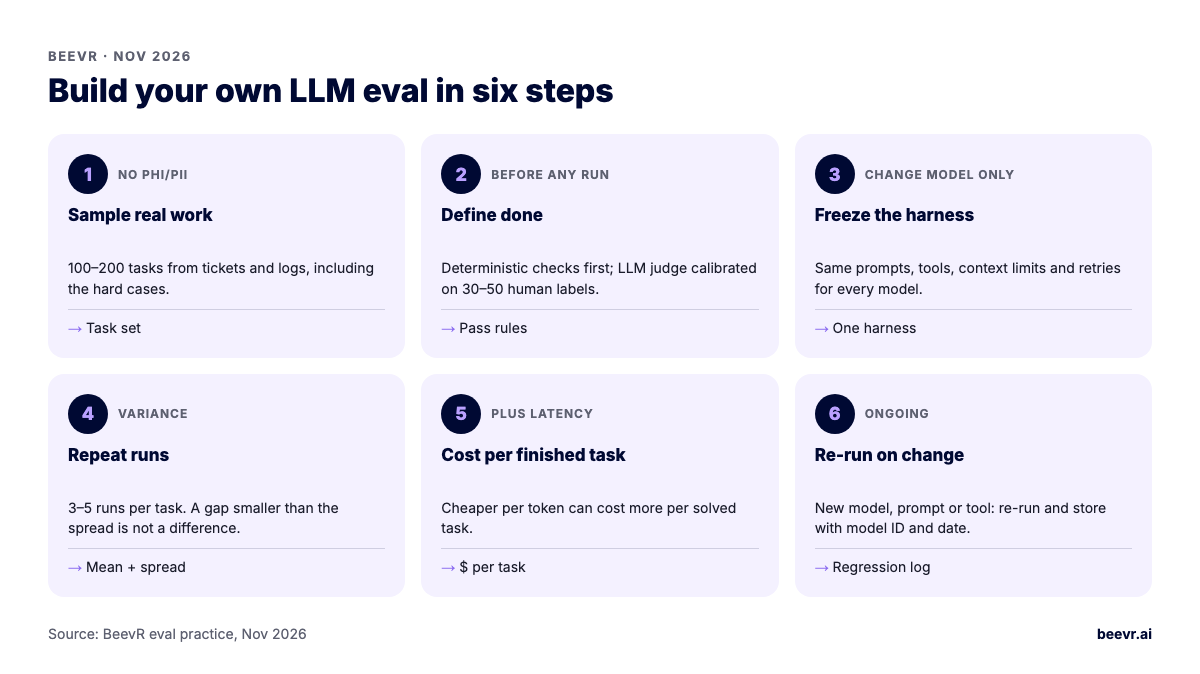
Collect 100–200 real tasks from your own work, write a pass/fail rule for each, and run every candidate model 3–5 times in your production harness at the effort level you will pay for. Track pass rate, cost per finished task and latency. A one-week build beats any public leaderboard for your decision.
The steps
- Sample real work. Pull tasks from tickets, logs or past requests, including the hard cases that cause incidents. Remove PHI or PII, or keep the set inside your compliant environment.
- Define "done" before you run anything. Use deterministic checks where you can (tests pass, JSON validates, the right record changed). Use a rubric with an LLM judge only for open-ended output, and calibrate the judge against human labels on 30–50 items.
- Freeze the harness. Same prompts, tools, context limits and retry policy for every model. Change only the model and the effort setting.
- Repeat runs. Agent results vary run to run. Three to five runs per task give you a mean and a spread, and a gap smaller than the spread is not a difference.
- Measure cost per finished task. Tokenizers and verbosity differ. A model that is cheaper per token can cost more per solved task. Our Opus 5.5 vs GPT-6 Sol comparison walks through the math.
- Re-run on every change. New model, prompt or tool: re-run, and store results with the model ID and date.
In healthcare or finance you also need evidence an auditor can follow. Our guide to LLM testing for regulated industries covers that layer, and AI agent evaluation and observability covers how offline evals connect to production tracing.
Which benchmarks should a CTO look at when picking a model in November 2026?
Use public benchmarks to shortlist two or three models, then let your own eval decide. For coding agents, use Terminal-Bench 4.1 with its confidence intervals. For knowledge work, use GDPval-style results and note who ran them. Ignore SWE-bench Verified and small gaps on GPQA or Arena.
For back-office agents add AutomationBench and OSWorld-style computer-use results. For hard reasoning, compare ARC-AGI-3 only on the same harness. For price and limits, read vendor pricing pages, and use our model migration guide for the breaking changes to test when you switch.
How BeevR builds this
When a client asks "which model should we use?", we answer with an eval set, not a leaderboard. In the first phase we pull 100–200 real tasks from the client's workflow, write the pass rules with their domain experts, and run two or three candidate models through the same harness the product will ship with. The output is a short report: pass rate with spread, cost per finished task, latency and failure cases. The eval set stays in the repository and runs again whenever a model or prompt changes. In healthcare it runs inside the client's own AWS account under the AWS BAA, and BeevR signs a BAA as a business associate.
We are a senior, founder-led team in Hanoi. You see a working demo every Friday, work is fixed scope and fixed price from $10K per phase, and you own the source code and IP from day one. See our AI agent development page for how we scope this.
Choosing between Opus 5.5, Fable 5.2, GPT-6.2 or Gemini 4 for a real product? Book a 30-minute call and we will help you design the eval that settles it.