November 2026's AI agent news in three lines: Microsoft used Ignite (17–20 November) to put agent identity, MCP governance and a firewall for MCP traffic into Entra and Agent 365; Sierra ($1.75B at a $30B valuation) and LangChain ($300M at $3B) led agent funding; and the official MCP SDKs and several MCP gateways shipped security fixes.
Updated 24 November 2026. This roundup covers 1–24 November and is written for CTOs and engineering leads who build or buy AI agents. Every item is confirmed on a primary source: the company's own release, a security advisory or a standards body. Numbers like valuations and user counts are what the companies say. Funding figures reported only by the press are left out. New models from the same weeks (Claude Fable 5.2, GPT-6-Cyber, Gemini 4 Carbon) are in our November model releases roundup, and coding-agent changelogs are in our AI coding agent update.
What were the biggest AI agent news stories in November 2026?
Five stories mattered most for teams building agents: Microsoft's Ignite agent-governance launches, Sierra's $1.75B Series F, LangChain's $300M Series C, a run of vulnerabilities in MCP SDKs and gateways, and three acquisitions of agent observability and testing companies by CrowdStrike and Elastic.
The pattern is clear. In 2025 the news was about agents doing more. In November 2026 it was about knowing which agents exist, what they can reach and what they did. Microsoft, CrowdStrike and Elastic all spent their announcements on identity, observability and evaluation. Anthropic also completed its IPO this month, pricing on 18 November at $83 per share and closing on 20 November with about $93.5B in gross proceeds, per its closing announcement. That is model-company news rather than agent news, so we note it only for context.
What did Microsoft announce for AI agents at Ignite 2026?
Microsoft made Agent 365 usage insights, plugin and skill governance, an enterprise MCP server in Entra and Copilot SDK 2.0 generally available, and previewed Entra Agent ID for local agents like Claude Code and GitHub Copilot CLI, plus an MCP Firewall in Global Secure Access. The theme was governing agents your developers already run.
From the Ignite 2026 Book of News:
- Generally available: Agent 365 usage and activity insights; governance of plugins and skills; Microsoft MCP Server for Enterprise in Entra; Microsoft IQ (Work IQ, Fabric IQ, Foundry IQ, Web IQ) exposed over MCP to "any MCP-compatible harness"; Copilot SDK 2.0 on a Rust runtime in six languages; Foundry agent optimizer and multi-turn evaluation; Defender runtime protection for local agents including Claude Code, GitHub Copilot, ChatGPT and Ollama.
- Preview: Entra Agent ID for discovered local agents, starting with GitHub Copilot CLI and Claude Code; MCP Firewall in Global Secure Access; Agent 365 MCP-server governance; Intune governance of local agents; Windows 365 for Agents (Frontier program only).
- Security agents: Microsoft says its Triage Agent handles about 80% of alerts in a typical Defender queue. Treat that as a vendor claim.
Why it matters: if your company runs Microsoft 365 and Entra, the coding agents on developer laptops are about to become visible, and governable, to your security team. Plan for agent identities, MCP allow-lists and runtime alerts showing up in your existing tools. Our AI agent control plane guide explains the identity and kill-switch pieces.
What did AWS, Google and Salesforce ship for enterprise agents in November?
AWS updated Bedrock AgentCore with support for the MCP 2026-07-28 spec, skill packages in its Agent Registry and organisation-level access policies. Google made 3-legged OAuth for A2A agents GA in Gemini Enterprise on 13 November. Salesforce said Agentforce Coworker passed 185,000 users and agreed to buy Cresta.
AWS Bedrock AgentCore
The AgentCore release notes for November (dated by month) list: Runtime support for MCP spec 2026-07-28; a free tier of 5,000 web-search queries per account per month; skill packages (SKILL.md) in the AWS Agent Registry, synced from S3 or GitHub; resource control policies to limit AgentCore access across an organisation; container images up to 10 GB, up from 2 GB; and six more Regions. AWS re:Invent starts in early December, so expect more.
Google Gemini Enterprise
Per the Gemini Enterprise release notes, 3-legged OAuth with the Agent Identity auth manager for A2A agents became GA on 13 November. In practice this lets an agent act on behalf of a signed-in user across services, instead of with a shared service account.
Salesforce
On 4 November Salesforce said Agentforce Coworker passed 185,000 users, with usage up 21x in three months and one pricing option at $50 per user per month. On 2 November it signed a definitive agreement to acquire Cresta, a voice-agent platform for customer experience; terms were not disclosed.
Which AI agent companies raised money or were acquired in November 2026?
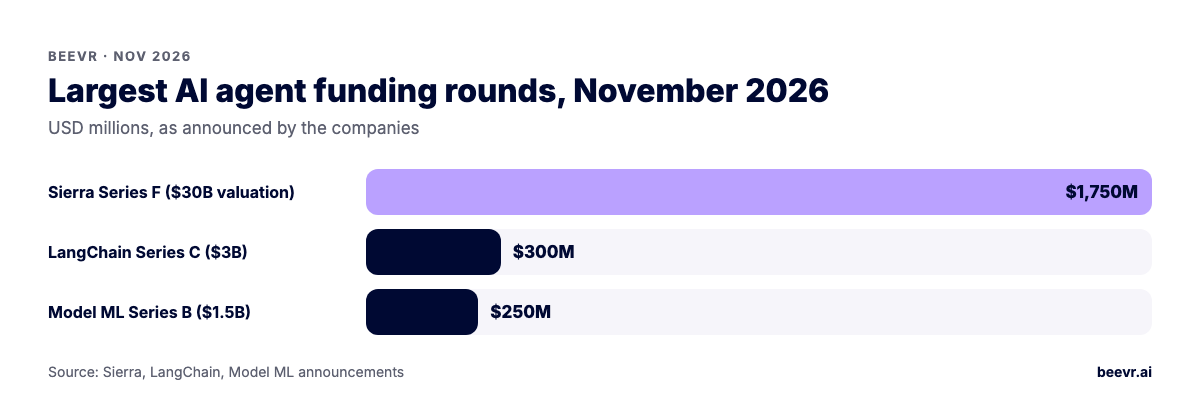
Three large agent rounds were confirmed by the companies: Sierra raised $1.75B at a $30B valuation, LangChain $300M at $3B and Model ML $250M at $1.5B. Four acquisitions were announced without prices: Salesforce–Cresta, CrowdStrike–Fiddler AI, CrowdStrike–Dreadnode and Elastic–HoneyHive.
| Date | Company | Deal | What the company says |
|---|---|---|---|
| 23 Nov | Sierra | $1.75B Series F, $30B valuation; led by Greenoaks and Lightspeed | Over $400M ARR; previous round $950M in May 2026 |
| 13 Nov | LangChain | $300M Series C, $3B valuation; led by CapitalG | 7,000+ organisations use LangSmith |
| 17 Nov | Model ML | $250M Series B, $1.5B valuation; co-led by General Atlantic and QED | Q3 ARR up 12x year on year |
| 2 Nov | Salesforce → Cresta | Acquisition, price not disclosed | Expected to close in Q1 of fiscal 2028 |
| 3 Nov | CrowdStrike → Fiddler AI, Dreadnode | Acquisitions, mostly cash, price not disclosed | Fiddler becomes Falcon Observe (agent observability) |
| 19 Nov | Elastic → HoneyHive | Agreement, terms not disclosed | Agent tracing and evaluation |
Sources: Sierra, LangChain, Model ML, CrowdStrike, Elastic. A widely quoted price for the CrowdStrike deals appeared only in press reports, so we leave it out.
What it signals for buyers: observability and evaluation tools are being absorbed into security and logging platforms. If you are choosing an agent tracing tool now, prefer one that exports OpenTelemetry, so an acquisition does not lock you in. Our AI agent frameworks guide covers what to standardise on.
Which AI agent and MCP security vulnerabilities were disclosed in November 2026?
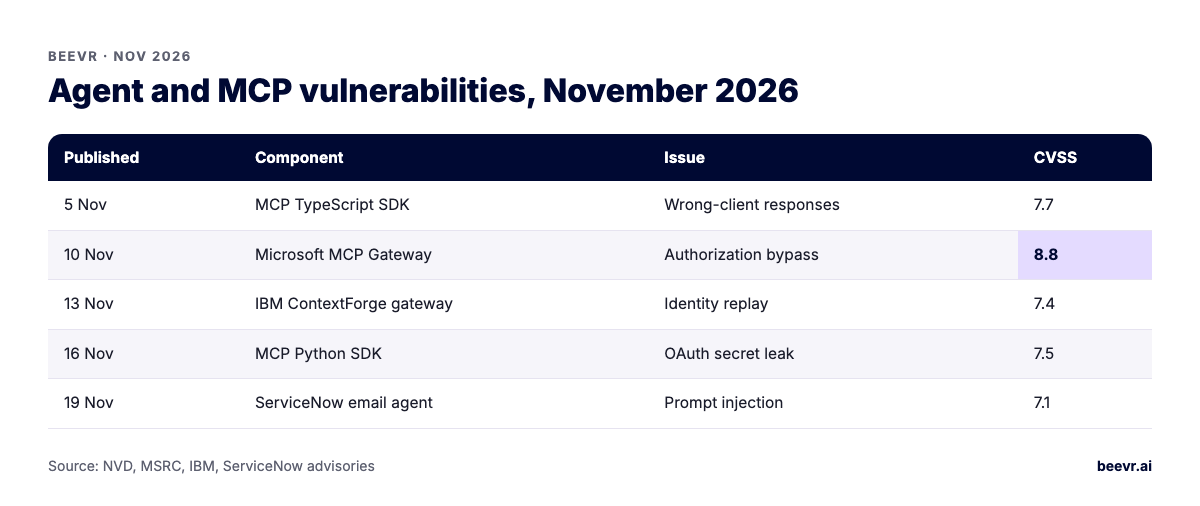
The most important were four CVEs in the official MCP TypeScript SDK (up to CVSS 7.7), an OAuth secret-leak bug in the official MCP Python SDK (CVSS 7.5), an authorization bypass in Microsoft's MCP Gateway (CVSS 8.8), a prompt-injection flaw in a ServiceNow email agent, and identity-replay bugs in IBM's ContextForge MCP Gateway.
| Published | Component | CVE | Issue | Score |
|---|---|---|---|---|
| 5 Nov | MCP TypeScript SDK | CVE-2026-111770 (+3 more) | Shared stateless HTTP transport could send responses to the wrong client | 7.7 |
| 10 Nov | Microsoft MCP Gateway | CVE-2026-109492 | Elevation of privilege via authorization bypass | 8.8 |
| 13 Nov | IBM ContextForge MCP Gateway | CVE-2026-110278 | Identity signatures replayable; identity exposed to third-party servers | 7.4 |
| 16 Nov | MCP Python SDK | CVE-2026-115563 | OAuth secrets could be sent to an auth server chosen by an untrusted MCP server | 7.5 |
| 19 Nov | ServiceNow Now Assist for CSM | CVE-2026-18883 | Indirect prompt injection in the Email Response AI Agent | 7.1 (v4) |
| 11–23 Nov | Reference MCP fetch and git servers | CVE-2026-134492, CVE-2026-134465 | SSRF guard bypass via IPv6; repository restriction bypass | Low to medium |
Sources: NVD CVE-2026-111770, MSRC, IBM, NVD CVE-2026-115563, GitHub advisory. The TypeScript fixes are in SDK 1.32.0 and @modelcontextprotocol/server 2.3.0. Some aggregators labelled the fetch-server bug "critical"; GitHub scores it 3.1, so it is not.
The bigger picture: an NVD keyword search for 1–23 November returned 74 CVEs mentioning "MCP server", most in third-party servers. If your agents load community MCP servers, treat each one as a dependency with its own patch cycle. Our MCP security guide lists the controls, and the AI agent security checklist covers prompt injection like the ServiceNow case.
Did MCP or A2A release a new version in November 2026?
No. The latest MCP specification is still 2026-07-28, and the latest A2A release is still v1.0.1 from May 2026. MCP did publish a more predictable release process on 11 November and an experimental file upload and download extension on 10 November.
- MCP: the MCP blog announced a release-manager rotation for the next spec cycle and the experimental file transfer extension. The Ruby SDK reached Tier 1 on 30 October.
- Agentic AI Foundation: on 22 October the Linux Foundation project added four projects, Agent Skills (Anthropic), Open Responses (OpenAI), OpenEnv (Hugging Face) and OpenSandbox (Alibaba), for 10 hosted projects in total (press release).
- A2A: v1.0.0 shipped on 12 March 2026 and v1.0.1 on 28 May 2026 (releases). Google's new A2A OAuth support is a product update, not a spec change.
For builders, a quiet spec month is good news. Target MCP 2026-07-28 and A2A 1.0.x now. Platforms like AgentCore already support them.
What should engineering teams do after this month's agent news?
Patch first, then inventory. Upgrade the MCP TypeScript and Python SDKs and any MCP gateway you run this week, list every agent and MCP server your developers use, and decide which identity system will own agent identities before your vendors decide for you.
- Patch. MCP TypeScript SDK 1.32.0 or server 2.3.0; the Python SDK fix for CVE-2026-115563; Microsoft MCP Gateway November updates; IBM ContextForge after 1.1.0.
- Inventory. Which coding agents, desktop agents and MCP servers run on company machines? Microsoft's and others' tools will soon show your security team; it is better to know first.
- Pick an identity model. Per-agent identities with user delegation (Entra Agent ID, Google's 3-legged OAuth for A2A) beat shared service accounts.
- Keep traces portable. With observability vendors being acquired, standardise on OpenTelemetry.
- Re-test prompt injection. Any agent that reads inbound email or tickets needs the kind of test that would have caught the ServiceNow bug.
How BeevR builds this
BeevR is a senior, founder-led software and AI studio in Hanoi. We build production agents on the rule that the model is an untrusted component: agents propose actions, a kernel validates them, and every tool call is logged. That is the design behind our open-source Kite framework. For client teams, a typical fixed-scope phase covers an agent and MCP inventory, SDK and gateway upgrades, per-agent identity and an OpenTelemetry trace pipeline. You get a working demo every Friday and own all source code and IP from day one. Phases are priced from $10K, with no per-user fees.
If you want an AI agent development partner to build or harden agents with you, book a 30-minute call.