Voice AI agents can handle a real share of patient access calls in 2026: scheduling, rescheduling, refill requests and routine questions. In one published hospital pilot, 36.6% of 806 automated pre-procedure calls needed no human follow-up and 12.2% were handed to a person. Plan for escalation, sub-second turn latency, a full BAA chain and TCPA consent from day one.
Phone lines are still the front door for most US health systems, and hold times are a patient access problem everyone can measure. Voice agents built on speech recognition, a language model and speech synthesis are now good enough to hold a natural conversation. The hard parts are not the voice. They are scheduling rules inside the EHR, knowing when to hand off, latency across four network hops, and the consent and privacy rules that apply to every call. This guide covers each.
What can a voice AI agent safely handle for patient access?
Inbound scheduling and rescheduling within published rules, appointment confirmations, refill requests routed to the care team, directions, hours, preparation instructions, and intake questions. It should not triage symptoms, give clinical advice, approve refills or handle anything that sounds urgent. Those go to a person immediately.
| Call type | Agent can complete | Agent prepares, human completes | Always hand off |
|---|---|---|---|
| Scheduling | Book, move or cancel within EHR scheduling rules | New patient with complex referral requirements | Patient reports worsening symptoms |
| Refills | Capture medication, pharmacy, callback number | Clinician reviews and approves or declines | Controlled substances, side effects, "ran out days ago" |
| Pre-visit / pre-procedure | Read instructions, confirm prep, run a scripted questionnaire | Answers outside expected range go to a nurse | Any sign of emergency |
| Billing questions | Balance lookup after identity verification | Payment plans, disputes | Distressed caller, complaints |
| General | Hours, locations, directions, parking | - | Caller asks for a person |
"Caller asks for a person" belongs in the last column for every call type. Making people fight the bot to reach a human is the fastest way to lose patient trust.
What results have voice agents shown in published studies?
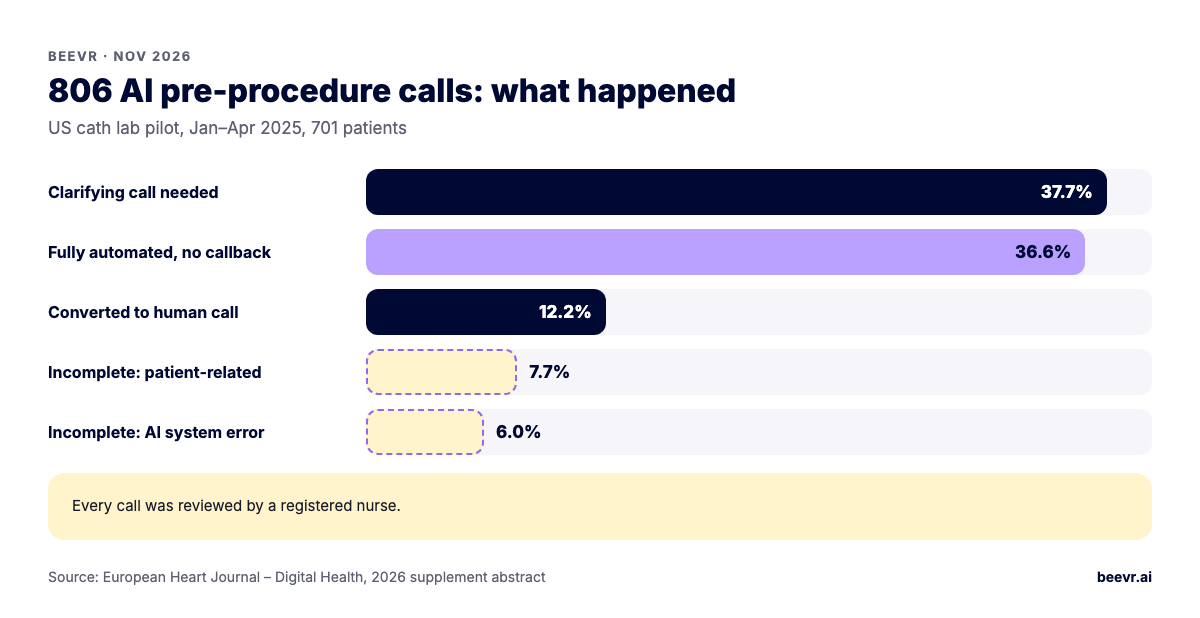
Peer-reviewed evidence is still thin, and most performance numbers come from vendors. One published pilot from a US cardiac catheterization lab is useful because it reports failures as well as successes: 86.4% of calls completed, 36.6% needed no nurse follow-up, and 6.0% failed because of AI system errors.
The conference abstract, published in European Heart Journal – Digital Health (2026 supplement), covers 806 pre-procedure calls to 701 patients between January and April 2025:
- 295 calls (36.6%) were fully automated with no nurse callback after review.
- 303 calls (37.7%) needed a quick, protocol-defined clarifying call.
- 98 calls (12.2%) were converted to a human call.
- 110 calls (13.6%) did not finish: 7.7% for patient-related reasons and 6.0% because of AI system errors.
- Post-procedure satisfaction was 94.9%, and no AI-assisted encounter proceeded without registered nurse review.
Note the limits: only English-speaking patients who could take the call without an interpreter were included. Use these numbers as a realistic shape for planning (about a third fully automated, the rest assisted or handed off), not as a promise. Be skeptical of vendor claims you cannot trace to a study or your own pilot data.
Why does latency matter so much for voice agents?
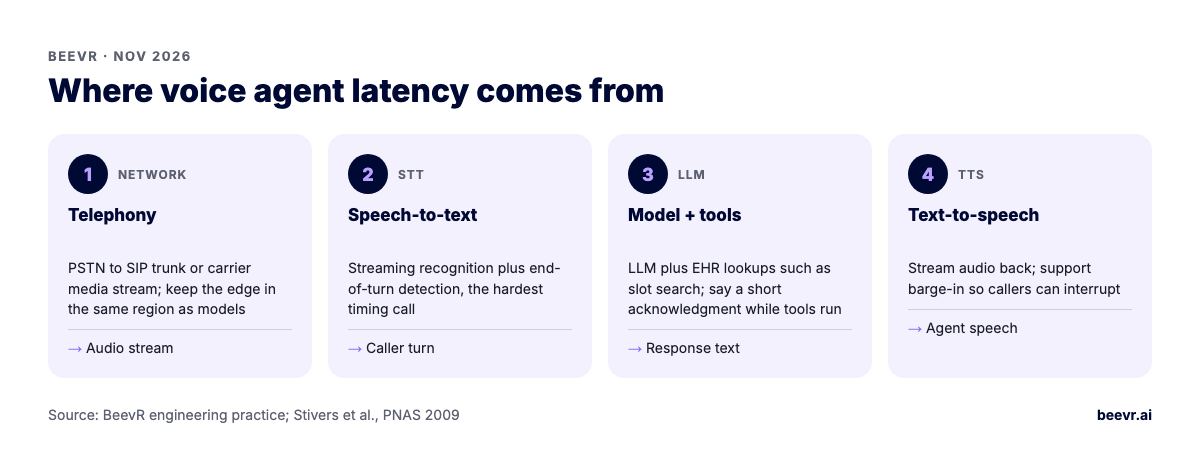
Because people notice silence. Research across ten languages found speakers avoid overlapping and minimize gaps between turns, with average gaps varying only narrowly across cultures. A voice agent that pauses for two seconds sounds broken, and callers start talking over it.
The study is Stivers et al., PNAS 2009. For engineering, the point is that every hop adds up:
- Telephony. PSTN to your SIP trunk or carrier media stream.
- Speech-to-text with end-of-turn detection. Deciding the caller has finished is the hardest part; too eager and you interrupt, too cautious and you add silence.
- Model and tools. The language model plus any EHR lookup, such as available slots.
- Text-to-speech and streaming audio back.
Practical techniques we use: stream every stage instead of waiting for complete outputs; start speaking a short acknowledgment while a slow tool call runs ("Let me check the schedule"); cache slot searches for the next few minutes; support barge-in so callers can interrupt; and keep the model and speech services in the same cloud region as the telephony edge. Measure latency per turn in production, at the 95th percentile, not the average.
How does a voice agent connect to EHR scheduling?
Through the EHR's scheduling APIs, which vary widely. Epic, for example, publishes FHIR STU3 Appointment.$find and $book operations. These depend on scheduling rules each health system configures, so the integration is as much a build-configuration project as a coding one.
Epic's scheduling FHIR page lists those operations alongside Appointment and Schedule reads. Other EHRs offer their own REST or FHIR scheduling APIs, and some only support HL7 v2 scheduling messages. Whatever the interface, the hard problems are the same:
- Visit types and rules. A "new patient, 40 minutes, physician only, requires referral" rule lives in the scheduling build. The agent should ask the EHR for valid slots, never compute them itself.
- Identity before access. Match the caller to a patient record with at least two identifiers before you reveal or change anything. Callers often phone for a parent or child; model the proxy relationship explicitly.
- Race conditions. A slot offered at the start of the call may be gone by the time the caller says yes. Book with a hold or re-check, and have a graceful "that time just went, here are two others."
- Write-back and audit. Every booking needs a clear source ("booked by voice agent, call ID") in the EHR audit trail.
Our EHR integration services page covers how we work with these APIs, and FHIR + MCP for AI agents covers how we expose them to an agent safely.
When should a voice agent escalate to a human?
On any sign of urgency, on request, after repeated misunderstanding, on identity failure, and whenever the call drifts outside the agent's allowed tasks. Escalation should be a warm transfer with a summary, not a cold drop into a queue.
- Urgency. Chest pain, trouble breathing, suicidal thoughts, severe bleeding and similar phrases trigger an immediate safety script and transfer. Tune this list with your clinical leaders and test it often; it is the highest-stakes classifier in the system.
- Request. "Agent," "representative," "a person," in any wording, transfers without argument.
- Confusion. Two failed attempts at the same step move to a human.
- Context handoff. The staff member sees who called, what was verified, what was asked and what the agent already did. Nobody should ask the patient to repeat their date of birth three times.
Design the escalation path before the happy path. It is the part regulators, clinicians and patients will judge you on. More on this in human-in-the-loop AI for regulated industries.
What do HIPAA and the TCPA require for voice AI calls?
HIPAA requires a BAA with every vendor that handles call audio, transcripts or PHI: telephony, speech-to-text, language model, text-to-speech, recording storage and analytics. The TCPA matters for outbound calls: the FCC ruled in 2024 that AI-generated voices count as "artificial" voices, so outbound AI calls need consent or must fit an exemption.
HIPAA
A typical voice stack has five or six vendors in the audio path. Each one that creates, receives, stores or transmits PHI needs a BAA, or you must keep PHI out of it. Recordings and transcripts are PHI; store them where your BAA covers them, set retention, and restrict who can play them back. Send the language model the minimum it needs for the turn. See HIPAA-compliant AI agents for the BAA chain.
TCPA
The FCC's February 2024 declaratory ruling (FCC 24-17) held that AI technologies that generate human-like voices fall under the TCPA's "artificial or prerecorded voice" rules. Inbound calls from patients are not robocalls. For outbound calls to mobile numbers, the healthcare exemption in 47 CFR 64.1200(a)(9)(iv) allows certain care-related calls from providers if they identify the provider, avoid marketing and billing content, stay about one minute or less, are limited to one per day and three per week per patient, and offer an automated opt-out. Opt-outs must be honored immediately.
Recording consent
Some US states require all parties to consent to call recording. Announce recording at the start of every call regardless of where the caller is. This is a summary, not legal advice; have counsel review your call flows.
How should you evaluate a voice agent before going live?
Run scripted test calls covering every intent, accent and failure path, then a limited pilot with human review of every call. Track task completion, handoff rate, AI error rate, latency at the 95th percentile, and missed urgent calls, which should be zero.
- Test set. Hundreds of recorded or simulated calls: noisy lines, speakerphones, accents, proxies calling for family, people who change their mind mid-call.
- Red-team the safety script. Urgent phrases said casually, buried mid-sentence, or in another language.
- Shadow mode. The agent listens and proposes actions while staff handle calls, so you can compare before it takes any.
- Per-intent go-live. Turn on rescheduling before new-patient booking. Expand as the numbers hold.
Our guides to LLM testing in regulated industries and the AI agent security checklist cover the evaluation and security sides in more depth.
How BeevR builds this
We build voice agents as one channel of a larger patient access system: a telephony edge, streaming speech services, a language model with narrow scheduling and lookup tools, and an EHR integration that asks the scheduling build for valid slots instead of guessing. Escalation is designed first, with warm transfer and a call summary. Every call has a transcript, tool log and outcome in an audit trail under your BAA. BeevR signs a BAA as a business associate, and models can run inside your own AWS account under the AWS BAA.
We run a multi-tenant EHR live across four US clinics at about 300 patients a day, so we know what scheduling rules look like in practice. We work in fixed-price phases from $10K per phase, demo every Friday, and you own the code. See healthcare AI agent development, or book a 30-minute call to scope a pilot.