Use an agency for a first healthcare product, an EHR integration or an AI agent with a defined scope. A minimal in-house team of three developers and a QA engineer costs about $730,000 a year fully loaded at US median wages, while published HIPAA MVP builds run roughly $40K–$80K. Build in-house once the roadmap needs several engineers for years.
"Agency or in-house" is usually decided on gut feeling. It shouldn't be, because in healthcare the choice changes three things at once: what you spend, how fast you ship, and who does the HIPAA compliance work every day. This guide uses public US wage data to put numbers on the in-house side and compares them with what a fixed-scope agency build costs. It also explains the hybrid model most practices and health startups end up with. For the general version of this question outside healthcare, see software agency vs in-house.
Should a healthcare company use a software agency or an in-house team?
Use an agency when the work has a beginning and an end, such as an MVP, a patient portal, an EHR or payer API integration, or an AI agent. Build an in-house team when software is the product and you have continuous work for at least three or four engineers for several years. Most clinics and practices are in the first group, and many health startups start there too.
The deciding question is not cost per hour. It is whether you will have full-time work for the people you hire every week for the next three years. Much of the healthcare engineering work in late 2026 is driven by deadlines with a clear end date. One example: under CMS-0057-F, impacted payers must stand up FHIR-based Patient Access, Provider Access, Payer-to-Payer and Prior Authorization APIs, generally by 1 January 2027. Providers and vendors who connect to those APIs face similar one-off projects. Integration sprints like these suit an agency. A digital-health company whose product is the software needs its own engineers eventually, because product knowledge compounds inside the team.
How much does an in-house healthcare software team cost in 2026?
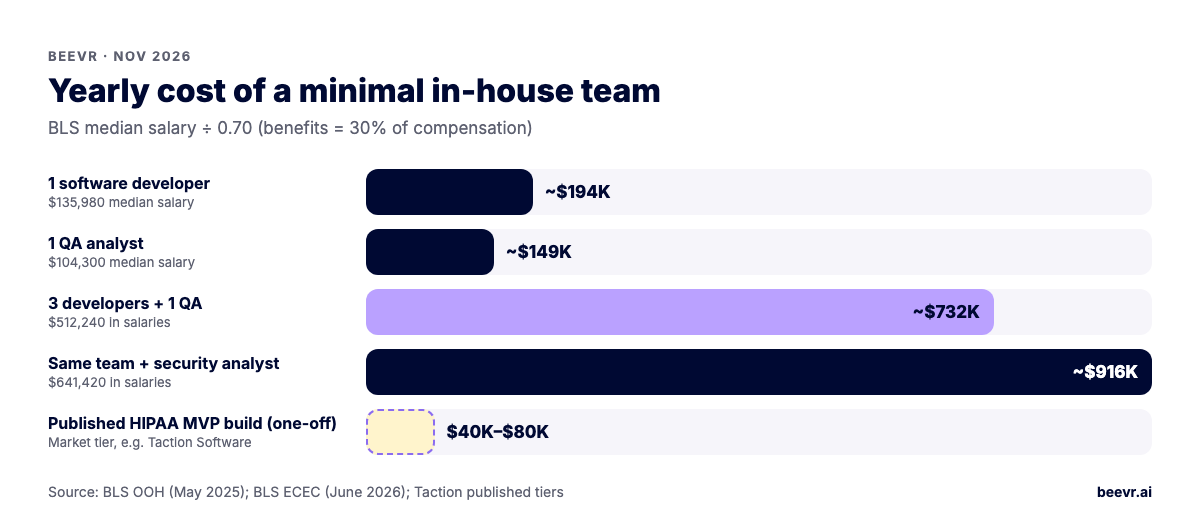
A minimal in-house team of three software developers and one QA engineer costs about $512,000 a year in median salaries, or roughly $730,000 once you add benefits at the US private-sector average. That is before recruiting fees, tools, cloud, security testing and management time.
The numbers come from two Bureau of Labor Statistics sources. The Occupational Outlook Handbook puts the median annual wage at $135,980 for software developers and $104,300 for QA analysts and testers (May 2025). BLS also reports $129,180 for information security analysts. The Employer Costs for Employee Compensation release (June 2026, published 9 September 2026) finds that wages are 70.0% of total compensation in private industry and benefits are 30.0%. Dividing salary by 0.70 gives a fully loaded estimate.
| Role | BLS median salary | Fully loaded (salary ÷ 0.70) |
|---|---|---|
| Software developer | $135,980 | ~$194,300 |
| QA analyst / tester | $104,300 | ~$149,000 |
| Information security analyst | $129,180 | ~$184,500 |
| Minimal team: 3 developers + 1 QA | $512,240 | ~$731,800 / year |
| Same team + 1 security analyst | $641,420 | ~$916,300 / year |
Treat these as a floor. Medians are national. Senior engineers with healthcare integration experience cost more in most metros, and the 30% benefits share is an all-industry average. The point is not the exact figure. A permanent team costs hundreds of thousands of dollars a year whether or not the roadmap keeps it busy.
What an agency build costs for the same outcome
For a defined outcome the agency number is much smaller, because you pay for the project, not for a team for a year. Published market tiers for HIPAA work start at about $40K–$80K for an MVP and $80K–$200K for a full platform (see, for example, Taction Software's published tiers). By the hour, US mid-market firms bill $100–$300 and Southeast Asian agencies $25–$65, according to FullStack Labs' 2026 price guide. Even a $200K platform costs less than four months of the minimal in-house team above. Running costs (cloud, model usage, monitoring, support) are a separate line: get them in writing. Our HIPAA app cost breakdown covers the line items.
How long does it take to hire an in-house team versus start with an agency?
Plan on months to hire and onboard an in-house team, because every senior hire needs sourcing, interviews, a notice period and ramp-up on your domain. An agency with a healthcare track record can usually start discovery within two to three weeks and show a working demo within the first month.
Time matters more than it looks. If the project has a regulatory date attached, such as an API deadline or a payer requirement, each month of hiring delay comes straight out of your build and test window. It also matters for compliance. A new team has to set up access control, logging, environments and BAAs with its tools before it can safely touch PHI. An experienced agency arrives with those patterns already in place.
Who carries the HIPAA compliance burden in each model?
You do, in both models, because a covered entity can't hand off HIPAA responsibility. In-house, you also run every engineering safeguard yourself. With an agency under a BAA, the day-to-day engineering controls move to the agency, but accountability stays with you.
The agency becomes a business associate and takes on contractual duties for the work it does, so the quality of the BAA and the statement of work decides how much of the daily load really moves.
The Security Rule's administrative safeguards (45 CFR 164.308) include a risk analysis, an assigned security official, workforce access management, security training, incident procedures, contingency planning and periodic evaluation. In-house, your engineers and managers do all of that for the software they build. With an agency, the BAA must, under 45 CFR 164.504(e), require the agency to safeguard PHI, report incidents and bind its subcontractors to the same terms.
| Compliance task | In-house team | Agency under a BAA |
|---|---|---|
| Risk analysis for the system | You run it | Agency supplies the technical input; you own the analysis |
| Access control, audit logging, encryption | Your engineers build and maintain | Agency builds; you approve; ongoing support under contract |
| BAAs with tools in the PHI path | You sign each one | Agency names its subcontractors; PHI stays in your cloud account under your BAA |
| Security training for people touching PHI | You train your staff | Agency trains its staff; you can ask for evidence |
| Incident response | Your on-call engineers | Agency reports to you within the contract's timeframe; you notify |
The real risk with agencies is not that you lose control. It is a vague contract. Use our HIPAA software checklist to check the deliverables.
When does an in-house team make more sense?
In-house is the better choice when software is your core product, the roadmap is continuous and you can keep at least three or four engineers busy for years. It also makes sense when you must keep deep clinical-workflow knowledge inside the company, or when an investor or acquirer expects an internal engineering team.
Signs that you have reached that point: you are paying an agency every month with no end date, product decisions wait on outside engineers, and the same domain knowledge has to be explained again with every new person. At that stage, hire a strong technical lead first. Don't hire four engineers at once.
What does a hybrid agency + in-house model look like?
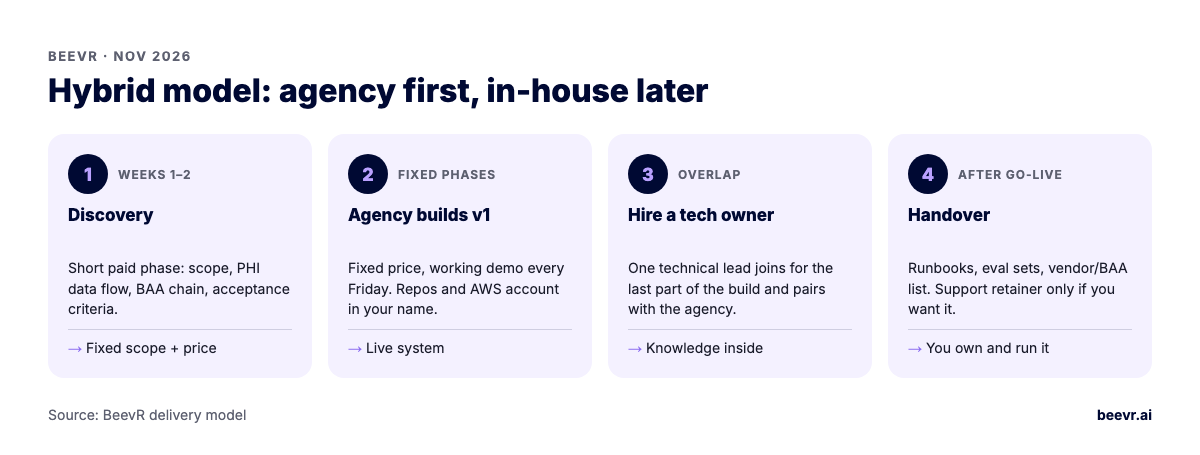
The agency builds version one under a fixed scope while you hire one technical owner. The two work together for the last part of the build, and then the agency hands over the code, documentation and runbooks. The agency stays on a small support retainer only if you want it.
You get speed now and ownership later, without a rewrite.
For this to work, ownership has to be clean from the start. Your repositories, your AWS account and your model keys should be in your name on day one. Read do you own the code when you hire an agency? before you sign anything. The agency should write code your future hires can read: conventional frameworks, tests, infrastructure as code, and an audit log you can query.
Handover checklist
- Architecture notes and a data-flow diagram showing exactly where PHI goes.
- Runbooks for deploys, rollbacks, key rotation and break-glass access.
- Test suite and evaluation sets for any AI features, so your team can change prompts or models safely.
- A list of every vendor in the PHI path, with its BAA status.
- Paired sessions with your new hire on the parts of the code that change most.
What should a healthcare agency contract include?
A signed BAA, assignment of all code and IP to you, fixed scope with written acceptance criteria per milestone, a change-request process with prices, a support option with response times, and a clause that lets you take the work in-house at any time without a transfer fee.
Also ask the agency to name the senior people who will actually write your code. In healthcare, the person wiring your EHR integration matters more than the firm's logo. Our guide on how to choose a development partner covers the interview questions.
How BeevR builds this
We work with health-tech companies and provider organisations that don't want, or don't yet need, a permanent engineering department for a given piece of work. We sign a BAA as a business associate. The AI model can run inside your own AWS account under the AWS BAA, and we design for safety from the start: only the minimum necessary PHI reaches the model, agent actions that write to clinical records or contact patients need human approval, access is role-based, and every action lands in an audit log. Integrations use official APIs (FHIR where available) with scoped credentials, never shared admin logins.
We are a senior, founder-led team in Hanoi with a multi-tenant EHR live across four US clinics at around 300 patients a day, and a 5.0 rating on Clutch. We work on a fixed scope and fixed price per phase, from $10K per phase, with a working demo every Friday, and you own the source code and IP from day one. When you are ready to hire in-house, we hand over. See HIPAA MVP development for new products and healthcare AI agent development for agentic work.
Not sure which model fits? Book a 30-minute call. We'll tell you honestly whether you need us, an in-house hire, or an off-the-shelf tool.