In November 2026 Epic ships three built-in AI lines: Art for clinicians (ambient AI Charting, message drafting, chart summaries), Emmie for patients in MyChart, and Penny for revenue cycle, used by 200+ organizations for coding. Agent Factory for custom agents reaches early adopters now, with broader availability in 2027. Custom agents still fit work that crosses systems Epic does not own.
Updated 24 November 2026. Search data shows many people still look for "Epic Orchard" when they mean Epic's app and AI ecosystem, so this guide starts from what Epic itself has published: its newsroom, product pages and open.epic. Every status and number below comes from Epic's own pages, with dates. Most outcome figures are self-reported by Epic customers, and we say so. Then we cover what Epic does not do natively, and where a custom agent built on Epic's APIs still makes sense.
What AI does Epic include natively in 2026?
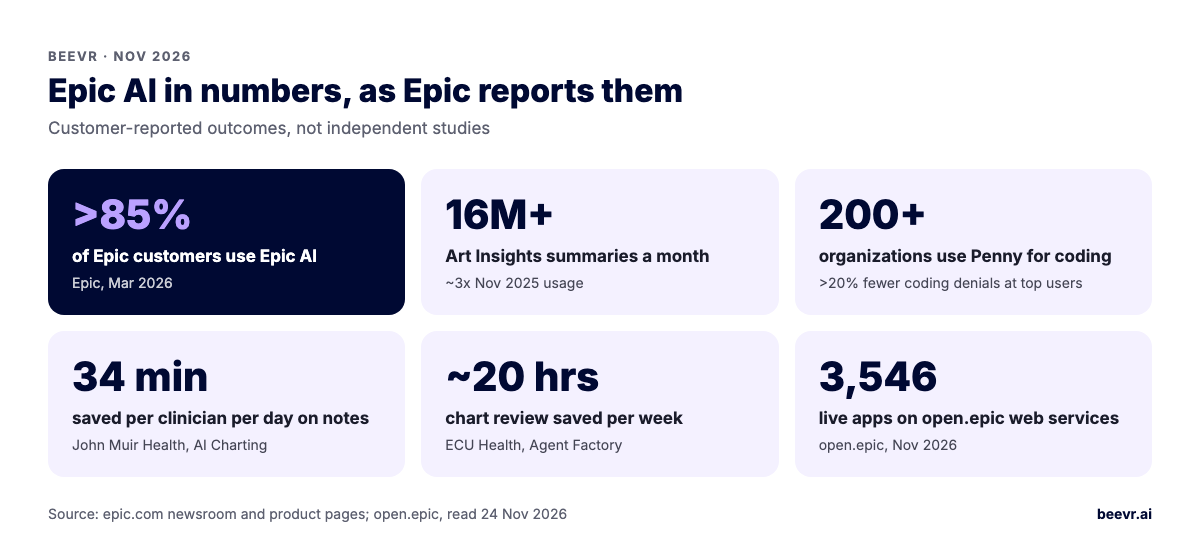
Epic groups its AI into three named assistants (Art, Emmie and Penny) plus a platform, Agent Factory, for health systems to build their own agents. Epic said in March 2026 that more than 85% of its customers use Epic AI. Most features draft or summarize for a person to review. Autonomous action is still limited and rolling out.
| Epic AI line | Who it serves | Main capabilities | Status (Epic's own pages) |
|---|---|---|---|
| Art | Clinicians and nurses | Ambient AI Charting, message drafting and routing, Insights summaries, Ask Art, coding suggestions | AI Charting released 4 Feb 2026; Insights used 16M+ times a month |
| Emmie | Patients in MyChart and by text | Scheduling by text, billing questions, result and report explanations, Ask Emmie | In use; Ask Emmie had limited availability in March 2026 |
| Penny | Revenue cycle and operations | Coding suggestions, denial appeal letters, prior auth answers, utilization review drafts | Coding used by 200+ organizations; autonomous coding and appeals "over time" |
| Agent Factory | Health system builders | Build, monitor and evaluate custom agents inside Epic | Early-adopter training from Oct 2026; broader availability planned for 2027 |
| Agent Factory Connectors | Third-party app developers | Let Epic AI read from or act in other apps | Announced 21 Oct 2026; on Showroom from March 2027 |
Sources: Epic's 10 March 2026 AI update, 4 February 2026 AI Charting post and the posts linked below, read 24 November 2026. Epic's newsroom did not have a single UGM 2026 recap we could cite, so this guide relies on Epic's dated posts and product pages, not conference coverage.
What can Epic's Art do for clinicians?
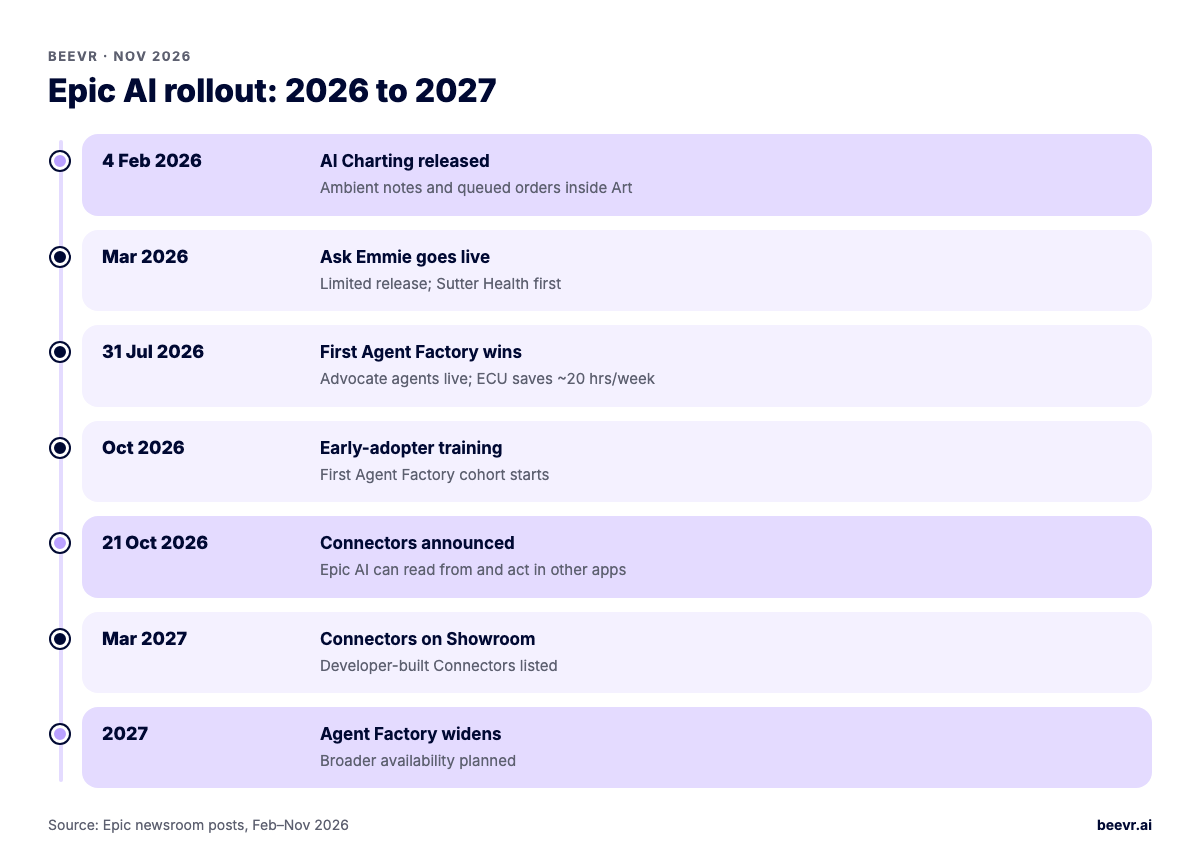
Art drafts notes, replies and summaries inside the Epic workflow. The headline feature is AI Charting, released on 4 February 2026: it listens during the visit, drafts the note and queues suggested orders for the clinician to review. Art also summarizes charts, drafts patient-message replies and suggests codes.
Epic's Art product page lists 35 capabilities. The ones most health systems ask about:
- AI Charting (ambient). Drafts outpatient notes, orders and diagnoses from the visit conversation, with inpatient and ED versions. Epic cites John Muir Health clinicians saving 34 minutes a day on notes.
- Insights. Pre-visit and inpatient chart summaries. Epic said in February 2026 these were used more than 16 million times a month, nearly three times November 2025 usage.
- Message drafting and routing. A 4 November 2026 post says Advocate Health nurses save about 1.5 minutes per drafted reply, and that at OhioHealth urgent messages were read 2.5 hours sooner than routine ones once Art sorted them.
- Draft Hospital Course Notes. Discharge summaries completed 20–30% faster, per Epic's March update.
- Ask Art, coding and extraction. Cited answers about a patient, diagnosis code and level-of-service suggestions, and data pulled from pathology, imaging and staging text.
As of Epic's March 2026 update, conversational AI for clinicians and a Diagnosis Checker were announced but not yet available. If you are evaluating ambient documentation, our ambient AI scribe evaluation guide covers how to test it before rollout.
What does Emmie do for patients in MyChart?
Emmie is Epic's patient-facing assistant in MyChart and over text. It schedules and reschedules by text, answers billing questions and takes payments, explains imaging and endoscopy results in plain language, and sends follow-up reminders generated from visit notes. Its open-ended chat, Ask Emmie, was still in limited release in March 2026.
According to Epic's Emmie page and March update, Ask Emmie answers questions by referencing visit notes, lab results and past messages. Sutter Health was the first live organization, with broader availability planned "in the coming weeks." Reported results are self-reported by customers: patients rescheduled more than 14,900 appointments with Emmie at Ochsner Health, saving almost 750 staff hours, and Rush saw a 58% drop in billing-related service messages.
What does Penny automate in the revenue cycle?
Penny drafts and suggests. It does not yet run the revenue cycle on its own. It offers coding suggestions, drafts denial appeal letters and prior authorization answers, and checks medical necessity against payer criteria. Epic said in February 2026 that more than 200 organizations use it for professional billing coding.
The Penny page lists 24 capabilities across utilization management, denials, coding, reporting and discharge planning. Epic reports coding-related denials down more than 20% at the most active users and appeal letters written 23% faster. Its March update says Penny will complete coding sessions and appeal submissions on its own "over time," within each organization's guardrails. Today a person still approves the output. For the wider picture of agentic AI in billing, see agentic AI in revenue cycle management.
What is Epic Agent Factory and when can health systems use it?
Agent Factory is Epic's platform for health systems to build, monitor and evaluate their own AI agents inside Epic. Training for the first early adopters began in October 2026, and Epic plans broader availability in 2027. Most Epic customers cannot build on it yet.
Early uses are already live at some sites. On 31 July 2026, Epic reported that Advocate Health runs agents for inpatient pharmacy and infusion chart preparation, and that ECU Health cut chart review by about 20 hours a week with stay summaries for case managers. A 15 September 2026 Build-a-Thon post lists agents in progress: checking refill requests against protocol, flagging likely day-of-surgery cancellations, and detecting missing critical care time documentation. Epic's posts do not say which language models Agent Factory uses or how it is priced.
How do Agent Factory Connectors change Epic integration for third-party apps?
Connectors let Epic's AI (Art, Emmie, Penny and agents built in Agent Factory) pull information from another app or complete a task in it. Developer-built Connectors will be listed on Epic Showroom starting in March 2027. Before turning one on, a health system can review what it can read and what it can change.
Epic's 21 October 2026 announcement gives two examples: pulling an ambulance's arrival time into the ED, and placing a meal order in a hospital's dietary system. The post does not name the protocol. Trade press reported MCP, but we could not confirm that on an Epic page, so plan for whatever Epic's developer documentation specifies. Related signals on open.epic: an open.epic MCP server now lets AI clients search Epic's API documentation, a "Validating AI Features" playbook exists for developers, and the site lists 3,546 live apps using its web services.
For app vendors this shifts the question. You used to ask how your app reads from Epic. Now you also ask whether Epic's own AI should be able to call your app. Our guide to FHIR MCP servers for AI agents covers the tool-design side.
Is Epic App Orchard still where you list AI apps?
No. App Orchard was replaced by Epic Showroom, and Showroom is also where Agent Factory Connectors will appear from March 2027. The public APIs on open.epic remain free to use. Our Epic App Orchard to Showroom guide covers tiers, fees and timelines.
For server-to-server access from an agent, Epic uses SMART Backend Services with its own requirements on keys and token lifetimes. See SMART Backend Services for AI agents for the JWT and JWKS details.
Where do health systems still need custom AI agents?
Custom agents fit where the work leaves Epic: payer portals, ERP and supply systems, non-Epic affiliates, contact centers, or products a vendor must sell across several EHRs. They also fit when you need control over the model, hosting and evaluation evidence, or cannot wait for Agent Factory's 2027 rollout.
Gaps Epic's native AI does not cover today
- Cross-system workflows. Prior authorization status on payer portals, claims in a clearinghouse, inventory in ERP. Connectors will help from 2027, but only for apps that build them.
- Multi-EHR organizations and vendors. A health system with Epic plus acquired sites on another EHR, or a digital health company selling to Epic and Oracle Health customers, needs one agent layer over several EHRs. See our Oracle Health FHIR integration guide.
- Payer-side work. Epic's Penny serves providers. Payers meeting the CMS-0057-F API deadlines in January 2027 build their own.
- Model and hosting control. Some teams must pin a model version, run it in their own cloud account or produce their own validation evidence for an AI governance committee.
- Timing. If you are not in the Agent Factory early-adopter group, a use case that cannot wait until 2027 needs another path.
When not to build
If Art, Emmie or Penny already covers the workflow, turn it on and measure it first. A custom ambient scribe or message drafter rarely beats the one already inside the clinician's screen.
Should you build inside Agent Factory or outside Epic?
Build inside Agent Factory when the work lives entirely in Epic and you have access. Build outside, on FHIR APIs, SMART Backend Services and eventually Connectors, when the work spans other systems, other EHRs, or must ship before 2027.
| Question | Turn on Art / Emmie / Penny | Build in Agent Factory | Custom agent on Epic APIs |
|---|---|---|---|
| Does the work stay inside Epic? | Yes, standard workflow | Yes, local variation | No, spans other systems |
| Available to most customers today? | Mostly yes | Early adopters; broader in 2027 | Yes, via open.epic and customer approval |
| Who controls model and hosting? | Epic | Epic platform | You |
| Works across several EHRs? | No | No | Yes, if designed for it |
| Who builds the eval evidence? | Epic plus your local testing | Your team, with Epic tools | Your team |
Our CMS prior authorization API guide covers one common cross-system case in detail.
How should you evaluate Epic's built-in AI before turning it on?
Treat Epic's published results as a starting point, not proof. Most are self-reported by early sites. Build a local test set from your own notes and messages, define what counts as an acceptable draft, measure edit rates and time saved on your units, and repeat after each Epic update.
AI behavior can change between Epic upgrades. Keep a fixed set of de-identified cases, re-run it after each upgrade, and track how often clinicians accept drafts without edits. Our guide to LLM testing for regulated industries covers audit-ready evaluation and the controls for custom builds.
How BeevR builds this
We build the parts Epic does not ship: agents that read from Epic through FHIR and SMART Backend Services, act in payer portals, ERP or a second EHR, and hand a draft to a person before anything is written back. We are not an Epic partner, and when Art, Emmie or Penny already covers a workflow we will tell you to turn that on instead. Every agent ships with an evaluation set built from your de-identified cases and an audit log of every action. BeevR signs a BAA as a business associate, and models can run inside your own AWS account under the AWS BAA.
Our senior, founder-led team in Hanoi has a multi-tenant EHR live across four US clinics at about 300 patients a day. You get a working demo every Friday, fixed-scope phases from $10K, and you own the source code and IP from day one. See healthcare AI agent development for how we scope these projects.
Mapping your 2027 AI plan around Epic? Book a 30-minute call and we will sort your use cases into turn on, build in Agent Factory, or build outside.