In November 2026 the main enterprise agent platforms are Salesforce Agentforce, Microsoft Copilot Studio with Agent 365, Google's Gemini Enterprise Agent Platform, OpenAI's Agents SDK and Frontier, Anthropic's Claude Managed Agents and AWS Bedrock AgentCore. Pick the platform that owns your data. Build custom only when the workflow crosses systems no single vendor controls.
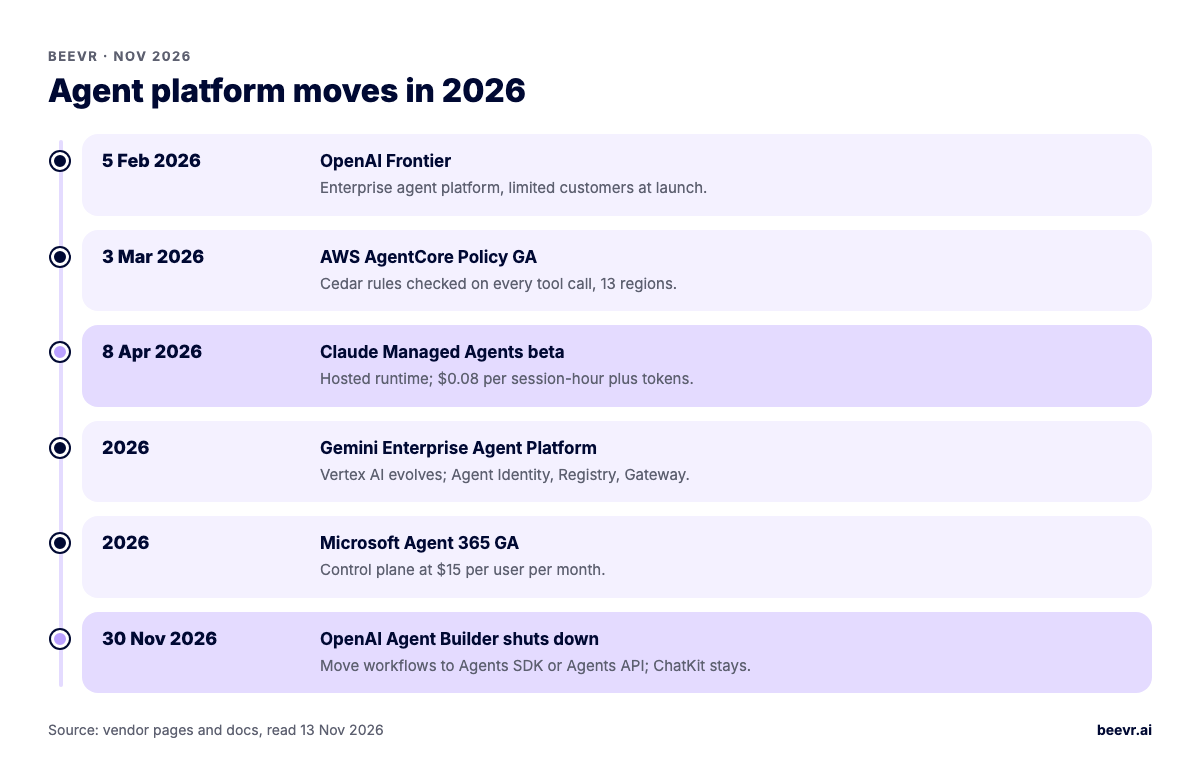
Updated 13 November 2026. Every major vendor now sells some mix of an agent builder, a managed runtime and a governance layer. The products changed fast this year. Google renamed Vertex AI, Anthropic launched a managed agent runtime, Microsoft shipped a separate control plane, and OpenAI is shutting down its visual Agent Builder on 30 November 2026. This comparison uses each vendor's own pages and docs, read on 13 November 2026, and ends with a build-vs-platform decision you can apply to your own case.
Which enterprise AI agent platforms matter in late 2026?
Six platforms cover most enterprise shortlists. They split into two groups. Some are tied to an application suite you already run (Salesforce, Microsoft, Google Workspace). The others are model-vendor or cloud runtimes you build on (OpenAI, Anthropic, AWS, and Google's developer platform).
| Platform | Best fit | Build style | Governance layer | Published pricing |
|---|---|---|---|---|
| Salesforce Agentforce | Sales, service and field ops on Salesforce data | Low-code in Salesforce | Inside the Salesforce platform | $500 per 100K Flex Credits (≈$0.10 per action) or $2 per conversation |
| Microsoft Copilot Studio + Agent 365 | Microsoft 365 and Teams-centred companies | Low-code, plus pro-code | Agent 365 control plane, Entra Agent ID | Agent 365: $15 per user per month; included in M365 E7 ($99) |
| Google Gemini Enterprise Agent Platform | Google Cloud and Workspace shops; multi-model | Agent Development Kit (code) plus no-code app | Agent Identity, Registry, Gateway, Model Armor | Usage-based by component |
| OpenAI Agents SDK, Agents API, Frontier | Teams standardised on OpenAI models | Code-first SDK; managed Codex-harness API | Frontier (limited availability at launch) | Token pricing; Frontier not published |
| Anthropic Claude Managed Agents | Long-running agents on Claude without running infra | API, agents defined in config | Scoped permissions, vaults, tracing in Console | Tokens plus $0.08 per session-hour (public beta) |
| AWS Bedrock AgentCore | AWS-native teams; any framework or model | Bring your own framework | AgentCore Identity, Gateway, Policy (Cedar) | Usage-based by component |
Pricing changes often. Treat the numbers above as list prices on the vendor pages on 13 November 2026, not as quotes.
What is Salesforce Agentforce best for, and what does it cost?
Agentforce is the right default when the work lives in Salesforce: cases, leads, orders, field service. The agent reads and writes the same records your teams use, under the same sharing rules, so there is no integration project before value. Outside Salesforce data it is weaker, and every external system still needs an integration.
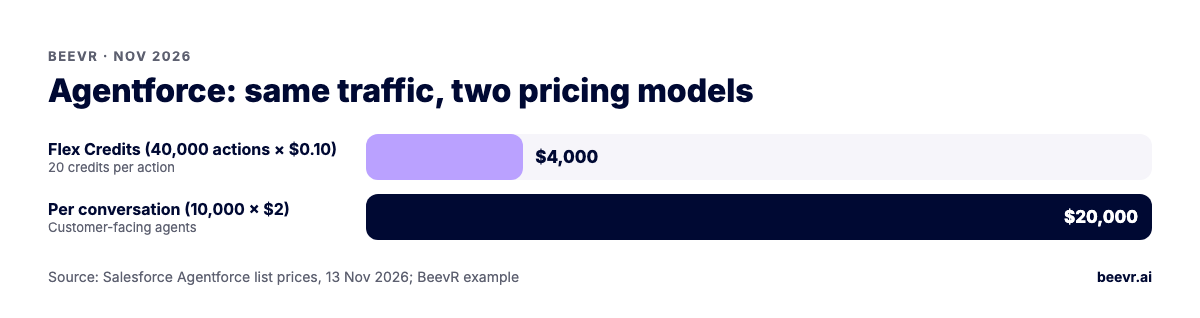
The Agentforce pricing page lists three models. Flex Credits cost $500 per 100,000; a standard action uses 20 credits (about $0.10) and a voice action 30 (about $0.15). Per-conversation pricing is $2 per conversation for customer-facing agents. Per-user add-ons start at $125 per user per month. Flex Credits and Conversations cannot be mixed in the same org.
The model you choose matters more than it looks. A service agent that handles 10,000 conversations a month at four actions each uses 40,000 actions. That is about $4,000 a month on Flex Credits, against $20,000 on per-conversation pricing. If your conversations are short and action-light, the gap narrows. Model it with your own traffic before you sign.
What does Microsoft offer for building and governing agents?
Two products. Copilot Studio is where business and pro developers build agents for Microsoft 365, Teams and the Power Platform. Agent 365 is the control plane that observes, secures and governs agents, including agents built outside Microsoft. It is now generally available at $15 per user per month standalone, and included in Microsoft 365 E7 at $99 per user per month.
The strength is identity. Agents published through Microsoft 365 channels and registered with an Entra Agent ID show up automatically in the Agent 365 inventory. Conditional access and network filtering extend from users to agents. Microsoft lists partners such as ServiceNow, Workday, Glean and Adobe whose agents can be registered too. If Entra is already your identity provider, this is the shortest path to knowing which agents exist and what they can reach. We go deeper into this pattern in AI agent control planes.
What is Google's Gemini Enterprise Agent Platform?
It is Google Cloud's developer platform for agents. Google's documentation describes it as "an evolution of Vertex AI". It bundles the Agent Development Kit (a model-agnostic framework), Agent Runtime for deployment (formerly Agent Engine), Agent Identity (a unique identity per agent), Agent Registry (a catalog of agents, tools and MCP servers), Agent Gateway (a central policy point for tool calls) and Model Armor (prompt-injection and data-leak filtering). Model Garden offers Gemini plus third-party and open models.
The employee-facing side is the Gemini Enterprise app, which took over from Agentspace. The platform's case is openness. It speaks MCP and Agent2Agent (A2A), runs many models, and puts identity and gateway policy in the platform rather than in your code. The cost is Google Cloud lock-in at the runtime and identity layer.
What happened to OpenAI's AgentKit and Agent Builder?
OpenAI is shutting Agent Builder down. Its developer docs say "OpenAI is deprecating Agent Builder" and that the product is scheduled to shut down on 30 November 2026. ChatKit, the embeddable chat UI, remains. If you built workflows in the visual builder, plan the move now.
OpenAI's current agents guide lists three paths. The Agents SDK runs the agent loop in your own application, with tools, handoffs and guardrails. The Agents API runs an agent on the Codex harness, which OpenAI manages, for long-running tasks. ChatKit covers the front end. For enterprises, OpenAI announced Frontier on 5 February 2026 as a platform to build, deploy and manage agents with shared business context and permissions. It was available only to a limited set of customers at launch, and we could not confirm general availability or published pricing.
The lesson is broader than OpenAI. Visual builders from model vendors come and go. Keep your agent logic in code you own, and treat hosted builders as prototyping tools.
What are Claude Managed Agents and how are they priced?
Claude Managed Agents is Anthropic's hosted agent runtime, in public beta since 8 April 2026. Anthropic runs the harness, secure sandboxes for code execution, and long-running sessions that keep progress through disconnections. It provides scoped permissions and identity, credential vaults for unattended scheduled runs, and tracing of every tool call in the Claude Console. Pricing is standard token rates plus $0.08 per session-hour of active runtime. Multi-agent coordination and outcome-based self-evaluation are still in research preview. Self-hosted sandboxes and MCP tunnels let the agent reach systems inside your own network.
Runtime cost is small next to tokens: 1,000 active session-hours a month is $80 before tokens. The real decision is whether you want Anthropic to host the loop. Teams that need the model to run inside their own cloud account for data-residency or BAA reasons usually call Claude through Amazon Bedrock or Google Cloud and run their own loop instead. Check current availability on each cloud before you design around it.
Where does AWS Bedrock AgentCore fit?
AgentCore is the bring-your-own-framework option. You write the agent in any framework (LangGraph, Strands, the OpenAI or Claude SDKs) and AWS provides the runtime, identity, memory, a gateway that turns APIs and MCP servers into tools, and observability. Policy in AgentCore became generally available on 3 March 2026 in 13 regions. Rules are written in plain language or Cedar, and the gateway checks every tool call against them before it runs.
For regulated teams already on AWS this is often the cleanest fit. Data stays in your account, you keep your framework, and tool permissions are enforced outside the model's reasoning.
Should we build our own agent or use a vendor platform?
Use the platform that owns the data when the workflow stays inside one suite. Build custom when the workflow crosses several systems, needs approval rules your platform cannot express, or must run in your own cloud for compliance. Most companies end up with both: suite agents for suite work, and one or two custom agents for the processes that make them different.
| Question | If yes | If no |
|---|---|---|
| Does 80%+ of the workflow's data live in one suite (Salesforce, M365, Google)? | Start with that suite's agents | Custom or a cloud runtime |
| Do actions need multi-step approvals, limits or human review the platform can't express? | Custom policy layer | Platform guardrails may do |
| Must data and the model run in your own cloud account? | AgentCore, Google Agent Platform, or self-hosted loop | Managed runtimes are an option |
| Will per-action or per-conversation pricing exceed a custom build's run cost within 12 months? | Model a custom build | Platform pricing is fine |
| Is the agent a product you sell, not an internal tool? | Own the code | Platform is fine |
Our build vs buy guide covers the business side in more detail, AI agent cost covers the numbers, and AI agent frameworks in 2026 covers the code-level choice if you build.
What lock-in risks should CTOs check before choosing a platform?
Check four things before you sign, because each one is expensive to undo later:
- Agent definitions. Can you export prompts, tools and workflows as code or config? A visual-only builder is a migration project waiting to happen, as Agent Builder users are finding out.
- Identity. Is the agent's identity in your IdP (Entra, Okta, Google) or only inside the vendor? Your audit trail follows the identity.
- Tools. Are integrations exposed as MCP servers or open APIs you can reuse elsewhere? MCP is now supported across most of these platforms, but it has its own risks; see MCP security in 2026.
- Logs. Can you stream full traces (inputs, tool calls, outputs, approvals) to your own SIEM or warehouse, with your retention rules?
How BeevR builds this
We build custom AI agents and integrate with the platforms above when that is the better answer. Sometimes the honest recommendation is "use Agentforce for this one" and we will say so. When we build, the agent logic is code in your repository, tools are MCP servers or plain APIs you own, and tool permissions and approvals are enforced in a policy layer outside the model. The model can run inside your own AWS account under the AWS BAA for healthcare work.
BeevR is a senior, founder-led team in Hanoi with a 5.0 rating on Clutch. Fixed-scope, fixed-price phases from $10K, a working demo every Friday, and you own the code and IP from day one. See how we approach AI agent development.
Choosing between a platform and a custom build? Book a 30-minute call and we will walk through your workflow against the table above.