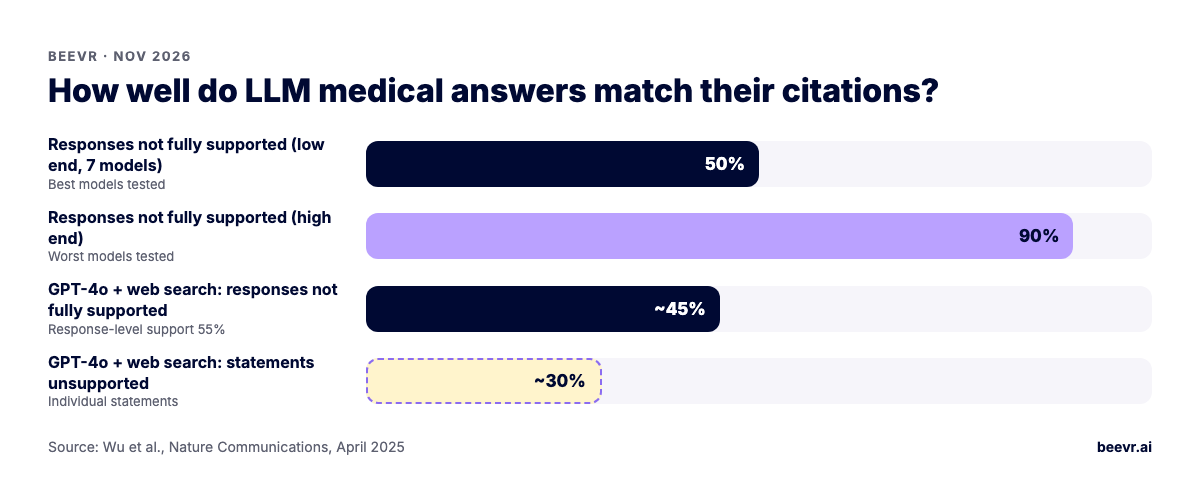
RAG over clinical guidelines and internal policies works when every answer cites the exact passage and version it came from, and the system refuses when nothing supports an answer. Without that, expect trouble: a 2025 Nature Communications study found 50–90% of LLM medical answers were not fully supported by their own citations.
Retrieval-augmented generation is the default architecture for "ask our policies" and "ask the guideline" tools in hospitals, payers and digital health companies. It looks simple: chunk documents, embed them, retrieve the top results, let the model answer. In clinical settings, the simple version fails in specific and predictable ways: stale versions, the wrong patient population, citations that do not say what the answer claims. This guide covers the architecture choices that matter, the failure modes, how to evaluate, and when RAG is the wrong tool. Checked on 12 November 2026.
When is RAG the right architecture for clinical guidelines and policies?
RAG is right when the answer is written down in a document you control, changes over time, and a clinician or staff member can check the cited passage themselves. Policy lookup, guideline navigation, payer coverage criteria and protocol questions fit well. Patient-specific calculations and dosing do not.
The test is whether a human could answer the question by finding the right paragraph. If yes, RAG saves the search time and shows the paragraph. If the answer requires combining a patient's data with rules (eligibility, dose adjustment, risk scores), you need structured logic or a validated calculator, possibly with the model only explaining the result. Mixing the two in one prompt is where many clinical assistants go wrong.
How should you chunk clinical guidelines for retrieval?
Chunk by the document's own structure, not by a fixed token count. A recommendation, its strength and evidence grade, its population and its caveats should stay together, and every chunk should carry metadata: source, version, effective date, section path, population and owner.
Rules that hold up
- Respect headings and recommendation boundaries. Split on section and recommendation, then sub-split only if a section is very long. Keep the section path ("Sepsis > Adults > Antibiotic timing") in the chunk text so retrieval sees it.
- Keep qualifiers attached. "Except in pregnancy" in the next paragraph is the kind of text fixed-size chunking cuts off. Attach footnotes and exclusions to the recommendation they modify.
- Treat tables as first-class. Dosing and criteria tables lose meaning when flattened. Store each row with its headers, or keep the table as one chunk with a text summary for retrieval.
- Index definitions separately. Terms like "high risk" are often defined once, pages away. Link the definition chunk so it can be retrieved alongside.
- Use hybrid retrieval. Combine keyword search (drug names, codes, exact terms) with embeddings, then rerank. Pure vector search is weak on exact identifiers.
How do you handle guideline versions and local policy overrides?
Store every version with an effective date and a supersedes link, retrieve only the version in force for the date in question, and rank local policy above external guidance when your organization has adopted a local rule. Show the version and date in every answer.
Stale guidance is the most dangerous quiet failure in clinical RAG, because the answer looks right and cites a real document. Three controls prevent it:
- Version registry. Each document has an ID, version, effective-from and effective-to dates, owner and status (draft, active, retired). Retrieval filters on status = active and the query date by default.
- Precedence rules. Decide in writing how local protocols, payer policies and national guidelines rank, and encode it. When two active sources conflict, the answer should say so and show both, not pick one silently.
- Change pipeline. When a document changes, re-chunk and re-index it, retire the old chunks, and re-run the evaluation questions that touch it. A policy owner signs off before the new version goes live.
How do you make citations in a clinical RAG answer trustworthy?
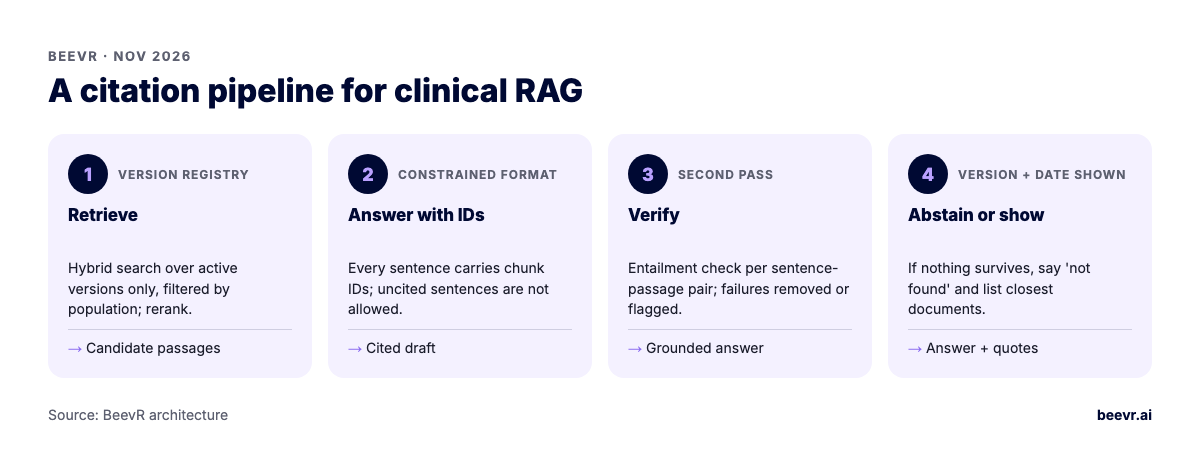
Cite at the statement level, link to the exact passage, and verify after generation that each cited passage actually supports the statement. Drop or flag statements that fail the check, and let the system say "I could not find this in the current policies" instead of answering from the model's general knowledge.
The evidence for doing this is strong. Wu et al. in Nature Communications (April 2025) tested seven models on 800 medical questions and nearly 58,000 statement-source pairs. Between 50% and 90% of responses were not fully supported by the sources they cited, and even GPT-4o with web search left about 30% of individual statements unsupported. Retrieval helps; it does not guarantee grounding.
A citation pipeline that works
- Constrained answer format. Each sentence carries one or more chunk IDs. Sentences without an ID are not allowed in the final answer.
- Quote spans. Show the exact supporting text when the user hovers or expands, not just a document title.
- Entailment check. A second pass, by a separate model call or a smaller classifier, asks "does this passage support this sentence?" for every pair. Failures are removed or marked.
- Abstain path. If retrieval confidence is low or no passage survives the check, the answer is a clear "not found" with the closest documents listed for the user to read.
What are the common failure modes of clinical RAG?
The recurring ones are retrieval misses, stale versions, wrong population, conflicting sources, split tables, citations that do not support the claim, answering beyond the documents, and instructions hidden in documents. Each has a specific control.
| Failure mode | What it looks like | Control |
|---|---|---|
| Retrieval miss | Right answer exists but is not in the top results | Hybrid search, reranking, query rewriting; measure recall@k |
| Stale version | Answer cites a retired protocol | Version registry with effective dates; filter on active |
| Wrong population | Adult guidance given for a pediatric question | Population metadata; ask a clarifying question when unclear |
| Conflicting sources | Local policy and national guideline disagree | Written precedence rules; show both when unresolved |
| Split context | Table or exception cut from its recommendation | Structure-aware chunking; tables as units |
| Unsupported citation | Citation is real but does not say what the sentence says | Statement-level entailment check after generation |
| Answering beyond documents | Model fills gaps from general knowledge | Abstain path; forbid uncited sentences |
| Injected instructions | A document contains text that steers the model | Treat retrieved text as data; strip or flag instructions; restrict tools |
The last one is easy to forget: if your corpus includes uploaded PDFs or external pages, any of them can contain text aimed at the model. OWASP lists prompt injection, including indirect injection through retrieved content, as the top LLM application risk. We cover this class of risk in our AI agent security checklist.
How do you evaluate a clinical RAG system?
Build a question set from real user questions, have clinicians or policy owners write the reference answer and the source passage for each, and measure retrieval recall, answer faithfulness, correct abstention and version correctness separately. Run the set on every change to documents, prompts, models or retrieval settings.
- Retrieval recall@k. Is the gold passage in the top k results? If not, the generator never had a chance.
- Faithfulness. Share of answer sentences supported by their cited passages.
- Correctness. Does the answer match the clinician's reference? Score major and minor errors separately.
- Abstention. Include questions the documents cannot answer. The right output is "not found", and you should measure how often the system says it.
- Version correctness. Questions whose answer changed between versions. The system must give the current one.
Start with 100–200 questions per domain, add every real failure users report, and keep the set under version control. This is the same discipline as any regulated LLM system; see LLM testing for regulated industries. In production, log queries, retrieved chunks, answers and user feedback so you can trace a bad answer to its cause.
When is RAG the wrong tool?
When the answer depends on calculation over patient data, when a validated clinical decision support rule already exists, when the corpus is too small to need search, or when the output would make the product a regulated medical device without the controls to match.
- Dosing and scores. Use deterministic code or validated calculators. The model can explain the result and cite the guideline the rule came from.
- Structured questions. "How many patients are overdue for X?" is a database query, not retrieval.
- Tiny corpora. If the whole policy set fits comfortably in the model's context, a well-structured prompt with the full text may beat retrieval and remove a failure mode. Retrieval still wins on version control at scale.
- Patient-facing answers. Clinical guidance to patients carries different risk and, in some states, disclosure rules; see healthcare AI laws by state.
Does the FDA regulate RAG tools for clinicians?
It can, depending on what the tool does. FDA's clinical decision support software guidance, revised in January 2026, keeps software for clinicians outside device regulation when, among other criteria, the clinician can independently review the basis for the recommendation. Statement-level citations to the source passage are how a RAG tool supports that.
The current CDS guidance applies the criteria in section 520(o)(1)(E) of the FD&C Act. Legal commentators such as Covington note that the 2026 revision is largely silent on generative AI and focuses on clinician-facing tools. A RAG tool that summarizes your own policies for staff is a different risk class from one that recommends treatment for a specific patient. Get a regulatory opinion before you ship the second kind.
How BeevR builds this
We build clinical and policy RAG systems with the controls above as defaults: structure-aware ingestion with tables kept intact, a version registry with effective dates and precedence rules, hybrid retrieval with reranking, statement-level citations verified after generation, an abstain path, and an evaluation set owned by your clinicians that runs in CI. PHI stays out of the index unless the use case needs it, and when it does, retrieval filters by the user's access. The model can run inside your own AWS account under your AWS BAA, and BeevR signs a BAA as your business associate.
We are a senior, founder-led team in Hanoi, rated 5.0 on Clutch, and we built a multi-tenant EHR now live across four US clinics at about 300 patients a day. We work in fixed phases, from $10K per phase, with a working demo every Friday, and you own the code from day one. See our healthcare AI agent development and our HIPAA-compliant AI agent architecture.
If you are planning a guideline or policy assistant, book a 30-minute call. Bring two or three real documents and ten real questions, and we will show you where a naive pipeline would fail.