Choose a fintech MVP firm that designs your card flow to keep you out of most of PCI DSS v4.0.1 scope, builds the SOC 2 controls into the code from sprint one, and can show you evidence: architecture diagrams, a sample control matrix and its own security policies. If a firm only offers "compliance later," take it off your list.
Founders ask this question in two forms: "Who are the top engineering firms for a fintech MVP with PCI and SOC 2?" and "Which vendors specialize in MVP-to-scale for regulated fintech?" Names won't answer either one, because every agency site claims both. What helps is a test you can run on any vendor in an afternoon. This guide sets out the selection criteria, the red flags, the questions to ask, and the specific PCI and SOC 2 evidence to request. All standards references were checked against current sources on 12 November 2026.
What should you look for in a fintech MVP development firm?
Look for four things: card data kept out of your systems by design, SOC 2 controls built into the product from the start, a delivery model with fixed scope and written acceptance criteria, and written ownership of code and infrastructure. Fintech experience you can verify comes next. A good portfolio does not make up for a missing item from the first four.
- Scope reduction first. The cheapest PCI program is one you mostly don't need. A good firm will propose hosted payment fields, tokenization from your processor, or a payment orchestration provider, so raw card numbers never touch your servers.
- SOC 2 controls in the code. Access reviews, audit logs, change management through pull requests, infrastructure as code, encrypted backups and incident runbooks are cheap to build in at the MVP stage and expensive to add after launch.
- Fixed scope and acceptance criteria. Each milestone should have a definition of done that includes the controls, not just the features. See fixed price vs time and materials.
- Ownership. Your cloud accounts, your processor account, your repositories, in your name from day one. Read do you own the code?
Which version of PCI DSS applies in 2026?
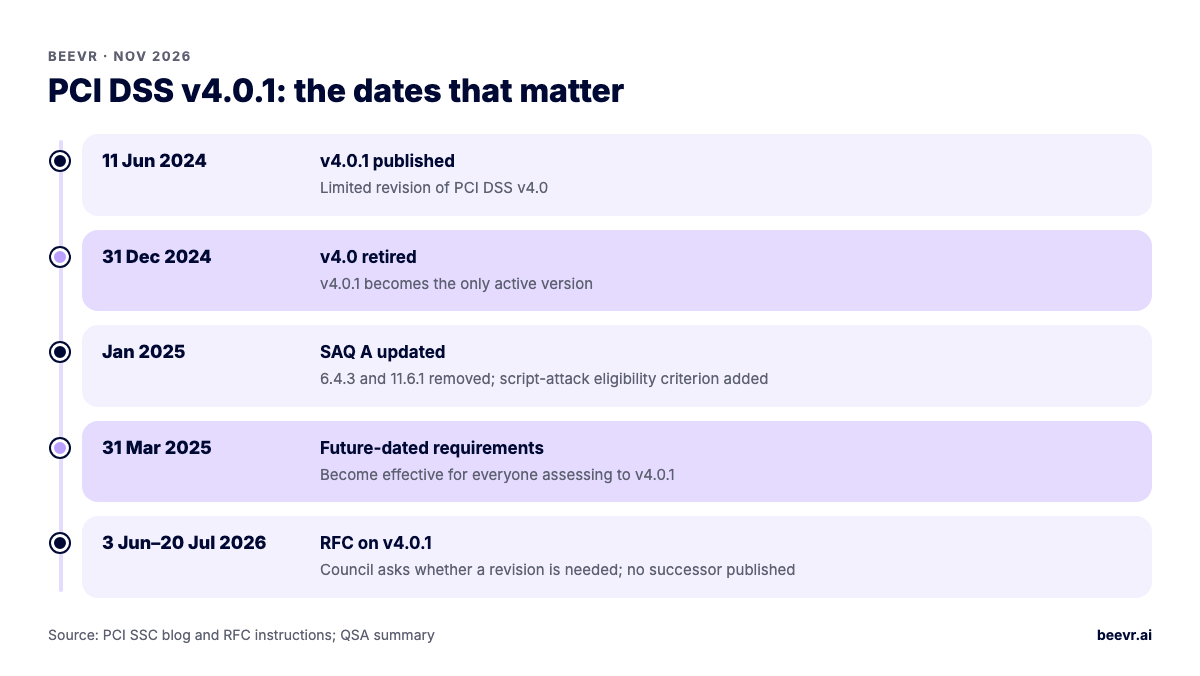
PCI DSS v4.0.1 is the only active version. The PCI Security Standards Council published it on 11 June 2024, retired v4.0 on 31 December 2024, and the requirements that had been future-dated became effective on 31 March 2025. As of November 2026 no successor has been published.
The Council's v4.0.1 announcement confirms those dates. Between 3 June and 20 July 2026 the Council ran a request for comments on v4.0.1, which it calls "the currently-published version". The RFC's stated purpose is to decide whether a revision is needed. So build to v4.0.1, and treat any vendor that pitches "PCI DSS 5.0 readiness" with suspicion.
One change that matters for MVPs: in January 2025 the Council updated the SAQ A questionnaire for e-commerce merchants that fully outsource payment pages. It removed requirements 6.4.3 and 11.6.1 (payment-page script controls) from the questionnaire and added an eligibility criterion that the merchant's site is not susceptible to script attacks. A QSA's summary explains the effect. Ask your firm how its checkout design lets you confirm that criterion. Our deeper write-up is PCI DSS 4.0.1 for fintech in 2026.
What PCI DSS evidence should you ask a vendor for?
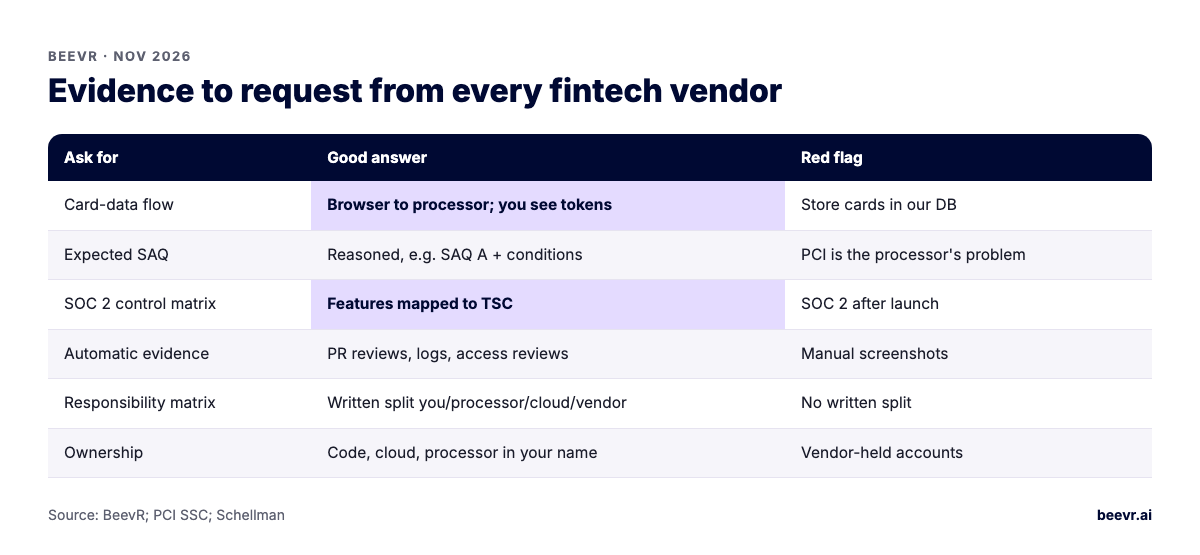
Ask for the card-data flow diagram they propose for your product, the self-assessment questionnaire (SAQ) type they expect it to qualify for, and the reasons. If the vendor will host or operate anything in your cardholder data environment, also ask for its own Attestation of Compliance as a service provider.
| Evidence | What good looks like | Red flag |
|---|---|---|
| Card-data flow diagram | Shows card data going from the browser or app straight to the processor; your servers only see tokens | "We'll store cards encrypted in our database" |
| Expected SAQ type | A reasoned answer (e.g., SAQ A for fully outsourced payment pages) with the conditions that keep you eligible | "PCI is the processor's problem" |
| Payment page script controls | Plan for script inventory, integrity and change detection on pages that host payment fields | No answer on third-party scripts at checkout |
| Vendor's own AOC | Provided if the vendor operates infrastructure that can affect your card data environment | Vendor hosts your stack but has no attestation and won't say who is responsible |
| Responsibility matrix | Written split of PCI requirements between you, the processor, the cloud and the vendor | No written split |
A development agency that only writes code and never operates your card data environment is usually not a PCI service provider at all. That's fine, but then the responsibility matrix must say who runs production. More on design patterns in PCI DSS for fintech software.
What SOC 2 evidence should you ask a vendor for?
Ask for three things: a draft control matrix that maps your MVP's features to the Trust Services Criteria, evidence that those controls generate audit artifacts automatically, and the vendor's own security policies. Ask whether the vendor has its own SOC 2 report and of what type. If it doesn't, ask how it will support your audit.
A SOC 2 report is an attestation by a CPA firm against the AICPA's Trust Services Criteria: security, availability, processing integrity, confidentiality and privacy. A Type 1 report evaluates control design at a single point in time. A Type 2 report also tests whether controls operated effectively over an examination period. CPA firm Schellman puts that period at about 3 months for a first report and 12 months for recurring ones. Enterprise and bank customers usually ask for Type 2. That means the controls have to run, and leave evidence, for months before you can show the report. This is why building them into the MVP matters.
- Access: SSO with MFA, role-based access, quarterly access review exported from the system.
- Change management: every production change through a reviewed pull request and a pipeline log.
- Logging: immutable audit log of admin and money-moving actions, with retention set.
- Resilience: tested backups and a documented recovery time.
- Vendor management: list of sub-processors and their own reports.
Our SOC 2 for startups guide covers timing and auditor selection.
What red flags should rule out a fintech development vendor?
Rule out vendors who want to store raw card numbers in an MVP, promise a "PCI certificate" or "SOC 2 certification" for your product, use shared credentials for production, or can't say who is responsible for each PCI requirement. Each one means you'll pay for compliance twice.
- "We'll make you PCI certified." Merchants validate compliance through an SAQ or a Report on Compliance with a QSA. A dev shop doesn't certify you.
- "We'll do SOC 2 after launch." If controls aren't designed in, the first Type 2 examination period starts late and costs more.
- Shared admin accounts. No attribution, no access review, no passing audit.
- Money movement without approval rules. Payouts, refunds and limit changes need maker-checker approval and an audit trail, including when an AI feature proposes them.
- Junior bench behind a senior sales team. Ask to meet the engineers who will write your ledger.
What questions should you ask before signing?
Ask these eight questions and require written answers. They separate firms that have shipped regulated fintech from firms that have only read about it.
- Draw our card-data flow. Which SAQ do you expect, and what would push us out of it?
- Show us a control matrix from a past project, with client details removed.
- How does your pipeline produce SOC 2 evidence without manual screenshots?
- Who has production access, how is it granted, and where is it logged?
- How do you design the ledger so that balances can be reconciled and every entry is immutable?
- Which parts are fixed price, and how are change requests priced?
- Do we own the code, cloud accounts and processor account from day one?
- What happens at scale: which parts of the MVP would you keep, and which would you rebuild?
Which types of firms build regulated fintech MVPs, and how do they compare?
Four types of firm do this work: large consultancies, fintech-specialist agencies, offshore development companies, and senior boutique studios. They differ mostly in price, how much compliance they build in by default, and who actually writes the code.
| Firm type | Strength | Watch out for | Best for |
|---|---|---|---|
| Large consultancy | Audit and procurement credibility; compliance teams in-house | Price; MVP speed; layers between you and engineers | Bank-backed or enterprise programs |
| Fintech-specialist agency | Payments and ledger patterns already in place | Lock-in to their in-house platform or components | Teams that value domain depth |
| Large offshore vendor | Scale and cost | Junior staffing; compliance as an extra line item | Large, well-specified backlogs |
| Senior boutique studio | Senior engineers write the code; fixed scope; controls built in | Capacity; check references at your stage | Seed to Series A MVP-to-scale |
Whatever the type, run the same evidence requests above. Our fintech MVP PCI DSS and SOC 2 checklist is a one-page version you can send to every shortlisted firm.
How BeevR builds this
We are a senior, founder-led team in Hanoi. We start every fintech MVP with a short paid discovery phase, and we price each phase as a fixed amount, from $10K per phase. In discovery we draw the card-data flow, pick the processor pattern that keeps raw card data off your servers, and write a control matrix next to the feature list. Then we build on a fixed scope and fixed price per phase, with a working demo every Friday. Access control, audit logs, reviewed changes and infrastructure as code go in from the first sprint, so your SOC 2 examination period can start soon after launch.
You own the source code, IP, cloud accounts and processor account from day one, with no per-user fees, and we're rated 5.0 on Clutch. See how we approach fintech MVP development and our security practices.
Shortlisting vendors? Book a 30-minute call and ask us the eight questions above. We'll answer in writing.