The best HIPAA-compliant AI development company for you is the one that will sign a Business Associate Agreement before it sees any PHI, shows healthcare work you can check, gives you the source code and IP in writing, and prices the work in a way you can budget. Score every shortlisted firm on those five criteria, including us.
Most "top 10 healthcare AI developers" lists are paid placements or are written by one of the firms on the list. This one is also written by a firm on the list, so we did two things to keep it useful. We set out the criteria first and applied them to every entry, BeevR included. We also limited each entry to what the firm says on its own public website, which we read on 12 November 2026. If a site doesn't mention something, we say so. That does not mean the firm can't do it. It is a question to ask on the first call.
What makes an AI development company HIPAA compliant?
No certificate makes a developer "HIPAA compliant." A firm qualifies when it acts as a business associate under a signed BAA, protects PHI with the safeguards the Security Rule requires, and builds your system so that it can meet those safeguards too. Anyone selling a "HIPAA certification" for software is selling marketing.
A developer becomes a business associate as soon as it creates, receives, stores or transmits PHI for you. That covers debugging with production data, running your cloud environment and supporting a live system. Under 45 CFR 164.504(e) the BAA must limit how the developer uses PHI. It must also require safeguards, require breach reporting, bind the developer's subcontractors to the same terms, and require PHI to be returned or destroyed when the contract ends. One of the firms below says it plainly on its own website: "There is no HIPAA certification for software." That is correct.
AI adds one more link in the chain: the model. If PHI reaches a prompt, a retrieval index or a log, the service that handles it needs a BAA too. On AWS, for example, Amazon Bedrock is on the HIPAA Eligible Services list (last updated 15 October 2026), so a model can run under the AWS BAA you already have. A consumer chatbot account is not covered. We explain why in is ChatGPT HIPAA compliant?
How should you compare HIPAA-compliant AI development companies?
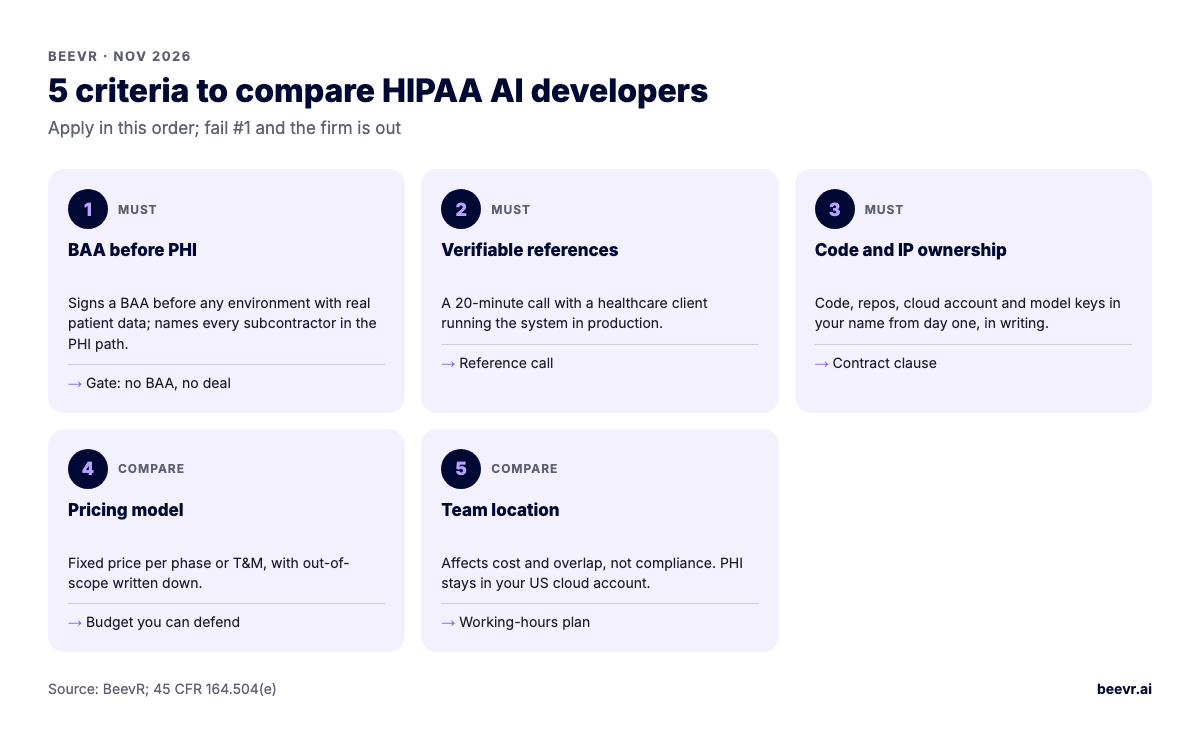
Compare them on five criteria, in this order: a BAA signed before PHI access, healthcare references you can check, written ownership of code and IP, a pricing model that fits your budget, and where the team is located. A firm that fails the first criterion should come off your list, however good its demo looks.
1. BAA signed, and when
Ask whether the firm signs a BAA, and also when. A good answer is "before any environment with real patient data exists." Also ask which subcontractors and tools will touch PHI, such as hosting, the model provider, error monitoring and the SMS vendor, and whether each one is covered by a BAA.
2. Healthcare references you can verify
Logos on a homepage are a start. What you need is a 20-minute call with a client who has run a system this firm built in production with real patients. Ask that client what broke in the first month and how fast it was fixed.
3. Code and IP ownership
The contract should assign the source code, repositories and IP to you, and should not make ownership depend on a maintenance contract. Your cloud account, your repositories and your model keys should be in your name from day one. We cover the traps in do you own the code when you hire an agency?
4. Pricing model
Fixed price per phase moves the estimation risk to the vendor. Time and materials keeps it with you. Either can be honest. What matters is whether the firm writes down what is out of scope. See fixed price vs time and materials.
5. Team location
Location affects cost, overlap with your working hours and data residency. It does not decide whether you can be compliant. HIPAA does not ban offshore developers. What matters is the BAA, access controls and keeping PHI inside your US cloud account instead of on laptops.
Which companies build HIPAA-compliant AI and software?
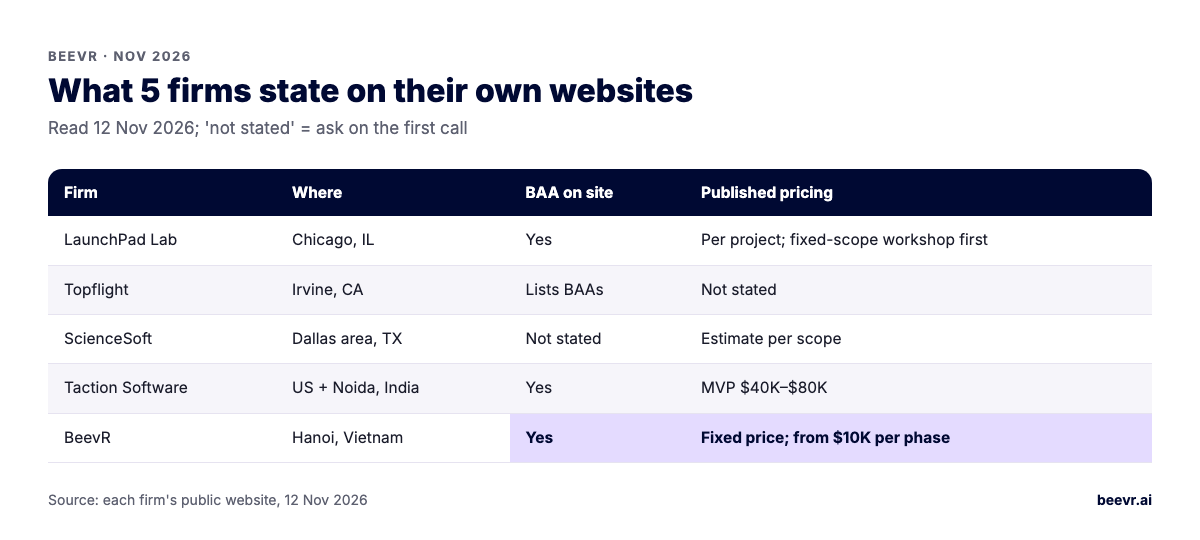
Below are five firms that publicly market HIPAA-compliant healthcare software or AI development, with what each says on its own site as of 12 November 2026. They cover the main buyer options: US onshore boutique, US-headquartered firm with an offshore development center, large IT services company with a healthcare practice, and founder-led offshore studio.
| Firm | Where (per its site) | BAA on its site | Healthcare proof it names | Pricing it publishes | Code/IP ownership on its site |
|---|---|---|---|---|---|
| LaunchPad Lab | Chicago, IL | Yes: executes a BAA before work touching PHI | Case studies naming MD Anderson Cancer Center and Lurie Children's Hospital | Scoped per project; starts with a fixed-scope Blueprint Workshop; "we do not quote fixed packages" | Hosting in a HIPAA-eligible cloud account the client owns; code ownership not spelled out on that page |
| Topflight | Irvine, CA address; engineer location not stated | Lists "BAAs & compliance documentation" in its HIPAA service | Names Stanford Medicine and Merck; GaleAI medical-coding case study with athena integration | Not on homepage | Not stated on homepage |
| ScienceSoft | McKinney (Dallas area), TX | Not mentioned on healthcare page; ask | Healthcare IT since 2005; "150+" healthcare projects; ISO 13485 and ISO 27001 | Estimates per scope; free ballpark estimate | Not stated on that page |
| Taction Software | US offices (Chicago, Austin, others) and a development center in Noida, India | Yes: signs a BAA before any environment with real patient data | Names delivered work for Voyant Health, PainKare, CHIPSS | Published tiers: MVP $40K–$80K; full platform $80K–$200K; enterprise $200K+ | Not stated on that page |
| BeevR (us) | Hanoi, Vietnam; senior founder-led team | Yes: signs a BAA as a business associate | A multi-tenant EHR live across four US clinics at ~300 patients/day; 5.0 on Clutch. No client names published | Fixed scope, fixed price per phase, from $10K per phase | Client owns source code and IP from day one; no per-user fees |
How to read this table: "not stated" means not stated on the page we read. It is not a criticism. Several of these firms likely answer those questions well in a proposal. Use the empty cells as your first-call agenda. You should also look at the firm's Clutch profile, ask for its most recent penetration test summary, and request a sample BAA.
Should you hire an onshore US firm or an offshore team for HIPAA work?
Hire onshore if you need people in the room, a US-only data handling policy written into your contracts, or procurement that requires a US vendor. Hire offshore if you want senior engineering per dollar and can work asynchronously with a daily overlap window. Either way, PHI should stay in your US cloud account.
Compliance doesn't change with the team's location. Your controls do: who can open production, from which device, with what logging. A US firm whose engineers download a production database to a laptop is a bigger risk than an offshore firm whose engineers can only reach PHI through audited, role-based access to your AWS account. Ask every firm the same question: "Show me how an engineer reaches production data, and where that is logged."
Cost differs a lot. The US Bureau of Labor Statistics puts the median software developer wage at $135,980 (May 2025), and that is salary, not a billing rate. Offshore senior rates are covered in our Vietnam rates guide.
What red flags should rule out a healthcare AI vendor?
Rule out any vendor that won't sign a BAA, claims a "HIPAA certification," wants to use its own cloud account or shared logins for your PHI, or can't explain what the AI does when it is wrong. Each of these signals that compliance is a sales slide rather than how the firm actually builds.
- "We're HIPAA certified." No official certification exists. Ask for their policies, their last risk assessment and a sample BAA.
- PHI sent to a model without a BAA. Ask which model endpoint is used, under which agreement, and whether prompts are kept or used for training.
- The agent writes to the EHR with no human approval. For anything clinical or patient-facing, a person should confirm before the write or the send. See human-in-the-loop AI.
- Shared admin logins to your EHR or billing system. Integrations should use official APIs or app connections with narrow scopes, so each action is attributable.
- No audit trail. If the vendor can't show who saw what and when, you can't do the activity review the Security Rule expects.
- Ownership tied to support. If the vendor keeps the code until you sign a retainer, you are renting your own product.
How much does a HIPAA-compliant AI project cost in 2026?
Published market ranges put a HIPAA-compliant MVP at roughly $40K–$80K and a full platform at $80K–$200K or more. Taction Software, for example, publishes exactly those tiers. By the hour, US mid-market firms bill $100–$300 and Southeast Asian agencies $25–$65, according to FullStack Labs' 2026 price guide.
BeevR prices by fixed phase, from $10K per phase.
Running costs are a separate line, and you should get them in writing before you sign: cloud hosting, model usage (tokens), message delivery, monitoring, backups and support hours. Agentic features cost more to run than a chat box, because one task can chain many model calls and tool calls. Ask each firm for a monthly estimate at your expected volume, and for the cost ceiling it will enforce in code. Our HIPAA app cost breakdown has the line items.
What should you ask on the first call?
Ask seven questions and compare the answers side by side. Any firm worth hiring answers all seven specifically, in writing, before you sign.
- Will you sign our BAA (or send yours) before you touch PHI? Which subcontractors are in the PHI path?
- Can we speak to a healthcare client running your system in production today?
- Who owns the code, repositories, cloud account and model keys on day one?
- What is fixed, what is not, and how are change requests priced?
- Which actions does the AI take without a human, and how do we approve the rest?
- Where is every action logged, and who can read the log?
- What will it cost per month to run once it's live, line by line?
How BeevR builds this
We are a senior, founder-led team in Hanoi, and we build HIPAA-compliant AI for US healthcare organisations and health-tech startups. We sign a BAA as a business associate. The AI model can run inside your own AWS account under the AWS BAA, and only the minimum necessary PHI reaches the model. Agent actions that write to clinical records or contact patients go through a human approval step. Access is role-based, break-glass access needs a written reason and raises an alert, and every action lands in an audit log you can query. Integrations use official APIs with scoped credentials, never shared admin logins.
The proof we can share: a multi-tenant EHR live across four US clinics at around 300 patients a day, and a 5.0 rating on Clutch. The commercial terms: fixed scope, fixed price per phase (from $10K per phase), a working demo every Friday, and you own the source code and IP from day one, with no per-user fees. See our HIPAA-compliant AI agent development page or how we approach healthcare AI agent development.
If you're shortlisting firms, put us through the same seven questions. Book a 30-minute call and we'll answer each one in writing.