November 2026 brought few new AI laws but several hard dates. The EU published a draft fundamental-rights impact assessment template on 16 November and two AI Act duties land in December. China moved all AI filings to one portal on 9 November. Vietnam passed a Data Security Law on 20 November with AI rules from 1 July 2027. The US and UK made no binding changes.
Updated 24 November 2026. This is our monthly AI regulation roundup for teams that build AI products and sell into the EU, US, UK, China or Vietnam. We only list actions we confirmed on an official government or legislature source, with links to the text. Items reported only by law firms or the press are listed at the end as unconfirmed. For the bigger picture, see our explainers on the EU AI Act Digital Omnibus deadlines, US federal preemption versus state AI laws and Vietnam's AI Law.
What changed in AI regulation in November 2026?
Four things changed: the EU opened consultation on its FRIA template and proposed a Digital Fairness Act; China launched a single filing portal and published new generative AI filing totals; Vietnam's National Assembly passed data security and electronic identification laws; and California released recommendations for mandatory AI safety standards. No new binding federal AI rule was issued in the US.
| Date | Jurisdiction | Action | Binding? |
|---|---|---|---|
| 6 Nov | China | CAC enforcement against AI impersonation of public figures | Enforcement |
| 9 Nov | China | Single filing portal for generative AI, algorithms, deep synthesis | Yes (procedure) |
| 11 Nov | EU | Digital Fairness Act proposed | No, proposal |
| 16 Nov | EU | Draft FRIA template under AI Act Art. 27 | Consultation to 15 Jan 2027 |
| 18 Nov | California | Report "AI Safety in 2026 and Beyond" | No, recommendations |
| 20 Nov | China | Generative AI filing bulletin: 1,245 services filed | Information |
| 20 Nov | Vietnam | Data Security Law and E-Identification Law passed | Yes, from 1 Jul 2027 |
| 28 Nov | US | EO 14434: 60-day deadline for "Super Intelligence" definition | Internal deadline |
| 2 Dec | EU | Art. 50(2) grace period ends for legacy generative systems | Yes |
What did the EU do on the AI Act in November 2026?
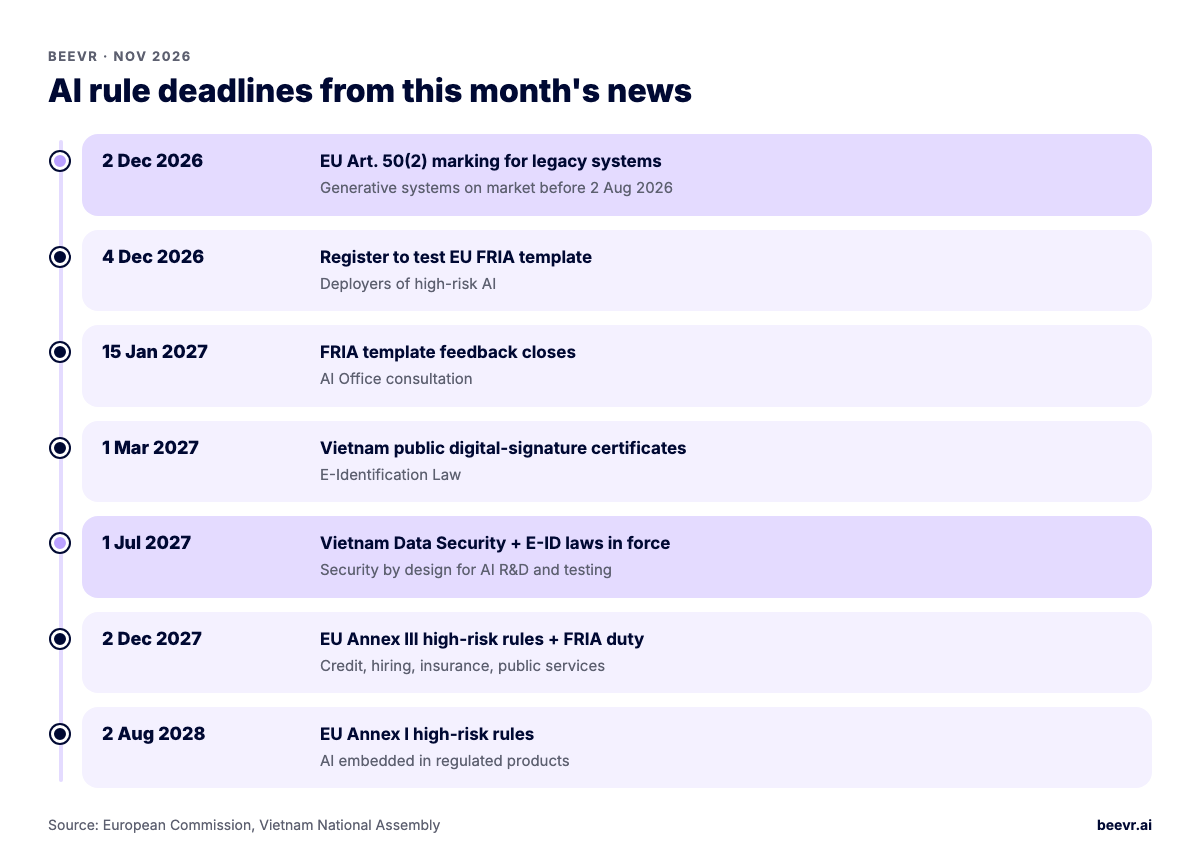
On 16 November the Commission published a draft template for the fundamental rights impact assessment (FRIA) that certain deployers of Annex III high-risk systems must complete from 2 December 2027. Feedback is open until 15 January 2027, and deployers who want to test it must register by 4 December 2026.
The Commission's announcement says the AI Office drafted the template under Article 27(5) with input from the EU Agency for Fundamental Rights, and that the final version will become an automated tool on the AI Act Single Information Platform.
Why it matters if you sell B2B: FRIAs are done by the deployer, but the deployer will ask you, the provider, for most of the facts: intended purpose, affected groups, human oversight, logs. If your product goes into credit scoring, insurance pricing, hiring or public services in the EU, build a "FRIA pack" with that information now. It will shorten procurement later.
Digital Fairness Act proposal
On 11 November the Commission also proposed a Digital Fairness Act: a ban on dark patterns, "fairness by design" with an option to turn off addictive features, limits on unfair personalised ads and prices aimed at minors, and an end to subscription traps. The Commission's page does not mention AI agents specifically. It is a proposal, so nothing applies yet, but consumer AI apps with personalisation and engagement loops should read it.
What happens on 2 December 2026 under the EU AI Act?
Two things. Generative AI systems placed on the market before 2 August 2026 must comply with the Article 50(2) machine-readable marking and detection duty from 2 December 2026. And the Commission's timeline lists a new ban on AI systems that generate non-consensual sexual content or child sexual abuse material from December 2026.
- Article 50 marking. Article 50 has applied since 2 August 2026. The Commission's Article 50 FAQ says providers of systems already on the market "must comply with those obligations only as from 2 December 2026". Content generated before 2 August 2026 does not need retroactive labelling. The FAQ says the transparency Code of Practice "has been assessed as adequate by both the Commission and the AI Board", so signing it is the simplest route to show compliance.
- New prohibition. The Commission's AI Act policy page lists the ban for "December 2026". Secondary sources give 2 December; we could not open the consolidated text to confirm the exact day and article number.
The same page confirms that Annex III high-risk rules apply from 2 December 2027 and Annex I (product-embedded) rules from 2 August 2028. Our Article 50 developer checklist walks through watermarking, metadata and disclosure in code.
Did US federal AI policy change in November 2026?
Not in binding terms. The FTC's July 2026 policy statement on AI accuracy and state-law preemption is still only proposed, NIST's AI standards centre published nothing new in November that we could find, and the main federal date is an internal one: a 28 November deadline under Executive Order 14434 for draft legislation defining "Super Intelligence".
- EO 14434, signed 29 September 2026 (White House text), tells agencies to use "Super Intelligence" and "SI" instead of "AI" in non-statutory documents. Section 3(b) gives the President's science adviser 60 days to propose legislative language on whether that definition should replace the statutory definition of AI. By our count that is 28 November. Legal scope does not change today, but expect "SI" wording in federal RFPs.
- FTC: the FTC policy statements list still shows the AI accuracy statement as proposed (1 July 2026). The argument that it preempts state laws like Colorado's is not final.
- Preemption litigation: we found no new DOJ AI Litigation Task Force lawsuit in November.
For product teams, the practical answer has not changed: state laws still apply. See our preemption explainer.
Which US states acted on AI in November 2026?
California released recommendations on 18 November for mandatory AI safety standards, including independent testing, incident reporting and verified shutdown protocols, for a 2027 bill. New York's law restricting AI companion chatbots for minors was signed on 28 October, just before the window, with penalties up to $25,000 per violation.
- California. The Governor's 18 November release covers the report "AI Safety in 2026 and Beyond": baseline standards for all AI companies, independent testing at each stage, expanded incident reporting, state emergency shutdown authority and state-accountable evaluators. These are recommendations, not law. The release also cites 2026 laws already signed, including SB 813, AB 1405 and "Adam's Law" on companion chatbots for children.
- New York. The Governor's release says the law bans companion features such as posing as human or romantic role-play for users under 18 or not confirmed as adults, requires more than one age-check method and deletion of age data, and sets penalties up to $25,000 per violation. The effective date is described as "in the coming months".
If you build healthcare AI, our state-by-state healthcare AI law guide covers the laws already in force.
What did the UK do on AI regulation in November 2026?
No AI bill was introduced and the AI Security Institute published nothing new that we could find in November. The relevant change was Ofcom's update to its Online Safety Act codes, published on 16 November, which proposes proactive detection of new image-based child abuse material and stronger grooming protections backed by age assurance.
See the Online Safety Act collection on GOV.UK. Most measures are drafts. If your product lets UK users share AI-generated images, plan for detection duties. A chatbot-specific Online Safety Act duty still depends on regulations not yet made.
What new AI rules did China announce in November 2026?
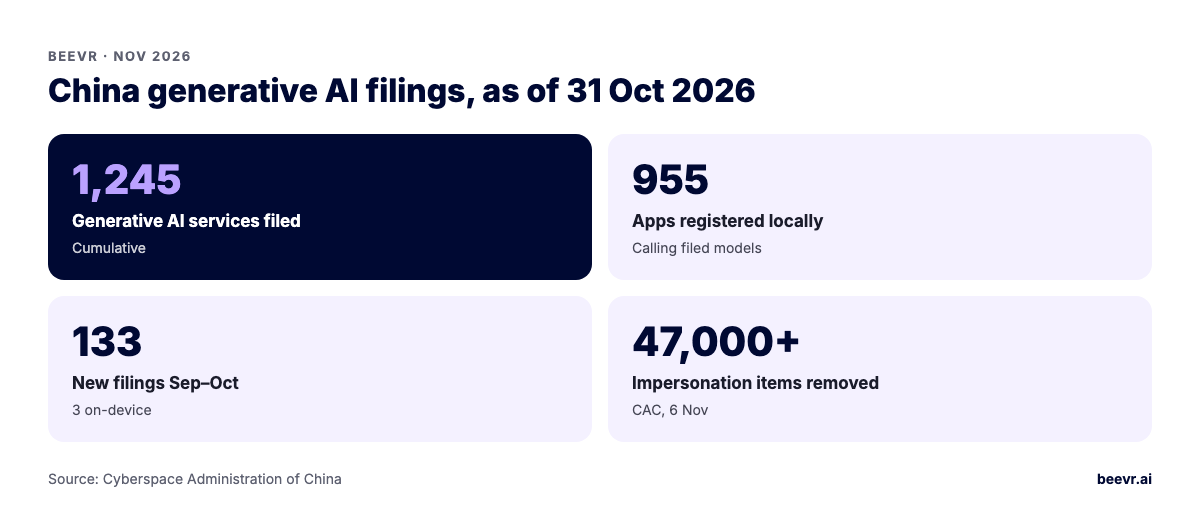
China's Cyberspace Administration launched one portal, beian.cac.gov.cn, on 9 November for generative AI, algorithm, deep synthesis and blockchain filings, and switched the old systems off the same day. On 20 November it reported 1,245 filed generative AI services and 955 registered apps as of 31 October.
- Single portal (CAC notice, 9 Nov): all new filings and changes go through the "Internet New Technology and New Application Information Service Filing System".
- Filing bulletin (CAC, 20 Nov): 133 new services filed in September–October, including 3 on-device services; 224 apps that call an already-filed model registered with local offices. Live apps must show the model name and its filing or registration number prominently.
- Enforcement (CAC, 6 Nov): more than 47,000 items removed and 3,961 accounts handled for AI impersonation of public figures.
If you build on a Chinese foundation model for the China market, registration and model disclosure are not optional. Voice and face cloning features need consent checks.
What did Vietnam pass in November 2026 that affects AI products?
On 20 November Vietnam's National Assembly passed a Data Security Law (468 of 474 votes, 28 articles) and an Electronic Identification and Authentication Law (473 of 478 votes, 45 articles), both in force from 1 July 2027. The data law requires security by design for AI research, development and testing.
- Data Security Law: organisations must assign data security risk levels and matching protections. Anyone researching, developing or testing AI must build in data security from the design stage, filter fake or malicious data and consider advanced and post-quantum encryption.
- E-Identification Law: bans fake biometrics or generated images used to create or pass digital identity checks, and bans making or selling biometric-spoofing tools. Public digital-signature certificates start on 1 March 2027.
- IP Law amendment passed on 21 November; the official release gives no detail, so do not assume new AI training rules.
Source: Đại biểu Nhân dân, the National Assembly's newspaper. Law numbers are not yet published in the Official Gazette. These sit on top of the AI Law and Decree 142/2026 covered in our Vietnam AI Law guide.
What should teams building AI products do before year-end?
Ship Article 50 marking for any generative product sold in the EU before 2 December, add safeguards against intimate deepfakes, prepare a FRIA information pack for high-risk EU customers, and put age assurance on consumer chatbots used by minors in New York. For China and Vietnam, plan filings and data classification into 2027 roadmaps.
- By 2 December: machine-readable marking and detection on generative outputs (EU); content safeguards for sexual deepfakes and CSAM.
- By 4 December: register to test the FRIA template if you deploy high-risk AI in the EU.
- By 15 January 2027: send FRIA template feedback if it affects your customers.
- Before 1 July 2027: data classification and security-by-design records for AI pipelines touching Vietnam.
- Ongoing: keep a register of which AI rules apply to which product, by market. Our AI agent security checklist maps many of these controls.
Which reported AI policy items could we not confirm?
We left out items we could not confirm on an official text: reported Colorado Department of Law rules from 19 November, the exact article number of the new EU prohibition, AI provisions in the FY2027 NDAA, a UK "Regulating for Growth Bill" and official law numbers for Vietnam's new laws. We will update this page if they are confirmed.
How BeevR builds this
BeevR is a senior, founder-led software and AI studio in Hanoi, building AI products for US and EU clients, including regulated healthcare and fintech. We turn rules like these into engineering tasks: content provenance and watermarking, audit logs, human oversight steps, age gates and data classification, delivered as fixed-scope phases with a working demo every Friday. You own all source code and IP from day one. Phases are priced from $10K, with no per-user fees. We are engineers, not lawyers, so we work alongside your counsel.
If you need an AI development company that builds compliance into the product, book a 30-minute call.